
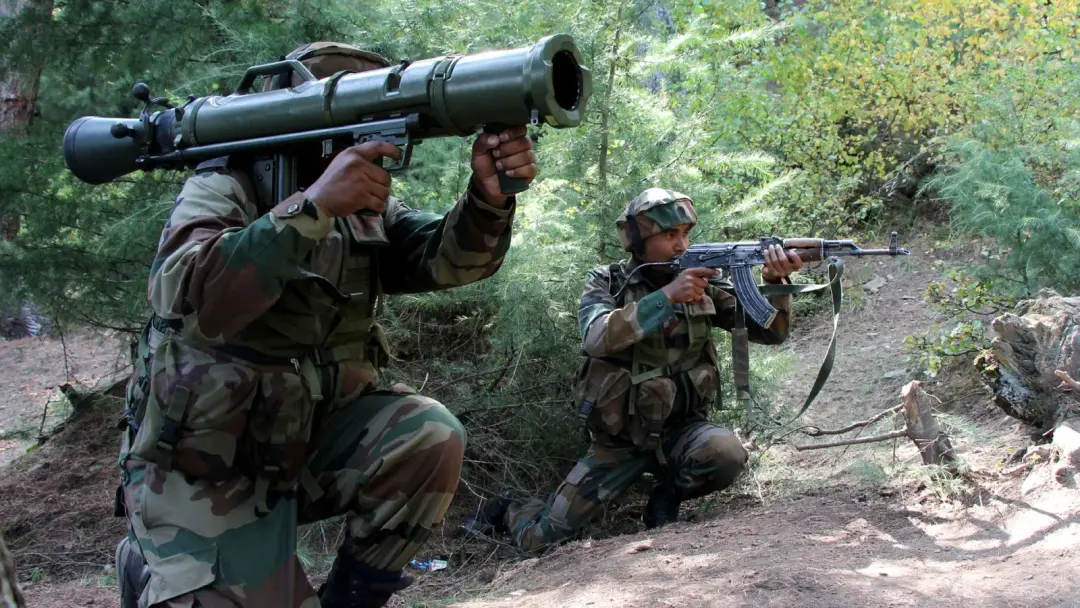
New Pir Panjal strategy aims to curb terrorist movement
Security forces are using Temporary Operational Bases (TOBs) in the Pir Panjal mountains that divide Jammu and Kashmir, officials said. Army units, para forces, J&K Police and paramilitary personnel stay deployed in the mountains from over 10 days to several months, using caves or Gujjar shacks where available. An officer said 40-50 such bases operate at a given time. A Lashkar-e-Toiba terrorist was killed at Ashdar Gali on September 4 after a four-month operation; three terrorists have been killed this month.
Source
Indian Express — India · read the original report ↗
Desk check · compared with the source
What the desk checked (5)
- An LeT terrorist was killed in Ashdar Gali in the upper Pir Panjal on September 4 after a four-month joint forces effort. — Date and detail appear in source; operation described by security officials, not independently documented.
- Security forces use Temporary Operational Bases (TOBs), with around 40-50 operational at a given time. — Figure attributed to an unnamed officer quoted in the source.
- J&K Police created new SOG units named 'Snow Leopards' and 'Markhor' after the Pahalgam attack. — Attributed to officials in the source.
- The Pahalgam attack killed 25 tourists and one local. — Figure stated in source; source says attack occurred in April 'last year' while also calling it the only major attack in the last 1.5 years — internal timeline is inconsistent, so avoid repeating the year.
- Three terrorists were killed this month — two in Udhampur forests and one in Ashdar Gali. — Stated in source and attributed to officials.
Analysts’ view opinion
The Temporary Operational Base (TOB) strategy in the Pir Panjal is a tactical shift with clear political value. For a central government that faced sharp criticism over the security lapse in the Pahalgam attack, officials' claim that all recent gunfights have come "on our initiative" offers a recovery narrative. At the same time, the rising profile of J&K Police's own elite units adds a fresh dimension to the unsettled question of who holds security authority between the elected state government and the Centre.
- A visible "new strategy" gives the Centre and the security establishment a usable answer to the political pressure that built after the Pahalgam attack.
- That it took a four-month operation to neutralise one terrorist also hands critics an argument that results are coming slowly and at high cost.
- Sustained deployment in Poonch-Rajouri and the Chenab Valley depends on managing relations with local populations, including in areas with Gujjar shelters — a politically sensitive terrain.
- The strengthening of J&K Police through units like 'Snow Leopards' and 'Markhor' gives regional parties a talking point about the role of the state machinery in counter-terror work.
- That a belt declared militant-free in 2012 now needs months-long deployments raises uncomfortable questions about the "normalcy" claims of the last decade.
What to watch — With proposals such as divisional status for Pir Panjal and the Chenab Valley already in play, watch how competing parties translate these security outcomes into political argument.
The story does not establish that the TOB approach alone caused the drop in attacks — the assessments come largely from unnamed officials, are not independently verified, and no political reaction is recorded here.
Deep dive
Research brief · 8 facts · 8 dates · exam-readyThe brief
Context
The Pir Panjal range divides the Jammu region (Poonch, Rajouri, and the Chenab Valley districts of Doda, Kishtwar and Ramban) from the Kashmir Valley, and its dense forests have long offered terrorists high-altitude transit routes between the two regions. Permanent camps in this terrain were considered technically infeasible because of the vast area, treacherous mountains and logistics. Security forces have now shifted to Temporary Operational Bases (TOBs) — small, intelligence-driven deployments that stay in the mountains for weeks or months — to maintain a sustained presence. The approach was visible in the September 4 killing of a Lashkar-e-Toiba terrorist at Ashdar Gali after a four-month operation.
Key facts
- On September 4, a Lashkar-e-Toiba terrorist was killed at Ashdar Gali in the upper reaches of the Pir Panjal, after a four-month joint operation.
- An officer said around 40-50 Temporary Operational Bases are operational across the area at a given time, the number changing with intelligence inputs.
- Under the TOB system, forces stay deployed in the mountains from more than 10 days to several months, using a Gujjar dhok (shack) or cave if available, else dense forest without shelter.
- The mountains are divided into three zones: upper reaches (army paratroopers), middle range (Rashtriya Rifles or joint J&K Police-paramilitary teams), lower reaches (J&K Police and paramilitary).
- Three terrorists were killed this month: two in Udhampur's forests (two Jaish-e-Mohammed militants killed on September 16) and a Pakistan-based LeT terrorist at Ashdar Gali.
- In 2003 the Army, with help from locals, launched Operation Sarp Vinash in the Poonch-Rajouri axis; the region was declared militant-free in 2012.
- After the Pahalgam attack that killed 25 tourists and one local, J&K Police set up new elite units within its Special Operations Group named 'Snow Leopards' (high-altitude winter warfare) and 'Markhor' (dense-forest gunfights).
- JeM commander Saifullah was killed in an encounter in February after a two-year chase in Kishtwar's Chatroo; his recovered phone led forces to an underground hideout with a gas stove and winter food stock.
Timeline
- 2003Indian Army, aided by locals, launches Operation Sarp Vinash to flush militants out of the Poonch-Rajouri axis.
- 2012The region is declared militant-free.
- Since 2020Militants begin setting up new hideouts without taking locals' help, making tracking harder; old OGW networks no longer exist.
- Last four yearsTerrorists exploit high-altitude forest transit routes to move between the Kashmir and Jammu regions.
- February (this year)JeM commander Saifullah killed in Kishtwar's Chatroo after a two-year chase; his phone leads to an underground hideout.
- April last yearPahalgam attack on tourists kills 25 tourists and one local; J&K Police raises new elite SOG units.
- September 4LeT terrorist killed at Ashdar Gali after a four-month joint operation run out of a Temporary Operational Base.
- September 16Two Jaish-e-Mohammed militants killed in a counter-terror operation in Udhampur.
Who has a stake
- Indian Army and its elite para forces — Paratroopers hold the upper reaches, are stationed on mountain tops and use drones to monitor transit routes; Rashtriya Rifles mans the middle range.
- J&K Police and its Special Operations Group — Operates in middle and lower ranges; raised 'Snow Leopards' and 'Markhor' units trained with elite forces for high-altitude and forest combat.
- Paramilitary forces — Part of joint teams in the middle and lower reaches of the Pir Panjal.
- Gujjar herders — Their dhoks (shacks) in the mountains are used as natural shelters for temporary bases.
- Residents of Poonch, Rajouri and Chenab Valley districts — Live along a former militant hotbed; security officials report a significant reduction in attacks on either side of the Pir Panjal.
- Terrorist groups (LeT, JeM) and overground workers — Lose the advantage of shifting between Jammu and Kashmir under pressure; must rebuild OGW networks and hidden shelters.
Why it matters
The Pir Panjal corridor determines whether terrorists can slip between the Jammu region and the Kashmir Valley, and for years this mobility blunted counter-terror operations launched on either side. TOBs, drones and better-armed special units are an attempt to replace impossible permanent camps with a continuous, intelligence-led footprint, and officials credit them with a marked drop in attacks. With only one major attack in the area in 1.5 years — Pahalgam — the tactic's durability matters for tourism, local security and the LoC hinterland.
UPSC angle
Prelims pointers
- Pir Panjal range divides Jammu (Poonch, Rajouri) from the Kashmir Valley; it links Kashmir to Chenab Valley (Doda, Kishtwar, Ramban) and stretches to Gulmarg-Baramulla near the LoC.
- Operation Sarp Vinash: 2003 Army operation in the Poonch-Rajouri axis; region declared militant-free in 2012.
- Temporary Operational Bases (TOBs): 40-50 operational at a time; deployments last 10 days to several months.
- 'Snow Leopards' and 'Markhor' are new elite units within J&K Police's Special Operations Group, named after high-altitude wild animals.
- Rashtriya Rifles is the Army's anti-insurgency force, deployed in the middle range of the Pir Panjal.
- Pahalgam attack (April last year) killed 25 tourists and one local.
Mains framing
The Pir Panjal problem is fundamentally one of terrain-driven mobility: dense forests and treacherous high-altitude routes let terrorists watch approaching troops from stationary positions, carry close-combat weapons such as the American M4 carbine, and shift between the Jammu and Kashmir sides whenever pressure mounted on one side, while permanent encampments remained technically infeasible over such a vast area. The response has been to substitute persistence for permanence — Temporary Operational Bases scattered on the basis of intelligence inputs and ground situation analysis, three-tier zonal deployment of paratroopers, Rashtriya Rifles, police and paramilitary, drone surveillance from mountain tops, night-vision equipment, comparable sophisticated weapons, and purpose-trained SOG units for winter high-altitude and dense-forest fighting. Officials claim results: gunfights on the forces' initiative, three terrorists killed this month, and only one major attack in 1.5 years. The residual challenges are intelligence-related rather than tactical — since 2020 militants have built hideouts without local help, old overground worker networks have dissolved and new ones are forming, which means the way forward lies in rebuilding human intelligence, sustaining logistics for long deployments and continuing technology-enabled surveillance of transit routes.
Key terms
- Temporary Operational Base (TOB)
- A temporary arrangement to keep a near-permanent footprint in difficult mountains; forces stay 10 days to several months, using caves or Gujjar shacks or no shelter at all.
- Operation Sarp Vinash
- 2003 Indian Army operation, aided by locals, to flush militants out of the Poonch-Rajouri forests.
- Gujjar dhok
- A herders' shack in the mountains, sometimes used by security forces as a natural temporary base.
- Snow Leopards and Markhor
- New elite J&K Police SOG units created after the Pahalgam attack, for high-altitude winter warfare and dense-forest gunfights respectively.
- Rashtriya Rifles
- The Army's counter-insurgency force, deployed in the middle range of the Pir Panjal.
- Overground workers (OGWs)
- Local support networks that aid militants; officials say old OGWs are gone and militants now build hideouts without local help since 2020.
Practice questions
- Examine how terrain shapes counter-insurgency strategy in Jammu and Kashmir, with reference to the Temporary Operational Base model in the Pir Panjal.
- "Technology can supplement but not substitute human intelligence in counter-terror operations." Discuss in the light of militants building hideouts without local support since 2020.
- Trace the trajectory of militancy in the Poonch-Rajouri axis from Operation Sarp Vinash (2003) to the present, and assess the effectiveness of current security measures.
Grounded only in the source report — figures and dates are the source's, not inferred.