
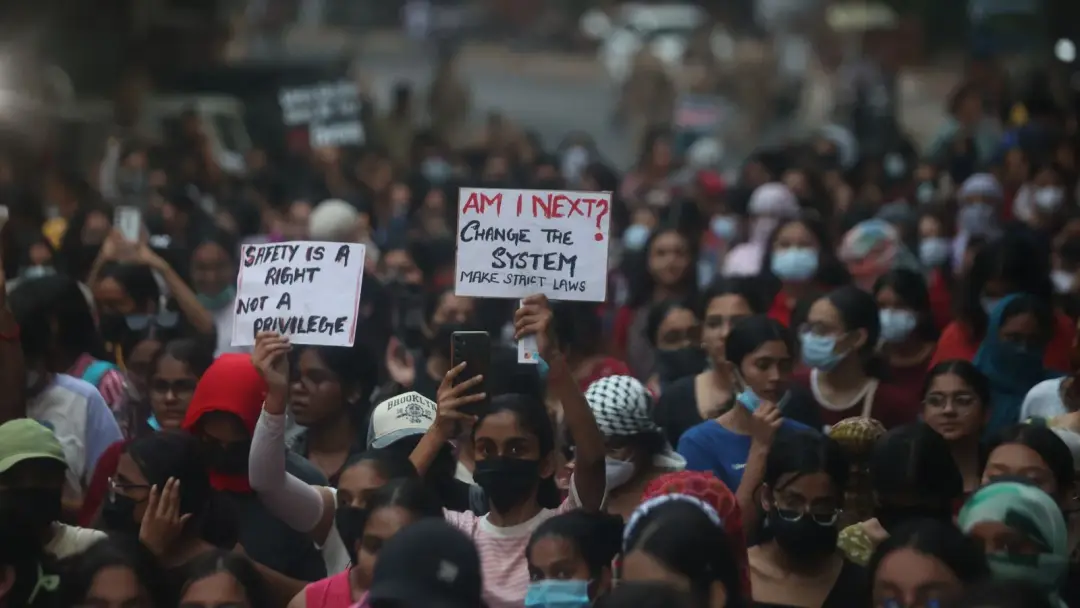
Delhi women students cite transport gaps, safety fears in commute
The alleged gangrape of a 17-year-old in a South Delhi DDA park has focused attention on commute safety for Delhi University's women students. Students said feeder buses that bring them in the morning often do not run around 4 pm when classes end, and that the DTC U-Special service relaunched last August has 26 buses with no public data on usage. They also reported deserted pink booths, poorly lit stretches and college instructions to step out only in groups.
Source
Indian Express — Cities · read the original report ↗
Desk check · some claims need care
What the desk checked (5)
- A 17-year-old was allegedly gangraped in a DDA park in South Delhi — Described as 'alleged' in the source; no police statement or case details provided
- Feeder buses run in the morning but are unavailable around 4 pm when classes end — Attributed to student Ananya Shukla based on her checks with drivers; no transport authority response
- DTC U-Special Bus Service, relaunched in August last year, has 26 buses with no public usage data — Figure appears in source, attributed to student Ananya Shukla
- Pink booths on DU South Campus are mostly unstaffed; no working CCTVs outside Laxmibai College — Attributed to an unnamed South Campus student and advocate Yakshna Sharma; no official rebuttal included
- Colleges instructed women students to move out only in groups; 6.30 pm curfew in one residence — Attributed to named first-year nursing students and an unnamed third-year resident
Analysts’ view opinion
This is less a crime story than a test of administrative delivery, and that lands squarely on whoever holds power in Delhi. Bus timetables, feeder services, pink booths, street lighting and patrolling are split across the state government, local bodies and the police — which makes buck-passing the likeliest first reflex. The sharpest political question is the one students themselves raise: the absence of public data on how the 26 U-Special buses are actually being used invites the charge that the scheme stopped at the announcement.
- The debate has shifted from announcing schemes to demanding proof of delivery, which is always the harder terrain for an incumbent.
- Students saying there is no public data on U-Special occupancy or cancelled trips hands the opposition an easy transparency line.
- Deserted pink booths and non-functional CCTVs are visible symbols of the "infrastructure exists, staffing doesn't" critique.
- The missing 4 pm feeder service and the scattered colleges of South, East and West Delhi raise a geographic equity argument against the clustered North Campus.
- Instructions to move only in groups and hostel curfews feed the criticism that the burden of safety is being placed on women rather than on the system.
What to watch — Watch whether the government releases U-Special usage data and fixes evening schedules, or falls back on visible policing and arrest tallies — that choice will decide how long this stays politically alive.
The story records student accounts and allegations; it does not establish actual service figures, any government or police response, or how responsibility is apportioned between agencies or parties.
Deep dive
Research brief · 8 facts · 5 dates · exam-readyThe brief
Context
The alleged gangrape of a 17-year-old in a DDA park in South Delhi, along with a series of sexual assault cases involving minors, has renewed scrutiny of how safe Delhi is for women students who commute daily. Delhi University's off-campus colleges in South, East and West Delhi are scattered along arterial roads and residential areas, unlike the clustered North Campus, making last-mile connectivity critical. Students at Maitreyi College, Lady Shri Ram College, Laxmibai College and RAKCON describe missing evening bus services, deserted 'pink booths', poorly lit stretches and street harassment. Colleges have responded largely with instructions to women to move in groups and with hostel curfews.
Key facts
- Kirti Sharma, a first-year BA Programme student at Maitreyi College, said September 18 was the first time she managed to take a bus home from college since classes began in August.
- Students said feeder buses from their areas leave as early as 6 am but there is no corresponding service around 4 pm, when colleges usually wind up.
- The Delhi government's DTC U-Special Bus Service was relaunched in August last year and runs 26 buses.
- Students say there is no public data on how many women students use the 26 U-Special buses, their occupancy, or how often trips are cancelled.
- Students at South Campus said 'pink booths' installed in the area are deserted most of the time.
- Advocate Yakshna Sharma said a public men's washroom outside Laxmibai College was built directly against the campus boundary wall, with no working CCTVs, no police presence and no functional booths.
- At Rajkumari Amrit Kaur College of Nursing (RAKCON), Lajpat Nagar IV, freshers were instructed to step outside campus only in groups.
- A third-year student in RAKCON's residential accommodation said a 6.30 pm curfew means residents largely avoid stepping out after dark.
Timeline
- August last yearDelhi government relaunches the DTC U-Special Bus Service with 26 buses.
- August (this academic session)Classes begin at Delhi University; students report they are unable to find evening buses home.
- September 18During the DU Students' Union election, a bus stuck in a jam near Satya Niketan lets Kirti Sharma travel home by bus for the first time that session.
- Recent (date not stated in the source)Alleged gangrape of a 17-year-old in a South Delhi DDA park; over 300 held in a Delhi Police crackdown.
- Days before the reportRAKCON freshers arrive and are told, as their first instruction, to step out only in groups.
Who has a stake
- Women students of DU's off-campus colleges — Daily safety and mobility; they plan routes, companions and return times around the risk of harassment and assault.
- Delhi Transport Corporation / Delhi government — Running the U-Special service and feeder buses; criticised for absent 4 pm services and no published usage data.
- Delhi Police — Visible presence and functioning of pink booths; deployed over 300 arrests in a crackdown after the park gangrape.
- College administrations (Maitreyi, LSR, Laxmibai, RAKCON) — Institutional response so far limited to group-movement advisories and hostel curfews such as 6.30 pm.
- Delhi Metro commuters and women students — A first-year LSR student said she feels unsafe even inside metro coaches, indicating safety gaps beyond buses.
- DDA (as park authority) — The alleged gangrape occurred in a DDA park in South Delhi, raising questions on upkeep and surveillance of public spaces.
Why it matters
Women's access to higher education depends on whether they can reach and leave campus safely; missing evening buses and unlit stretches effectively shrink their day and their choices. The students' testimony suggests the state's usual response — more policing after each crime, plus advisories telling women to travel in groups — shifts the burden onto women rather than fixing transport and infrastructure gaps.
UPSC angle
Prelims pointers
- DTC U-Special Bus Service: Delhi government service for students, relaunched in August last year with 26 buses.
- 'Pink booths': police booths meant for women's safety; students report those at DU South Campus are usually unmanned.
- DU's North Campus colleges are clustered; South, East and West Delhi colleges are scattered along arterial roads.
- Colleges named in the report: Maitreyi College, Lady Shri Ram College for Women, Laxmibai College, Campus Law Centre, RAKCON (Lajpat Nagar IV).
- Over 300 people were held in a Delhi Police crackdown after the alleged gangrape of a teenager in a park.
- Last-mile connectivity: the gap between a transport node and the final destination — the core deficit students cite.
Mains framing
The Delhi students' accounts show that women's safety in cities is primarily a question of infrastructure and service design, not merely of policing. The reported causes are structural: feeder buses scheduled for morning peaks but absent at the 4 pm college closing hour; only 26 U-Special buses with no published occupancy or cancellation data, making accountability impossible; scattered off-campus colleges with unlit, isolated approach roads; pink booths that exist on paper but stand empty; and, as outside Laxmibai College, public facilities sited without regard to women's spaces and without working CCTVs. The implications are that women self-ration mobility — walking only in groups, returning before a 6.30 pm curfew, avoiding evening travel — which curtails access to classes, libraries, part-time work and campus life. A 2021 alumna's critique that the standard response is "more policing, more surveillance, telling women not to step out after dark" points to the limits of a protectionist approach that "manages women". A credible way forward, as suggested by the grievances themselves, would combine evening-hour route planning tied to actual college timings, publication of U-Special usage and cancellation data, staffing of pink booths, functional CCTVs and lighting audits of approach roads, and relocation or redesign of facilities that enable harassment — with institutional responses moving beyond advisories to students.
Key terms
- DTC U-Special Bus Service
- Delhi Transport Corporation bus service for students, relaunched in August last year, currently with 26 buses.
- Pink booth
- Police booth intended as a safe point for women; students say South Campus booths are mostly deserted.
- Last-mile connectivity
- The final stretch of a journey from a bus stop or metro station to the destination, where students say gaps force them to walk isolated routes.
- Feeder bus
- Short-route bus linking neighbourhoods to main transport corridors or institutions; students say these run at 6 am but not at 4 pm.
- DDA
- Delhi Development Authority; the alleged gangrape of a 17-year-old took place in a DDA park in South Delhi.
- RAKCON
- Rajkumari Amrit Kaur College of Nursing, Lajpat Nagar IV, where freshers were told to step out only in groups and residents face a 6.30 pm curfew.
Practice questions
- Women's safety in Indian cities is often addressed through policing and advisories rather than transport and infrastructure reform. Critically examine with reference to the commute of Delhi's women students.
- How does inadequate last-mile connectivity affect women's access to higher education and public spaces? Suggest measures based on the gaps reported in Delhi.
- Discuss the role of data transparency in public transport services meant for vulnerable users, using the DTC U-Special Bus Service as an example.
Grounded only in the source report — figures and dates are the source's, not inferred.