
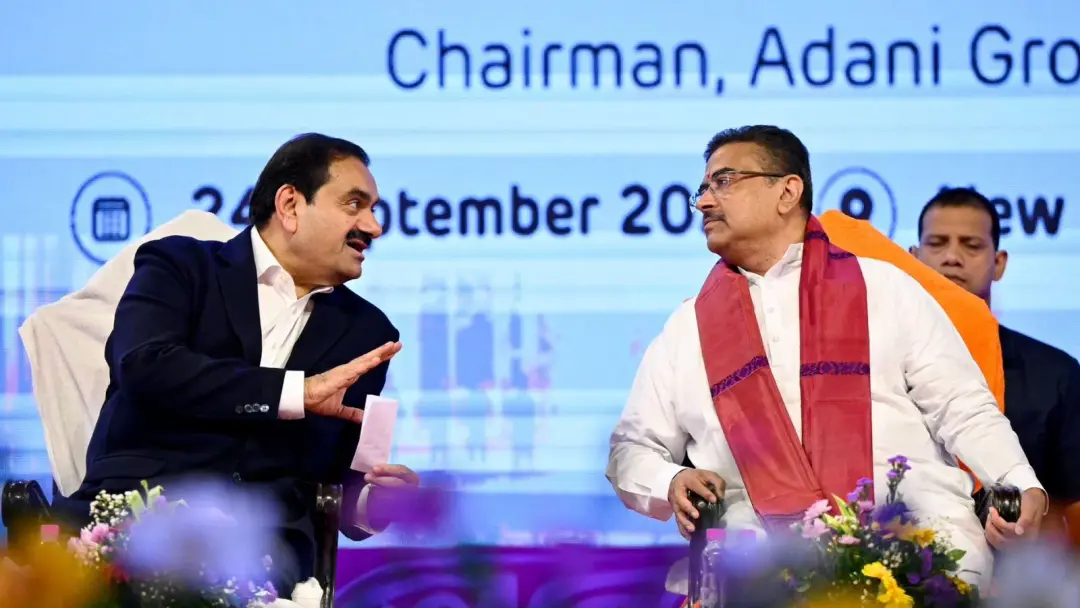
Adani to invest Rs 1 lakh crore in Bengal by 2035
Adani Group Chairman Gautam Adani said on Thursday the group expects to invest more than Rs 1 lakh crore in West Bengal by 2035, across ports, logistics, power generation, transmission and distribution, roads, bridges, ropeways, green cement and hyperscale data centres. He spoke after Chief Minister Suvendu Adhikari laid the foundation for a 2,000-bed hospital in Kolkata's New Town, costing Rs 4,000 crore over 51.75 acres. It targets 2 lakh inpatients, 20 lakh outpatients annually and about 10,000 jobs, with half the beds reserved for economically weaker sections.
Source
Indian Express — Cities · read the original report ↗
Desk check · compared with the source
What the desk checked (5)
- Adani Group plans to invest over Rs 1 lakh crore in West Bengal by 2035. — Directly attributed to Gautam Adani in a quoted statement at a Kolkata event; a forward-looking pledge, not verifiable now.
- The 2,000-bed multi-speciality hospital in New Town will cost Rs 4,000 crore across 51.75 acres. — Figures appear in the source, attributed to a statement; no independent documentation cited.
- The hospital will serve over 2 lakh inpatients and 20 lakh outpatients annually and generate about 10,000 jobs. — Projections attributed to a statement by the Adani Foundation project; internally consistent.
- Half the 2,000 beds will be reserved for economically weaker sections under state and central health insurance schemes. — Attributed to Adani; consistent with the stated not-for-profit nature of the project.
- Chief Minister Suvendu Adhikari met Mukesh Ambani and Anant Ambani in Mumbai two days before the announcement. — Attributed to Adhikari's own remarks and a post cited in the source; dates in source are internally consistent.
Analysts’ view opinion
A Rs 1 lakh crore pledge stretched over a decade is a statement of intent rather than committed capital, and the sectoral mix — ports, logistics, power generation and transmission, roads, bridges, ropeways, green cement and hyperscale data centres — tells you where the group sees Bengal's comparative advantage: infrastructure and freight gateways for eastern India, plus energy-hungry digital assets. The nearer-term, more verifiable piece is the Rs 4,000 crore, 2,000-bed not-for-profit hospital in New Town, which the group says targets about 10,000 jobs and reserves half its beds for patients under state and central insurance schemes. For a state that has struggled to convert announcements into factories, the economic test is not the headline number but the drawdown schedule, land and clearances, and how much of the spend lands in Bengal rather than in imported equipment.
- Announced intent by 2035 is not committed spend: such pledges are typically phased, condition-dependent and revised, so annualised capex matters more than the headline figure.
- The sector list is capital-intensive and mostly infrastructure, which means large construction-phase employment but comparatively modest permanent headcount once assets are operational.
- Hyperscale data centres and green cement both hinge on reliable, affordable power, which is why generation and transmission sit alongside them in the same package — but they also raise questions on tariffs and grid capacity the story does not address.
- The hospital's model — half the beds tied to insurance-scheme patients, the rest presumably paying, plus the Chief Minister's medical-tourism pitch — implies a cross-subsidy structure whose finances are not disclosed.
- The political economy is visible: the pledge follows the new government's investor outreach and an Ambani meeting, so competitive signalling between states for the same pool of capital is part of the story.
What to watch — Watch for signed MoUs converted into land allotments, financial closure and phase-wise capex disclosures — and whether the Reliance and Mitsubishi conversations produce comparable firm commitments.
The story establishes an announcement and a foundation stone, not binding agreements, funding structures, incentive terms or any independent verification of the jobs and patient-volume projections.
Deep dive
Research brief · 8 facts · 5 dates · exam-readyThe brief
Context
The Adani Group has announced its largest-ever commitment to West Bengal — over Rs 1 lakh crore of investment by 2035 — making it the biggest investment announcement since the BJP came to power in the state, ending the Trinamool Congress's 15-year tenure. Gautam Adani made the announcement in Kolkata after Chief Minister Suvendu Adhikari laid the foundation stone for a 2,000-bed multi-speciality not-for-profit hospital, the "Adani Arogya Mandir", in New Town. The announcement came two days after the Chief Minister met Reliance Industries Chairman Mukesh Ambani in Mumbai to discuss investment opportunities, as the new state government pushes to draw industry and create jobs.
Key facts
- Gautam Adani said the Adani Group expects to invest more than Rs 1 lakh crore in West Bengal by 2035.
- Sectors named: ports, logistics, power generation, power transmission and distribution, roads, bridges and ropeways, green cement and hyperscale data centres.
- The New Town, Kolkata hospital will have 2,000 beds and is being executed by the Adani Foundation as a not-for-profit facility built around a modern medical college.
- Rs 4,000 crore has been earmarked for the hospital, spread across 51.75 acres.
- The hospital aims to cater to over 2 lakh inpatients and more than 20 lakh outpatients annually and generate about 10,000 jobs.
- Half of the 2,000 beds will be reserved for economically weaker sections eligible under state and central health insurance schemes.
- Adani committed to supporting restoration of the historic Writers' Building, revitalisation of Kumartuli Ghat and initiatives showcasing Kolkata's Durga Puja art.
- Adani called Mundra port in Gujarat his first 'karmabhoomi' in the West and said he hoped Bengal would become the second, in the East.
Timeline
- Monday (week of the announcement)CM Suvendu Adhikari visits Mukesh Ambani and Anant Ambani at Antilla in Mumbai, offers prayers and discusses investment opportunities.
- September 22, 2026Adhikari posts about his visit to Mukesh Ambani's residence, seeking blessings for national progress.
- TuesdayAdhikari says there will be huge investments in Bengal and that all major investors will come to the state.
- Thursday, September 24, 2026Foundation stone laid for the 2,000-bed Adani Arogya Mandir in New Town; Gautam Adani announces over Rs 1 lakh crore investment in Bengal by 2035.
- By 2035Target horizon for the Adani Group's over Rs 1 lakh crore investment across sectors in West Bengal.
Who has a stake
- Adani Group / Gautam Adani — Seeks to make Bengal its 'second karmabhoomi' with over Rs 1 lakh crore across ports, power, roads, green cement and data centres.
- West Bengal BJP government under CM Suvendu Adhikari — Needs to deliver on its election promise of industrial investment and jobs; frames Bengal's growth as central to Viksit Bharat 2047.
- Adani Foundation — Executing agency for the Rs 4,000 crore not-for-profit hospital and medical college project.
- Patients from economically weaker sections — 1,000 of the 2,000 beds reserved for those eligible under state and central health insurance schemes.
- Job seekers and youth in Bengal — About 10,000 jobs from the hospital project alone, plus employment from wider industrial investments.
- Reliance Industries / Mukesh Ambani — Approached by the CM in Mumbai for investment in Bengal; potential future investor.
- Tapas Roy, State Industries Minister — Tasked with streamlining processes and offering incentives to attract major companies to invest.
Why it matters
West Bengal has long been seen as lagging in large-scale private industrial investment, and this is the biggest investment announcement since the change of government in the state. A Rs 1 lakh crore commitment spanning ports, power, cement and data centres, plus a Rs 4,000 crore hospital with half its beds for the poor, tests whether political change can translate into durable capital formation and jobs. It also signals a wider corporate courtship of Bengal, with Reliance, DRDO, Amul and reportedly Mitsubishi in the frame.
UPSC angle
Prelims pointers
- Adani Group announced over Rs 1 lakh crore investment in West Bengal by 2035 (announced Thursday, September 24, 2026).
- Adani Arogya Mandir: 2,000-bed not-for-profit hospital at New Town, Kolkata; Rs 4,000 crore; 51.75 acres; executed by Adani Foundation.
- Hospital targets: over 2 lakh inpatients, over 20 lakh outpatients annually, about 10,000 jobs; 50% beds for EWS under state/central health insurance schemes.
- Mundra port in Gujarat was described by Gautam Adani as the group's first 'karmabhoomi'.
- Heritage commitments: Writers' Building restoration, Kumartuli Ghat revitalisation, global showcasing of Kolkata's Durga Puja art.
- Other announced projects: DRDO project at Junput (Purba Medinipur), Agrawal Group solar plant in Purulia, two Amul ice cream factories; talks reported with Mitsubishi for a semiconductor plant.
Mains framing
West Bengal's industrial deficit has been a long-standing political and economic question, and the new BJP government has made investment attraction and job creation its central plank after ending the Trinamool Congress's 15-year tenure. The Adani Group's announcement of over Rs 1 lakh crore by 2035 — across ports, logistics, power generation and transmission, roads, bridges and ropeways, green cement and hyperscale data centres — together with a Rs 4,000 crore, 2,000-bed not-for-profit hospital and medical college at New Town, illustrates how state-level investment revival is often anchored in a mix of infrastructure, energy, digital capacity and social infrastructure. The state's approach, as articulated by Industries Minister Tapas Roy, rests on streamlining approvals and offering incentives, with the Chief Minister personally courting investors including Mukesh Ambani. Yet announcements are not realisation: the credibility of such commitments depends on land availability, clearances, power and port connectivity, and the actual pace of deployment over a decade. Equity questions also matter — reserving half the hospital beds for economically weaker sections linked to state and central health insurance schemes is significant, but medical tourism ambitions and public health needs must be balanced. A credible way forward involves transparent monitoring of announced versus committed versus deployed capital, project-level timelines, skilling pipelines to ensure local employment, and integrating heritage and cultural investments (Writers' Building, Kumartuli Ghat) so that growth does not come at the cost of Bengal's identity.
Key terms
- Hyperscale data centre
- A very large-scale data facility for cloud and digital services; one of the sectors named in Adani's Bengal investment plan.
- Green cement
- Cement produced with lower carbon emissions; listed among the sectors of the proposed Rs 1 lakh crore Bengal investment.
- Adani Foundation
- The Adani Group's philanthropic arm, executing the Rs 4,000 crore not-for-profit 2,000-bed hospital in New Town, Kolkata.
- Karmabhoomi
- Literally 'place of work/action'; Adani called Mundra port his first karmabhoomi and hopes Bengal becomes the second.
- Viksit Bharat 2047
- The developed-India-by-2047 goal invoked by CM Adhikari, who said it can happen only if Bengal develops.
- DRDO
- Defence Research and Development Organisation; a DRDO project was announced at Junput in Purba Medinipur district.
Practice questions
- Large private investment announcements at the state level often outpace actual capital deployment. Examine the factors that determine whether such commitments translate into projects on the ground, using West Bengal as a case.
- Discuss the role of corporate philanthropy in India's healthcare delivery, with reference to not-for-profit hospitals that reserve capacity for beneficiaries of public health insurance schemes.
- 'Cultural heritage and industrial development are complementary, not competing, goals.' Critically evaluate this proposition in the context of investment-led growth in West Bengal.
Grounded only in the source report — figures and dates are the source's, not inferred.