
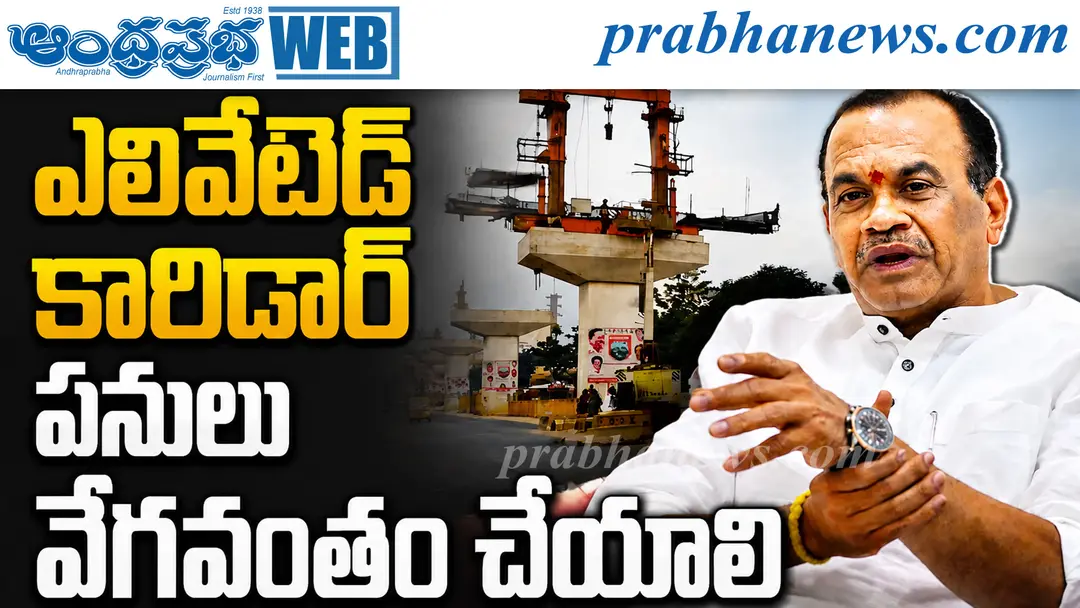
Minister orders faster work on Uppal elevated corridor
Minister Komatireddy Venkat Reddy reviewed progress on the Uppal elevated corridor with Roads and Buildings officials and construction agency representatives, stating that delays and negligence would not be tolerated. He directed that manpower be increased to run work in three shifts, including from 11 pm to 6 am, and that the 6.25 km BT road under the corridor be finished by month-end. He said the target is to open the corridor by October 2026 (Dasara) and that he would inspect the site personally every ten days.
Source
Uppal — స్థానికం · read the original report ↗
Desk check · compared with the source
What the desk checked (5)
- Minister Komatireddy Venkat Reddy reviewed Uppal elevated corridor progress with R&B officials and construction agency representatives. — Attributed to the minister's review meeting as reported in the source; no other source given.
- Work is to run in three shifts, including from 11 pm to 6 am, with increased manpower. — Stated in source as the minister's directive; figures appear in source.
- The 6.25 km BT road under the corridor is to be completed by the end of this month. — Figure appears in source, attributed to the minister's instruction; exact month not named.
- The corridor is targeted for public use by October 2026 (Dasara). — Target attributed to the minister; forward-looking claim that cannot be verified.
- The minister said he would personally inspect the site every ten days. — Direct assertion by the minister as reported; no independent confirmation.
Analysts’ view opinion
This reads less like a routine review meeting and more like a carefully timed political message. By publicly fixing October 2026 (Dasara) as the deadline and promising to inspect the site himself every ten days, Minister Komatireddy Venkat Reddy is claiming the credit if it lands on time — and the blame if it slips. Framing it as an accountable "people's government" under Chief Minister Revanth Reddy is an attempt to tell east Hyderabad's voters that Congress governance is delivering visible results.
- Announcing a public deadline is a double-edged political move: on-time delivery is a talking point, delay becomes a ready-made opposition weapon.
- The order to finish the 6.25 km BT road under the corridor by month-end signals appetite for quick, visible relief for local commuters.
- Three shifts and overnight work project administrative toughness, and the pressure on contractors also plays well as political optics.
- Personal, recurring site inspections strengthen the minister's grip on the R&B portfolio and raise his own profile within the government.
- Describing the traffic problem as one endured "for years" quietly builds a narrative that assigns earlier delay to the past dispensation.
What to watch — Watch whether the month-end BT road target is actually met and whether the ten-day inspections continue — that will decide if this promise becomes an asset or a liability.
The story does not establish the current percentage of work completed, project cost, the reasons for delay so far, or any opposition response — nor does it offer independent evidence that the 2026 deadline is achievable.
Deep dive
Research brief · 8 facts · 5 dates · exam-readyThe brief
Context
The Uppal elevated corridor is a Roads and Buildings (R&B) department project in Hyderabad meant to ease long-standing traffic congestion on the Uppal stretch. Telangana Roads and Buildings Minister Komatireddy Venkat Reddy held a review with R&B officials and representatives of the construction agencies on the progress of the works. He said delay and negligence would not be tolerated and set a target of opening the corridor to the public by October 2026, coinciding with Dasara.
Key facts
- Minister Komatireddy Venkat Reddy reviewed Uppal elevated corridor progress with Roads and Buildings officials and construction agency representatives.
- He declared that delay and negligence in the works would not be tolerated in the least.
- Officials were directed to increase manpower so that works run in three shifts.
- Work was ordered to continue even from 11 pm to 6 am.
- The 6.25 km BT (bitumen) road under the elevated corridor must be completed by the end of this month.
- Launching girders are to be used on the Narapally and Uppal sides to further speed up the works.
- Target: open the elevated corridor to the public by October 2026, timed with Dasara.
- The Minister said he will personally inspect progress at the field level once every ten days.
Timeline
- Years before (ongoing)People on the Uppal route have been suffering traffic problems, which the government says it aims to relieve.
- Day of the review (date not stated in the source)Minister Komatireddy Venkat Reddy holds review meeting with R&B officials and construction agencies; orders three-shift work and night work from 11 pm to 6 am.
- By end of this monthDeadline set for completing the 6.25 km BT road under the corridor.
- Every ten daysMinister to personally inspect progress on site.
- October 2026 (Dasara)Target for opening the Uppal elevated corridor to the public.
Who has a stake
- Commuters on the Uppal route — Relief from traffic problems faced for years; depend on timely completion of the corridor.
- Minister Komatireddy Venkat Reddy — Accountable for the deadline; has promised personal field inspections every ten days.
- Roads and Buildings (R&B) Department officials — Must raise manpower, run three shifts and deliver the 6.25 km BT road by month-end.
- Construction agencies executing the project — Face zero tolerance for delay and negligence; must deploy launching girders at Narapally and Uppal ends.
- State government led by CM Revanth Reddy — Cited by the Minister as a 'people's government' working accountably; credibility tied to keeping the promise.
- Residents of Narapally and Uppal areas — Affected by round-the-clock construction activity, including night work from 11 pm to 6 am.
Why it matters
Uppal is one of Hyderabad's most congested corridors, and the elevated stretch is the state's main answer to years of commuter delay. The Minister's directives — three shifts, night work, launching girders and a fixed Dasara 2026 opening — turn a routine review into a public deadline with personal monitoring, making political accountability measurable. For urban governance, it illustrates how deadline-setting and site inspection are used to push stalled infrastructure to completion.
UPSC angle
Prelims pointers
- Uppal elevated corridor is a Roads and Buildings (R&B) Department project in Hyderabad, Telangana.
- Telangana Roads and Buildings Minister: Komatireddy Venkat Reddy; Chief Minister: Revanth Reddy.
- Length of BT road under the corridor to be completed by month-end: 6.25 km.
- Directed work schedule: three shifts, including night work from 11 pm to 6 am.
- Launching girders to be deployed on the Narapally and Uppal sides to speed up construction.
- Announced completion/opening target: October 2026, coinciding with Dasara.
Mains framing
Urban mobility bottlenecks like the Uppal stretch in Hyderabad reflect a mismatch between rapid peri-urban growth along arterial highways and the pace of public works delivery; the source records that commuters have endured traffic problems on this route 'for years'. The Minister's response is essentially delivery-side: expanding manpower to run three shifts including an 11 pm to 6 am window, mandating launching girders at the Narapally and Uppal ends to accelerate span erection, fixing a month-end deadline for the 6.25 km BT road beneath the corridor, and locking a Dasara (October 2026) opening date. Crucially, he couples this with a monitoring mechanism — personal field inspection every ten days — and an explicit warning that delay and negligence will not be tolerated, framing the project within the accountability claim of the 'people's government' under CM Revanth Reddy. The implications cut both ways: compressed schedules and night work can shorten commuter pain but raise questions of quality assurance, worker conditions and noise for residents, none of which the source addresses. The way forward suggested by the story itself is disciplined milestone tracking, deployment of appropriate construction technology, and political ownership of deadlines rather than open-ended timelines.
Key terms
- Elevated corridor
- A road built on piers above an existing surface road to let through traffic bypass junctions and congestion.
- Roads and Buildings (R&B) Department
- The Telangana state department responsible for building and maintaining roads and government structures, executing this corridor.
- BT road
- Bitumen-topped road; here the 6.25 km surface road beneath the elevated corridor to be finished by month-end.
- Launching girder
- A heavy construction machine used to lift and place bridge/viaduct girders in position, speeding up elevated works.
- Three-shift working
- Running construction round the clock in three work shifts, including the 11 pm to 6 am night shift, to compress timelines.
Practice questions
- Elevated corridors are increasingly used to decongest Indian cities. Examine their benefits and limitations as an urban mobility solution, using the Uppal corridor as an illustration.
- How do fixed political deadlines and periodic ministerial site inspections affect the delivery of public infrastructure projects? Discuss with reference to accountability mechanisms.
- Round-the-clock construction can accelerate projects but raises quality, safety and residential concerns. Suggest safeguards that state works departments should adopt.
Grounded only in the source report — figures and dates are the source's, not inferred.