
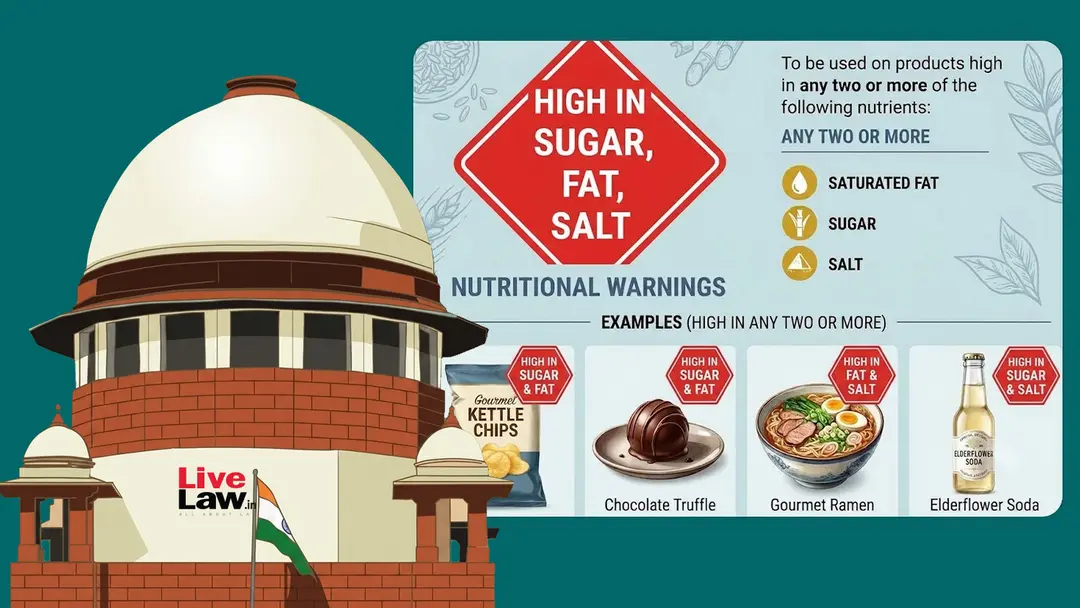
FSSAI proposes red hexagon warning labels on packaged foods
The FSSAI has told the Supreme Court it proposes a red hexagonal warning label on a white square background, broadly based on the Canadian model, for packaged foods high in sugar, fat or salt. The warning would apply if any one nutrient exceeds thresholds drawn from the ICMR-NIN Dietary Guidelines for Indians, 2024. FSSAI says draft regulations will take about four months, followed by a 365-day voluntary implementation period. The matter is listed on September 28.
Source
Live Law (courts) · read the original report ↗
Desk check · compared with the source
What the desk checked (5)
- FSSAI proposes a red hexagonal warning label on a white square background, broadly based on the Canadian model, on the top left of packages. — Attributed in source to FSSAI's proposal submitted to the Supreme Court.
- Warning would apply if a product is high in any one of the nutrients of concern (sugar, fat, salt), replacing the earlier 'two or more' trigger. — Figure and change appear in source, attributed to FSSAI after objections by petitioner and the Court.
- FSSAI needs about four months to issue and finalise draft regulations, with a 60-day comment period and a 365-day voluntary implementation period. — Timelines stated in source as FSSAI's submission; not independently verifiable here.
- Thresholds are based on ICMR-National Institute of Nutrition's Dietary Guidelines for Indians, 2024 (Table 15.1, Guideline 15). — Source cites the document; figures such as 5% energy from added sugar for solids appear in source.
- The Court's order seeking responses on 13 aspects is dated September 10, 2026, and the matter is listed on September 28. — Dates appear in source as written; the 2026 date is internally inconsistent with a listing date and should be checked against the order.
Analysts’ view opinion
The real political story here is not the label design but who forced it: this is court-driven policy, not regulator-led reform. FSSAI produced a proposal only after the Supreme Court criticised its inaction, and then dropped its softer "two or more nutrients" trigger for the stricter "any one nutrient" standard after the petitioner and the bench pushed back. For now, the initiative in shaping this public-health rule sits with the judiciary and a petitioner NGO, with the regulator in a responsive posture.
- Because the tightening followed judicial pressure, the reputational gain accrues mainly to the petitioner society and the Court, while the regulator carries the charge of having been slow to act.
- The staged timeline — roughly four months for draft rules, 60 days of consultation, then a 365-day voluntary period — gives industry room to adjust, but invites criticism from health advocates that the pace is too gentle.
- Basing the trigger on nutrient content rather than degree of processing is both technically simpler and politically less confrontational, since it avoids targeting whole product categories.
- Adopting a red hexagon broadly modelled on Canada's system is a signal in itself, given the regulator's earlier position that international standards could not simply be followed.
- With both domestic consultation and the WTO platform built into the draft stage, food industry and trade-based arguments have a formal channel to shape the final rules.
What to watch — Watch whether, at the September 28 hearing, the Court accepts FSSAI's timeline or presses to compress it — especially the 365-day voluntary compliance window.
This remains a proposal at draft stage; the story does not establish the final thresholds, label specifications or deadlines, nor any on-record response from industry or political parties.
Deep dive
Research brief · 8 facts · 6 dates · exam-readyThe brief
Context
India has for years debated Front-of-Pack Nutrition Labelling (FoPL) — simple front-label warnings on packaged foods high in sugar, fat or salt. Acting on a writ petition by the NGO '3S and Our Health Society', the Supreme Court criticised the Food Safety and Standards Authority of India (FSSAI) for inaction and for arguing that international standards could not be followed. FSSAI first proposed a warning only where two or more "nutrients of concern" exceeded limits; after the petitioner and the Court objected, it agreed to revisit the framework. It has now told the Court it proposes a red hexagon warning label on a white square background, broadly based on the Canadian model, triggered by any one nutrient.
Key facts
- FSSAI proposes a red hexagon on a white square background on the front of packages, with the name of the exceeding nutrient(s) written inside the hexagon.
- The warning would be triggered if a product is high in any one nutrient of concern (sugar, fat or salt), replacing the earlier 'two or more' trigger.
- Thresholds are proposed to be based on Table 15.1 of Guideline 15 of the ICMR-National Institute of Nutrition's Dietary Guidelines for Indians, 2024.
- For solid foods: sugar threshold at about 5% of energy from added sugar, not exceeding 10% of energy from total sugar; for liquids/beverages, about 10% added sugar and up to 30% total sugar.
- Products, including beverages, with non-caloric sweeteners may carry the front-of-pack warning 'CONTAIN NON CALORIC SWEETENER'.
- Label to be placed prominently on the top left of the front of the pack, with font at least one point larger than the back-of-pack nutrition information table.
- FSSAI says it needs about four months to issue and finalise draft regulations; drafts to be published for 60 days for comments via domestic consultation and the WTO platform, followed by a 365-day voluntary implementation period.
- Added sugar and added fat (not total sugar or saturated fat) are proposed as the basis; trans-fat is excluded as it is already separately declared and regulated; food additives are covered by the FSS (Food Products Standards and Food Additives) Regulations, 2011.
Timeline
- 2011Food Safety and Standards (Food Products Standards and Food Additives) Regulations notified, regulating additives such as preservatives and emulsifiers.
- 2020FSS (Safe Food and Balanced Diets for Children in School) Regulations bar sale of foods high in saturated fat, trans-fat, added sugar or sodium on school premises.
- 2024ICMR-NIN issues Dietary Guidelines for Indians, whose Table 15.1 thresholds FSSAI now cites; writ petition W.P.(C) No. 437/2024 filed by 3S and Our Health Society.
- Earlier stage of hearingsFSSAI proposes warning only if two or more nutrients of concern exceed limits; petitioner calls it unscientific, Court agrees, FSSAI agrees to revisit.
- September 10, 2026 (order date as stated in source)Supreme Court seeks responses from the Union and FSSAI on 13 specific aspects of the proposed FoPL framework.
- September 28Matter listed for further consideration before the Supreme Court.
Who has a stake
- FSSAI — Must frame, notify and enforce the FoPL regulations under the Food Safety and Standards Act after being criticised by the Supreme Court for inaction.
- Supreme Court bench of Justice JB Pardiwala and Justice K Vinod Chandran — Monitoring the framework; raised concerns on children's health, nutrient thresholds, label design and additive use.
- 3S and Our Health Society (petitioner, Adv Rajiv Shankar Dwivedi) — Sought a scientific trigger — warning for any one nutrient of concern rather than two or more.
- Food business operators / packaged food and beverage industry — Face redesign of packaging, disclosure of added sugar/fat/salt and non-caloric sweeteners; get a 365-day voluntary period after notification.
- Consumers, especially schoolchildren — Stand to gain simpler front-of-pack information; targeted by Eat Right School and nutrition literacy proposals.
- Department of School Education and Literacy and CBSE — Proposed partners for including nutrition literacy and Eat Right India in school curricula.
Why it matters
Front-of-pack warnings change how ordinary shoppers judge packaged food at the point of purchase, and the shift from a 'two or more nutrients' trigger to 'any one nutrient' widens the net considerably. The design draws on the Canadian model and anchors thresholds in Indian dietary science (ICMR-NIN 2024), signalling that domestic standards can align with global practice. It is also a case study in judicially driven regulation, with the Supreme Court pressing a statutory regulator on timelines and design details.
UPSC angle
Prelims pointers
- FoPL = Front-of-Pack Nutrition Labelling; FSSAI proposes a red hexagon on a white square, broadly on the Canadian model.
- Nutrients of concern named: sugar, fat and salt; trigger is any one nutrient exceeding the threshold.
- Thresholds drawn from Table 15.1, Guideline 15 of ICMR-National Institute of Nutrition's Dietary Guidelines for Indians, 2024.
- Process: ~4 months for draft regulations, 60-day comment period (domestic + WTO), then 365-day voluntary implementation.
- Case: 3S and Our Health Society v. Union of India, W.P.(C) No. 437/2024; bench of Justices JB Pardiwala and K Vinod Chandran.
- FSSAI programmes cited: Eat Right School, Eat Right India, #StopObesity and #FightObesity campaigns; FSS (Safe Food and Balanced Diets for Children in School) Regulations, 2020.
Mains framing
The FSSAI's red hexagon proposal marks a shift from information-heavy back-of-pack nutrition tables to an interpretive warning that consumers can read at a glance, and it came only after the Supreme Court censured the regulator's inaction and its claim that international standards could not be applied in India. Substantively, the framework makes three choices worth examining: the trigger is any one nutrient of concern rather than two or more, meeting the petitioner's objection that the earlier rule was unscientific; thresholds rest on Indian evidence (ICMR-NIN Dietary Guidelines for Indians, 2024, Table 15.1) rather than borrowed limits; and nutrient content, not degree of processing, is the regulatory criterion, which keeps ultra-processed foods outside the label's logic even as added sugar and added fat replace total sugar and saturated fat. Implementation is the weak link: roughly four months for drafting, a 60-day consultation including the WTO platform, and a 365-day voluntary period for food business operators mean years before mandatory compliance, while enforcement and industry reformulation remain untested. Complementary steps — the 2020 school food regulations, Eat Right School, and proposed curriculum tie-ups with the Department of School Education and Literacy and CBSE — suggest labelling alone cannot shift diets without nutritional literacy. The way forward lies in firm mandatory deadlines, transparent threshold review, and monitoring whether the label reduces consumption rather than merely relabels products.
Key terms
- FSSAI
- Food Safety and Standards Authority of India, the statutory food regulator functioning under the Food Safety and Standards Act.
- Front-of-Pack Nutrition Labelling (FoPL)
- Simplified nutrition warning or rating displayed on the front of a food package to guide consumer choice.
- Nutrients of concern
- In this proposal, sugar, fat and salt — excess intake of which is linked to diet-related disease.
- ICMR-NIN Dietary Guidelines for Indians, 2024
- National dietary guidance from ICMR's National Institute of Nutrition; its Table 15.1 supplies FSSAI's proposed thresholds.
- Non-caloric sweetener
- Sweetening agent with negligible calories; FSSAI proposes a front-of-pack declaration 'CONTAIN NON CALORIC SWEETENER'.
- Eat Right School / Eat Right India
- FSSAI initiatives promoting safe and healthy eating, proposed for inclusion in school curricula with CBSE.
Practice questions
- Critically examine the shift in FSSAI's Front-of-Pack Labelling proposal from a 'two or more nutrients of concern' trigger to 'any one nutrient'. What does this reveal about evidence-based food regulation in India?
- FSSAI has chosen nutrient content rather than level of processing as the criterion for front-of-pack warnings. Discuss the implications of this choice for tackling diet-related non-communicable diseases.
- Discuss the role of judicial intervention in shaping food safety regulation, with reference to the Supreme Court proceedings in 3S and Our Health Society v. Union of India.
Grounded only in the source report — figures and dates are the source's, not inferred.