
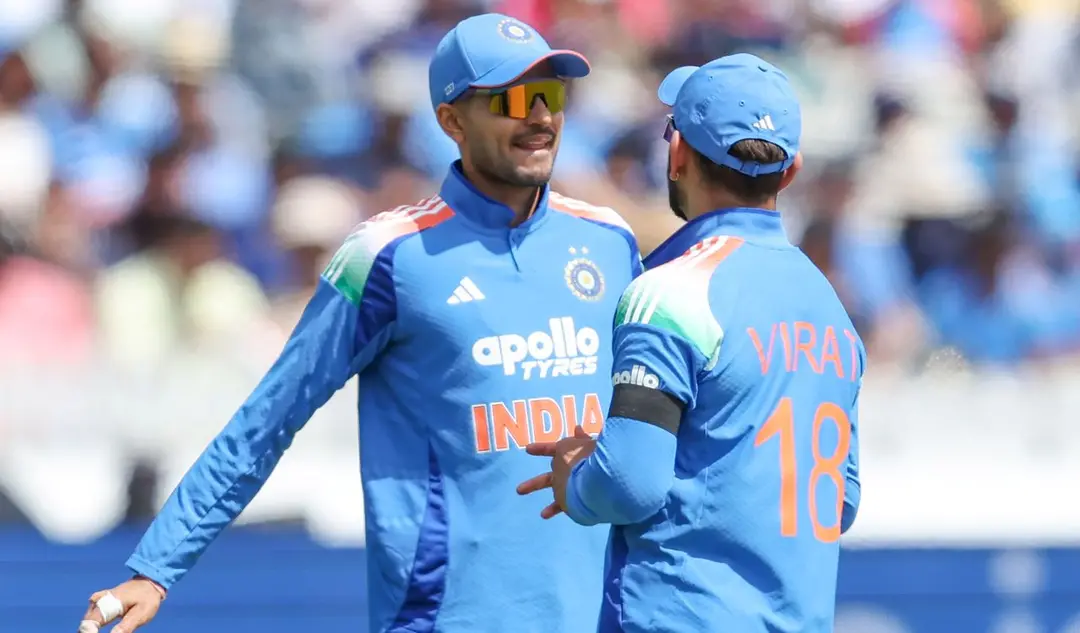
Kohli says trust in teammates lets him bat with freedom
Senior India batter Virat Kohli said he has consciously decided to bat with greater freedom in ODIs, moving away from the anchor role he held for much of his career. Kohli, who turns 38 in November, has three centuries, four fifties and a score in the 90s in his last 10 ODIs. He told JioStar that faith in India's long batting lineup allows more risks. He praised captain Shubman Gill, saying he is still learning. India play the West Indies in Thiruvananthapuram on September 27 at 2 pm.
Source
Telangana Today · read the original report ↗
Desk check · compared with the source
What the desk checked (4)
- Kohli has scored three centuries, four fifties and a score in the 90s in his last 10 ODI appearances. — Figure appears in source as reported statistic; no stats provider cited.
- Kohli turns 38 in November. — Stated in source without attribution; internally consistent.
- Quotes on playing freely, World Cup intensity and captain Shubman Gill. — Attributed to Kohli in remarks to JioStar.
- India's first ODI against the West Indies is in Thiruvananthapuram on September 27 from 2 pm. — Stated in source; source date line says 26 September 2026 and refers to Sunday, internally consistent.
Analysts’ view opinion
Kohli's decision to shed the anchor role reads less like a personal reinvention and more like a response to how 50-over cricket has shifted — when 350-360 is the benchmark rather than 300, the value of a batter holding one end down drops sharply. Three centuries, four fifties and a score in the 90s in his last 10 ODIs give the argument real evidence: the freer method has not cost him consistency. The trade-off is that this approach leans on faith in a deep batting lineup, and on days the middle order misfires, early risk-taking will look expensive.
- Modern ODI maths rewards a top-order batter who lifts tempo over one who merely stabilises, and Kohli's own 350-360 framing acknowledges exactly that.
- The numbers back his case: seven scores of fifty or more in his last 10 ODIs, including three hundreds, suggest freedom has not undermined reliability.
- The method is lineup-dependent; if the lower order stumbles, the same risks that produce quick runs will be scrutinised harder.
- Turning 38 in November, his stated confidence in sustaining high intensity across a long campaign rests on the physical work he has put in — a genuine variable at this stage of a career.
- His read on Shubman Gill is measured: proactive with field placements and the right intent, but with decision-making still maturing through experience.
What to watch — Watch how aggressively Kohli plays in the early overs of the first ODI against the West Indies in Thiruvananthapuram on September 27, and whether India's scoring rate tracks anywhere near that 350-plus ambition.
This is Kohli's own account of his intent; the story does not establish his batting position, India's likely combination, or how team management views this approach heading into any major tournament.
Deep dive
Research brief · 8 facts · 4 dates · exam-readyThe brief
Context
Virat Kohli, India's senior batter, has spoken to broadcaster JioStar about a deliberate shift in his ODI batting approach — from the "anchor" role he played for years to a freer, more aggressive game. He links the change to confidence in India's long batting lineup and to rising ODI scoring benchmarks of 350-360. The remarks came ahead of the first ODI of the West Indies' tour of India in Thiruvananthapuram, in a squad now led by young captain Shubman Gill.
Key facts
- Kohli said he has consciously decided to play with greater freedom in ODIs, moving away from the anchor/stabiliser role he held for much of his career.
- Kohli turns 38 in November, as stated in the source.
- In his last 10 ODI appearances Kohli has scored three centuries, four fifties and one score in the 90s.
- Kohli said that with fast-paced, good conditions and rivals pushing towards 340-350, India should be able to score 350-360.
- Kohli said he is willing to take risks because he has faith that other players around him are very good and can handle the situation.
- Kohli said the same mental freedom has also helped him in the IPL.
- Kohli called a 50-over World Cup tougher than bilateral series: about 10 games at T20-level intensity, especially in foreign conditions.
- Kohli praised captain Shubman Gill for proactive field placements and intensity, while saying Gill is still young and learning in the role.
Timeline
- Last 10 ODI appearances (period not stated in the source)Kohli scores three centuries, four fifties and a score in the 90s.
- 26 September 2026, 09:00 PM (publication date)Kohli's interview with JioStar is published ahead of the first ODI.
- September 27, 2 pmIndia play West Indies in the first ODI at Thiruvananthapuram.
- NovemberKohli turns 38.
Who has a stake
- Virat Kohli — His late-career relevance and output in ODIs; shifting from anchor to aggressor while sustaining fitness for long tournaments.
- Shubman Gill (India captain) — Growing into the leadership role; his tactical calls and field placements are under scrutiny as he is 'still learning'.
- Indian ODI team — A batting template aimed at 350-360 totals, and combination-building through bilateral series ahead of big tournaments.
- West Indies team — Opponents in the ODI series in India, starting at Thiruvananthapuram.
- JioStar (broadcaster) — Carried the interview; commercial and viewer interest in the India-West Indies series.
- Thiruvananthapuram / host venue and fans — Hosting the first ODI of the series on September 27.
Why it matters
Kohli's shift signals how ODI cricket has changed: par scores have moved towards 350-360, so even classical accumulators must convert risk into runs. It also frames India's transition phase — a senior batter recalibrating his role while a young captain, Shubman Gill, learns on the job through bilateral series that are essentially preparation for World Cups.
UPSC angle
Prelims pointers
- Virat Kohli told JioStar he has moved away from the ODI anchor role to bat with greater freedom.
- Kohli's last 10 ODIs: three centuries, four fifties, one score in the 90s.
- Kohli turns 38 in November (as per the source).
- India vs West Indies first ODI: Thiruvananthapuram, September 27, 2 pm.
- Shubman Gill is India's captain; Kohli described him as young and still learning in the role.
- Kohli's benchmark for modern ODI batting: chasing or setting totals of 350-360.
Mains framing
Kohli's stated move from stabiliser to risk-taker illustrates a structural change in one-day cricket rather than merely a personal choice: as he notes, opposition sides now push towards 340-350, so a competitive total is 350-360, which compresses the space for pure accumulation. Two enabling conditions he identifies are institutional and physical — depth in India's batting order, which lowers the cost of an individual dismissal, and sustained fitness work, which he says lets him hold T20-level intensity across the roughly ten matches of a 50-over World Cup in foreign conditions. The same logic explains why bilateral series matter differently: they run at lower intensity and serve to test combinations and give players game time under pressure, while tournament cricket demands consistency of intensity. The leadership dimension is complementary — Kohli credits Shubman Gill with proactive field placements, varied fields and clear communication with bowlers, while conceding that situational decision-making will improve only with experience. The way forward implied by the source is continuity: freedom underwritten by batting depth, fitness as the base for tournament endurance, and patience with a young captain who has the right perspective and intent.
Key terms
- Anchor role
- A batting brief focused on stabilising the innings and batting through, rather than taking risks for quick runs.
- ODI
- One Day International, the 50-over format of international cricket.
- Bilateral series
- Matches between two countries outside global tournaments, often used to test combinations and give players game time.
- 50-over World Cup
- The global ODI tournament; Kohli describes it as roughly 10 games at T20-level intensity.
- JioStar
- The broadcaster to which Kohli gave the interview ahead of the West Indies ODI series.
- IPL
- Indian Premier League, the domestic T20 league where Kohli says the same mental freedom has helped him.
Practice questions
- How have rising par scores in ODI cricket changed the traditional roles of anchor and finisher? Discuss with reference to Kohli's stated shift in approach.
- Examine the role of bilateral series in preparing a national side for global tournaments, using Kohli's distinction between bilateral and World Cup intensity.
- What qualities does Kohli identify in Shubman Gill's captaincy, and what does the transition to a young captain mean for a team in a rebuilding phase?
Grounded only in the source report — figures and dates are the source's, not inferred.