
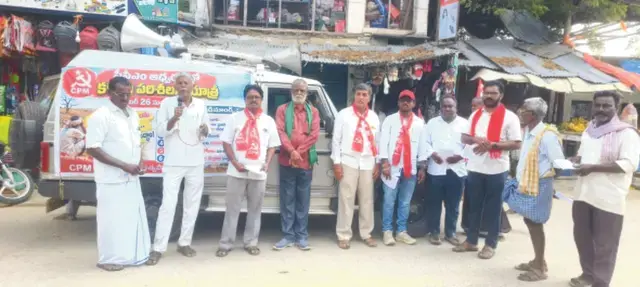
CPM demands Sri Sathya Sai be declared a drought district
CPM district secretary C. Ramakrishna demanded that all 32 mandals in Sri Sathya Sai district be identified as drought mandals and the district declared drought-hit. He spoke during a drought survey jeep yatra held on Sunday in Puttaparthi, Kothacheruvu, Penukonda, Gorantla and other mandals. Crops were sown on only 2.70 lakh acres against 12 lakh acres, he said, seeking Rs 50,000 per acre compensation, fodder, 200 workdays and Rs 700 daily wage. A dharna at the collectorate was announced for the 30th.
Source
Sri Sathya Sai — వార్తలు · read the original report ↗
Desk check · compared with the source
What the desk checked (5)
- CPM demands all 32 mandals be identified as drought mandals and Sri Sathya Sai declared a drought district — Attributed to CPM district secretary C. Ramakrishna in the source
- Crops were sown on only 2.70 lakh acres against a normal 12 lakh acres due to severe drought — Figures appear in source, stated by Ramakrishna; no official/government confirmation cited
- Demand for Rs 50,000 per acre compensation, fodder supply, 200 days of work at Rs 700 a day under the employment guarantee scheme — Attributed demands, not government decisions
- Promise to fill 193 tanks in the constituency through the Handri-Neeva canal remains unfulfilled — Claim made by CPM leader; no government response included in source
- Dharna planned at the Collector's office on the 30th of this month — Announcement attributed to the organisers; month not specified in source
Analysts’ view opinion
Strip away the political framing and the core economic claim is stark: on the CPM's account, sowing in Sri Sathya Sai district collapsed to roughly 2.70 lakh acres against a normal of about 12 lakh acres, and even that sown area has dried up. If those figures hold up in official enumeration, this is not merely a farm-income shock but a district-wide demand shock — lower rural spending, weaker local trade, distress sale of livestock and a likely spike in outward migration for work. The compensation and wage demands are the costlier part of the ask, which is precisely why a formal drought declaration is being resisted or delayed in practice.
- A drop from around 12 lakh to 2.70 lakh acres sown, as claimed, implies most of the district's kharif farm income simply did not materialise, hitting input dealers, transporters and rural retail alongside farmers.
- The Rs 50,000-per-acre compensation demand is a large fiscal number by any measure — on the sown area alone it would run into thousands of crores — so the state's fiscal capacity, not just its willingness, is the real constraint.
- Tenant farmers are the weakest link economically: they bear crop losses but often lack the land records needed to claim relief, so relief that flows only to titleholders leaves the worst-hit uncovered.
- The demand for 200 days of work at Rs 700 a day is essentially a request to convert employment guarantee into a drought income floor, which shifts much of the cost to the central-state shared wage bill.
- Fodder supply and water delivery — canal-fed tank filling and town drinking water — are the cheaper, faster interventions, and delays there raise the eventual cost through cattle distress and emergency water supply.
What to watch — Watch whether the district administration's own crop-sowing and rainfall enumeration matches these figures and whether a formal drought notification follows, since that notification is the trigger that unlocks relief spending, and watch the January 30 collectorate protest for the scale of pressure.
The acreage, loss and shortfall figures here are a political party's claims made during a campaign tour, not verified official data, and the story does not establish the government's response, the actual fiscal cost, or the status of the canal and drinking water commitments referred to.
Deep dive
Research brief · 8 facts · 2 dates · exam-readyThe brief
Context
Sri Sathya Sai district in Andhra Pradesh, carved out of the old Anantapur region, is one of the state's most drought-prone rain-shadow areas. The CPM has launched a drought survey "jeep yatra" across the district's mandals to record crop failure and farmer distress, and is demanding an official drought declaration that would unlock relief. Its district secretary C. Ramakrishna says sowing collapsed this season and that promises made by the TDP-led coalition government, including filling tanks through the Handri-Neeva canal, remain unfulfilled.
Key facts
- CPM demands that all 32 mandals of Sri Sathya Sai district be identified as drought mandals and the district declared drought-hit.
- Against about 12 lakh acres that should have been sown in the district, cultivation was limited to only 2.70 lakh acres due to severe drought, per CPM district secretary C. Ramakrishna.
- Even the crops that were sown have dried up, Ramakrishna said.
- Demand: Rs 50,000 per acre compensation for every farmer who sowed a crop, plus support for tenant farmers.
- Demands include supply of cattle fodder, 200 days of work for employment guarantee workers and a daily wage of Rs 700.
- CPM questioned the unfulfilled promise to fill 193 tanks in the constituency through the Handri-Neeva canal.
- The jeep yatra covered Puttaparthi, Kothacheruvu, Obuladevaracheruvu, Nallamada, Penukonda, Somandepalli and Gorantla mandals on Sunday.
- A dharna on drought issues has been called at the Collector's office on the 30th of this month.
Timeline
- Sunday (date not stated in the source)CPM drought survey jeep yatra continues through Puttaparthi, Kothacheruvu, Obuladevaracheruvu, Nallamada, Penukonda, Somandepalli and Gorantla mandals; pamphlets distributed.
- 30th of this month (month not stated in the source)Dharna announced at the Collector's office in Sri Sathya Sai district on drought issues.
Who has a stake
- Farmers of Sri Sathya Sai district — Crop loss on most of the 12 lakh acres normally sown; seeking Rs 50,000 per acre compensation.
- Tenant farmers — CPM demands they too be supported, as they often fall outside formal relief lists.
- Employment guarantee workers — Demand for 200 workdays and Rs 700 daily wage as drought-time livelihood support.
- District administration / Collector — Target of the drought declaration demand and of the dharna planned at the collectorate on the 30th.
- TDP-led coalition government — Accused of not fulfilling promises on drought relief, filling 193 tanks via Handri-Neeva and permanent drinking water for Puttaparthi municipality.
- CPM, AP Rythu Sangham, CITU, Agricultural Workers' Union — Mobilising farmers and workers; leaders Hari, Jangapalli Peddanna, ZP Srinivasulu and Praveen joined the yatra.
- Livestock owners — Dependent on demanded fodder supply as pasture and crops dry up.
Why it matters
A formal drought declaration is the administrative trigger for relief such as input subsidy, fodder supply and extra employment guarantee work, so the gap between ground distress and official notification directly decides whether farmers get help. With sowing down to 2.70 lakh acres from a normal 12 lakh acres, the district faces both crop and fodder crises. The protest also links drought relief to irrigation promises and to the credibility of political commitments ahead of local body elections.
UPSC angle
Prelims pointers
- Sri Sathya Sai district (Andhra Pradesh) has 32 mandals, per the CPM demand for drought mandal status.
- Handri-Neeva canal: project cited as the means to fill 193 tanks in the constituency.
- Normal sown area in the district cited as about 12 lakh acres; actual sowing this season 2.70 lakh acres.
- CPM demands: Rs 50,000/acre compensation, 200 workdays, Rs 700 daily wage under the employment guarantee scheme.
- Puttaparthi, Penukonda, Gorantla, Nallamada, Kothacheruvu, Obuladevaracheruvu, Somandepalli are mandals covered by the jeep yatra.
- Organisations involved: CPM, AP Rythu Sangham, CITU, Agricultural Workers' Union.
Mains framing
The Sri Sathya Sai episode illustrates how drought distress in India's rain-shadow districts becomes a question of administrative recognition as much as of rainfall: sowing shrank to 2.70 lakh acres against a normal 12 lakh acres, yet relief hinges on the district and its 32 mandals being formally notified as drought-affected. The immediate causes are monsoon failure and the drying of even sown crops; the structural causes cited by protesters are unfulfilled irrigation commitments, such as filling 193 tanks through the Handri-Neeva canal, and the absence of permanent drinking water for Puttaparthi municipality. The implications run beyond crop loss to fodder scarcity for livestock, wage-labour distress requiring expanded employment guarantee work, and the specific vulnerability of tenant farmers who usually lack the documents needed to claim compensation. Protesters also link land acquisition for industry to farmer insecurity. A grounded way forward would combine timely and transparent drought assessment at the mandal level, compensation that reaches tenant cultivators, fodder banks and extended employment guarantee days as the drought-proofing safety net, and completion of the promised tank-filling works so that irrigation assurances translate into assured water. The source does not state the government's response.
Key terms
- Drought mandal declaration
- Official identification of a mandal as drought-affected, which is the basis for relief measures; demanded here for all 32 mandals.
- Handri-Neeva canal
- Irrigation canal through which the government promised to fill 193 tanks in the constituency, a promise CPM says is unmet.
- Jeep yatra (drought survey)
- CPM's touring campaign by jeep through mandals to inspect crop damage and collect farmers' grievances.
- Tenant farmers
- Cultivators who farm leased land; CPM demands they be included in drought relief.
- CITU
- Centre of Indian Trade Unions, the CPM-affiliated trade union whose district president joined the yatra.
- Dharna at collectorate
- Sit-in protest at the district Collector's office, called for the 30th to press drought demands.
Practice questions
- Examine how the process of declaring a district drought-affected determines the timeliness and reach of relief, using the Sri Sathya Sai case.
- Tenant farmers are often excluded from crop loss compensation. Discuss the measures needed to make drought relief inclusive.
- Assess the role of canal-based tank filling and employment guarantee work as drought-proofing strategies in rain-shadow districts of Andhra Pradesh.
Grounded only in the source report — figures and dates are the source's, not inferred.