
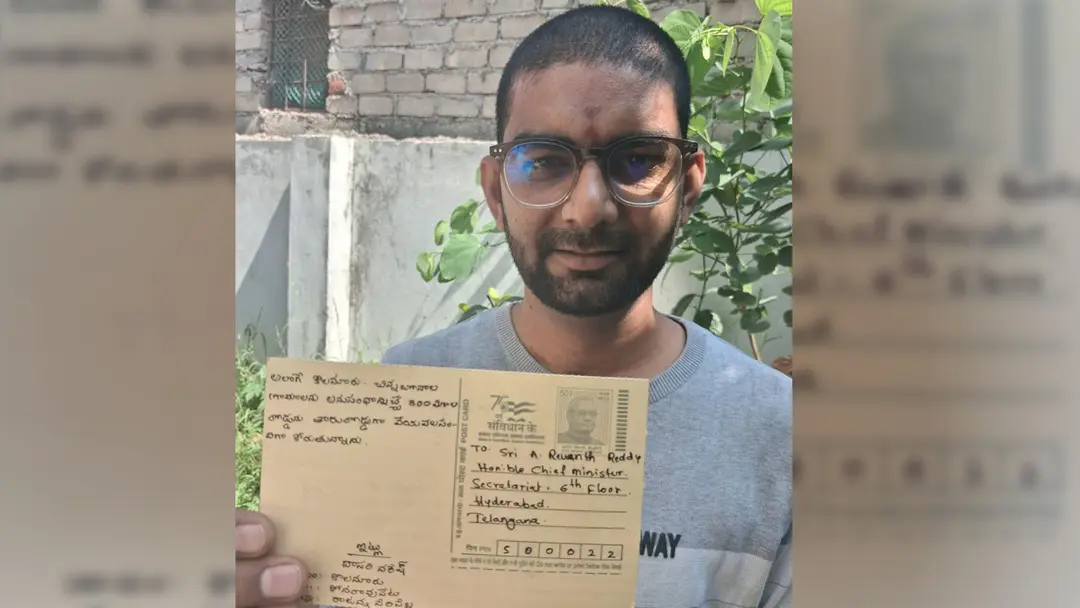
Kolanur youths write postcards to CM seeking new school building
Kolanur residents Dasari Naresh and Gajula Srinivas have written postcards to Telangana Chief Minister Revanth Reddy seeking sanction of a new government high school building. They said the existing structure, built about four decades ago, has been unused for five years after turning dilapidated, leaving more than 90 students studying in tin sheds. They sought demolition of the old building and development of the 800-metre Kolanur–Chinna Bonala road as a tar road. The CM visits Sircilla on the 30th.
Source
Sircilla — స్థానికం · read the original report ↗
Desk check · compared with the source
What the desk checked (5)
- Kolanur residents Dasari Naresh and Gajula Srinivas sent postcards to CM Revanth Reddy seeking a new high school building. — Attributed to the two named youths, who are quoted directly in the source.
- The Kolanur government high school building was built about four decades ago and has been unusable for the past five years. — Figure appears in source; the headline says 35 years while the text says about four decades — internal inconsistency an editor should note.
- More than 90 students are studying in tin sheds; the school serves Kolanur, Marthannapet, Gollapalli and Ramannapet. — Figure appears in source, attributed to the petitioners; no official enrolment data given.
- An 800-metre road linking Kolanur and Chinna Bonala is damaged and has been sought as a tar road. — Stated by the petitioners; no engineering or official source cited.
- Revanth Reddy is visiting Sircilla on the 30th of this month for the first time. — Stated in a quote by Dasari Naresh; no official itinerary cited.
Analysts’ view opinion
This is not merely a village grievance story — it exposes a structural gap in how government school infrastructure is prioritised and delivered. A building put up nearly four decades ago has been out of use for five years, yet neither its demolition nor a replacement sanction has moved: that points less to a pure funding shortage than to unclear ownership of the decision. That two young men felt a postcard ahead of a Chief Minister's visit was their best available channel is itself a comment on the credibility of routine grievance systems.
- The school serves Kolanur along with Marthannapet, Gollapalli and Ramannapet, which makes this a cluster-level service deficit rather than a single-village complaint.
- The story notes students shifting to private schools for want of facilities — meaning a delayed building quietly converts into an indirect fee burden on poor and lower-middle-class families.
- Demolishing a dangerous structure is a far smaller and cheaper administrative act than sanctioning a new block; that even this has not happened suggests accountability at the field level is diffuse.
- The pattern of being offered "a room or two" at a time mirrors a familiar weakness in education infrastructure schemes — piecemeal approvals that never add up to a completed building.
- Read alongside the 800-metre road request, the case reflects a common governance problem: habitations sitting at the edge of two constituencies often slip down priority lists.
What to watch — The test after the Chief Minister's September 30 visit to Sircilla is whether this moves to a sanction order, a budget line and tendering — or becomes one more assurance on record.
The story carries no response from the government or the education department on where the proposal actually stands, so it does not establish whether a sanction already exists or why funds have not flowed.
Deep dive
Research brief · 8 facts · 6 dates · exam-readyThe brief
Context
Kolanur is a village in Rajanna Sircilla district of Telangana whose government high school building, constructed about four decades ago, was declared unsafe and taken out of use around five years ago. Since then, more than 90 students from Kolanur and neighbouring villages have been attending classes in tin-sheet sheds. Ahead of Chief Minister Revanth Reddy's visit to Sircilla on the 30th, two local youths — Dasari Naresh and Gajula Srinivas — have written postcards to him seeking sanction of a new school building and a tar road between Kolanur and Chinna Bonala.
Key facts
- Kolanur government high school building was constructed about four decades ago; the source also refers to it as a 35-year-old building.
- The building has been out of use for the past five years after becoming dilapidated and dangerous.
- More than 90 students are currently studying in tin-sheet (rekula) sheds.
- Students from Kolanur, Marthannapeta, Gollapalli and Ramannapeta villages depend on this school.
- Residents say promises of a new building have been repeated for five to six years, but construction work has not begun.
- The Kolanur–Chinna Bonala road stretch of about 800 metres is damaged; residents have sought its development as a tar road.
- The road links the Vemulawada and Sircilla constituencies and, if developed, would benefit thousands, according to the petitioners.
- CM Revanth Reddy is visiting Sircilla on the 30th — his first such visit, per the petitioners — prompting the postcard appeal.
Timeline
- About four decades agoThe Kolanur government high school building was constructed.
- Past five yearsThe building, having turned dilapidated and dangerous, was taken out of use; classes shifted to tin sheds.
- Past five to six yearsRepeated promises of a new high school building; construction works never started.
- Over a decadeVillagers have been demanding a permanent Kolanur–Chinna Bonala road.
- September 29 (report date)Dasari Naresh and Gajula Srinivas send postcards to CM Revanth Reddy detailing the school's condition.
- 30th of the monthCM Revanth Reddy scheduled to visit Sircilla.
Who has a stake
- 90-plus students of Kolanur government high school — Safety, health and continuity of schooling; they study in tin sheds exposed to summer heat and fall sick frequently.
- Teachers at the school — Working in fear that the old building may collapse, while conducting classes in makeshift sheds.
- Dasari Naresh and Gajula Srinivas, Kolanur residents — Petitioners who chose postcards to the CM after other attempts for a school building failed.
- Poor and lower-middle-class families of Kolanur, Marthannapeta, Gollapalli, Ramannapeta — Facing extra financial burden as children shift to private schools for want of facilities.
- Chief Minister Revanth Reddy and the Telangana government — Sanctioning the new school building and ordering demolition of the unsafe structure.
- District officials — Expected to act on orders to demolish the dangerous building and start construction.
- Commuters between Vemulawada and Sircilla constituencies — Depend on the damaged 800-metre Kolanur–Chinna Bonala link road.
Why it matters
A single unsafe building can push government school children into private schooling, adding costs on poor families and quietly shrinking public education access in a cluster of four villages. The case shows how last-mile infrastructure gaps — a school block and an 800-metre road — persist for years despite repeated assurances, forcing citizens to use postcards to reach the Chief Minister. It also raises the question of safety liability when a structure declared dangerous is neither demolished nor replaced.
UPSC angle
Prelims pointers
- Kolanur government high school is in Sircilla (Rajanna Sircilla district), Telangana; Revanth Reddy is the Chief Minister of Telangana.
- The school building is about four decades old and unused for five years; over 90 students study in tin sheds.
- Four villages depend on the school: Kolanur, Marthannapeta, Gollapalli and Ramannapeta.
- The demanded road stretch is about 800 metres, connecting Kolanur and Chinna Bonala, linking Vemulawada and Sircilla constituencies.
- Postcard petitions to the CM were timed to his Sircilla visit on the 30th.
Mains framing
The Kolanur episode illustrates how school infrastructure deficits translate directly into educational inequity: a government high school building declared unsafe five years ago has neither been demolished nor replaced, leaving over 90 students from four villages learning in tin sheds that become unbearable in summer and cause frequent illness. The immediate causes cited by residents are administrative inertia and promises confined to "one or two rooms" over five to six years, with no construction start; the consequences are absenteeism risk, health hazards, safety risk from a collapse-prone structure, and migration of students to private schools that burdens poor and lower-middle-class households. A parallel deficit — an 800-metre damaged link road between Kolanur and Chinna Bonala, sought for over a decade — shows how connectivity and schooling gaps compound in the same habitations. The way forward suggested by the petitioners themselves is sequenced and concrete: immediate demolition of the dangerous building on official orders, sanction and early start of a fully equipped new high school block, and upgradation of the link road to a tar road serving the Vemulawada–Sircilla stretch. The larger lesson is the need for time-bound, publicly trackable action on structures already certified unsafe, rather than citizens having to rely on postcards timed to a Chief Minister's visit.
Key terms
- Government high school (prabhutva unnata pathashala)
- State-run secondary school; here the Kolanur school serving four surrounding villages.
- Dilapidated building (shithilavastha)
- A structure declared structurally unsafe and unfit for use, as the Kolanur school building was five years ago.
- Tin-sheet sheds (rekula shed)
- Temporary metal-roof structures used as classrooms, which trap heat in summer.
- Postcard petition
- Low-cost written appeal mailed directly to an authority; used here to reach CM Revanth Reddy before his Sircilla visit.
- Vemulawada–Sircilla link road
- The roughly 800-metre Kolanur–Chinna Bonala stretch described by petitioners as a strategic connector between the two constituencies.
Practice questions
- Unsafe and unused school buildings can silently push children out of public education. Examine, with reference to the Kolanur case, how state and district administrations should handle schools declared structurally dangerous.
- Discuss how deficits in basic rural infrastructure — school buildings and short link roads — reinforce each other and impose costs on poor households.
- Citizen petitioning through postcards and direct appeals during VIP visits reflects gaps in routine grievance redressal. Critically comment.
Grounded only in the source report — figures and dates are the source's, not inferred.