
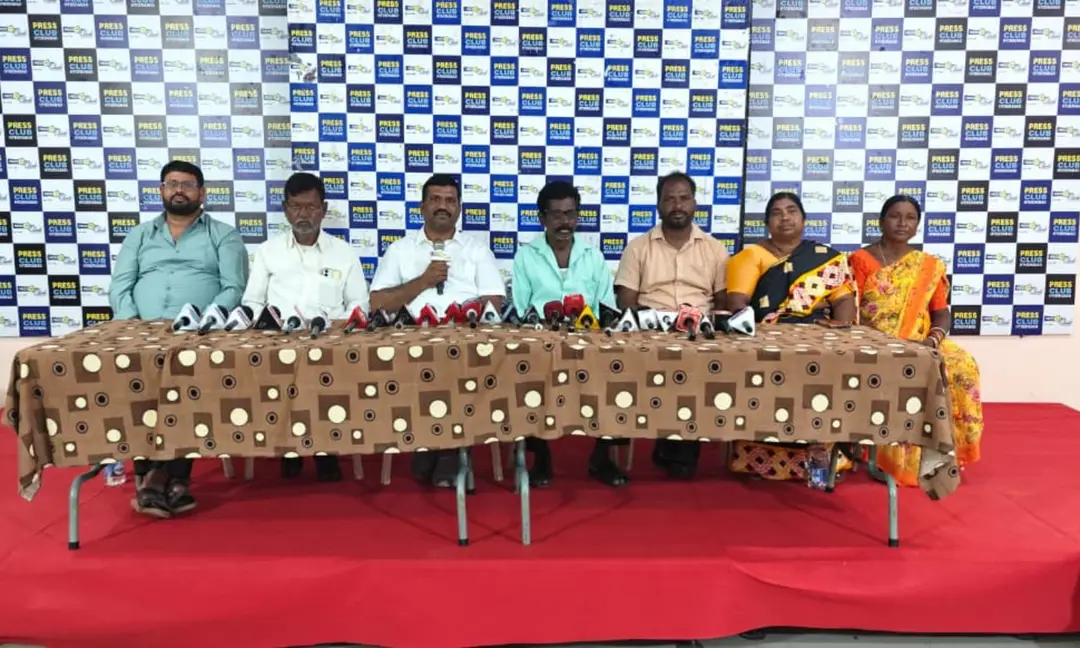
Rangareddy farmer family seeks rights over 18 acres of land
A farmer family from Kongara Kurdu (A) village in Maheshwaram mandal of Rangareddy district held a press conference at Somajiguda Press Club. Farmers Sriramulu, Rajakumar, Pramila and Sushila said 18 acres in survey numbers 384 to 386 and 388 to 394 came to their great-grandfather Ramayya through inam and that the family has farmed it for five generations. They said a court ruled in their favour after a 2007 dispute over the land being claimed as Waqf property, and sought action against those attempting to grab land.
Source
Rangareddy — వార్తలు · read the original report ↗
Desk check · some claims need care
What the desk checked (5)
- 18 acres in survey numbers 384-386 and 388-394 of Kongara Kurdu (A) village came to great-grandfather Ramayya through inam — Attributed to the farmers at the press conference; no document or official record cited in the source
- The family has cultivated the land for five generations — Family's own statement; no independent corroboration in the source
- A dispute arose in 2007 over the land being claimed as Waqf property and a court ruled in the family's favour after a detailed inquiry — Attributed to the speakers; court name, case number and date of judgment not given
- Newspaper reports showed others claiming ownership of the land — Mentioned by the family; the reports and rival claimants are not identified in the source
- Farmers Sriramulu, Rajakumar, Pramila and Sushila spoke at Somajiguda Press Club — Named in the source; event details appear internally consistent
Analysts’ view opinion
At first glance this is a family land dispute, but politically the ingredients are notable: high-value land on Hyderabad's fringe, a waqf claim in the background, and a press conference at Somajiguda Press Club. A family that says it already holds a favourable court ruling choosing the media route suggests it believes public opinion and administrative pressure matter as much as paperwork. In peri-urban mandals like Maheshwaram, land-title grievances are perennial currency for local politicians, so the speed of any government response will itself be a political signal.
- Opting for the Press Club rather than only the courts indicates the goal is administrative and political pressure, not fresh litigation.
- Any dispute touching waqf land carries the risk of becoming a polarising issue in Telangana, with different parties able to frame it in opposing ways.
- Rising land values on Hyderabad's periphery make legacy inam-title cases recurrent, pointing to a broader policy problem rather than a one-off grievance.
- The demand for "strict action against land grabbers" effectively asks the government to take sides, which can be a politically awkward choice.
- No party or leader is named in the story, so the matter is still pre-political — how long that lasts is the open question.
What to watch — Watch for an official response from the local MLA, the revenue administration or the waqf authorities, and whether any party publicly adopts the family's cause.
The story reflects only the family's account; the contents of the court ruling, the rival claimants' case and any political involvement are not established.
Deep dive
Research brief · 8 facts · 4 dates · exam-readyThe brief
Context
A farmer family from Kongara Kurdu (A) village in Maheshwaram mandal of Rangareddy district, Telangana, went public at the Somajiguda Press Club in Hyderabad to assert ownership over 18 acres of farmland they say has been in their family for five generations. The land, in survey numbers 384-386 and 388-394, is claimed to have come to their great-grandfather Ramayya through an inam grant. In 2007 the land was claimed as Waqf property, triggering a dispute; the family says the court, after a detailed inquiry, ruled in their favour. They now say fresh newspaper reports of others claiming the land have shocked them, and want the government to act against those attempting land grabbing.
Key facts
- The disputed land measures 18 acres in Kongara Kurdu (A) village, Maheshwaram mandal, Rangareddy district.
- The land falls in survey numbers 384 to 386 and 388 to 394 within the village limits.
- The family says the land came to their great-grandfather Ramayya through inam.
- The family says it has cultivated the land for five generations since the inam grant.
- In 2007 a dispute erupted with the land being claimed as Waqf land.
- The family approached the court, which after a comprehensive inquiry ruled in their favour, they said.
- The press conference was held at Somajiguda Press Club; farmers Sriramulu, Rajakumar, Pramila and Sushila spoke.
- Prabhakar, Bhushan Narasimha, Pavan and others participated in the programme.
Timeline
- Generations ago (date not stated in the source)The 18 acres came to great-grandfather Ramayya through inam; family begins cultivating it.
- 2007Dispute erupts with the land being claimed as Waqf property; family moves court, which rules in their favour after a full inquiry.
- Recently (date not stated in the source)Newspaper reports appear of others claiming the land; family says it was shocked.
- Day of the press conference (date not stated in the source)Family holds press conference at Somajiguda Press Club seeking action against land grab attempts.
Who has a stake
- The farmer family (Sriramulu, Rajakumar, Pramila, Sushila) — Claim full ownership rights over 18 acres cultivated for five generations; fear losing land they must repeatedly prove is theirs.
- Waqf claimants / those claiming the land — The land was claimed as Waqf property in the 2007 dispute; identity of current claimants not stated in the source.
- State government and Rangareddy district administration — Asked to take stringent action against those attempting to grab others' land.
- Judiciary — Has already conducted an inquiry and ruled in the family's favour, per the family; its order's finality is at issue.
- Media / Somajiguda Press Club — Newspaper reports on rival claims triggered the family's public response; venue for the grievance.
- Supporters present (Prabhakar, Bhushan Narasimha, Pavan and others) — Backed the family's demand at the press conference.
Why it matters
Disputes between private cultivators of old inam land and Waqf property claims are a recurring source of title insecurity in peri-urban Telangana, where land near Hyderabad has high value. The family's complaint that it must prove ownership again despite a favourable court ruling highlights weaknesses in land records and in the finality of settled titles.
UPSC angle
Prelims pointers
- Kongara Kurdu (A) village lies in Maheshwaram mandal of Rangareddy district, Telangana.
- Inam: a pre-independence grant of land or revenue rights, later abolished by inam abolition laws; the family traces title to an inam grant.
- Waqf: property permanently dedicated for religious or charitable purposes under Muslim law, administered by Waqf Boards.
- The contested 18 acres fall in survey numbers 384-386 and 388-394.
- The Waqf claim dispute over this land arose in 2007.
- Somajiguda Press Club, Hyderabad, was the venue of the farmers' press conference.
Mains framing
The case illustrates how unsettled land titles in India's peri-urban belts generate repeated litigation even after judicial determination. Here a family claims descent-based possession over 18 acres traced to an inam grant to their great-grandfather Ramayya and five generations of cultivation, while the land was claimed as Waqf property in a 2007 dispute that, the family says, the court decided in their favour. The causes are structural: presumptive rather than conclusive land titles, overlapping revenue and Waqf records, incomplete survey and settlement of old inam tenures, and the high market value of land near Hyderabad that incentivises encroachment. The implications are heavy transaction and litigation costs for smallholders, erosion of trust in records, and social friction where community-linked property claims intersect with cultivator possession. The way forward, as the family itself demands, lies in prompt administrative action against attempts at illegal land grabbing, alongside accurate reconciliation and digitisation of survey, inam and Waqf records, transparent notification of claims with a hearing for possessors, and mechanisms to give effect to court findings so that settled titles are not reopened. Nothing beyond these elements is stated in the source.
Key terms
- Inam
- A grant of land or its revenue made by earlier rulers; the family says the 18 acres devolved to their great-grandfather through inam.
- Waqf
- Property dedicated in perpetuity for religious or charitable purposes under Muslim law; the land was claimed as Waqf in 2007.
- Survey number
- The revenue record identifier for a land parcel; here survey numbers 384-386 and 388-394 of the village.
- Mandal
- Sub-district administrative unit in Telangana; the village falls in Maheshwaram mandal.
- Land grabbing
- Illegal occupation or claiming of another's land; the family sought stringent government action against such attempts.
Practice questions
- Why do disputes between inam-derived private titles and Waqf property claims recur in peri-urban areas around Hyderabad, and how can land records reform reduce them?
- "A favourable court verdict does not always end a land dispute in India." Discuss with reference to the Kongara Kurdu case.
- Examine the administrative measures a district administration can take to protect cultivators in continuous possession from land grabbing attempts.
Grounded only in the source report — figures and dates are the source's, not inferred.