
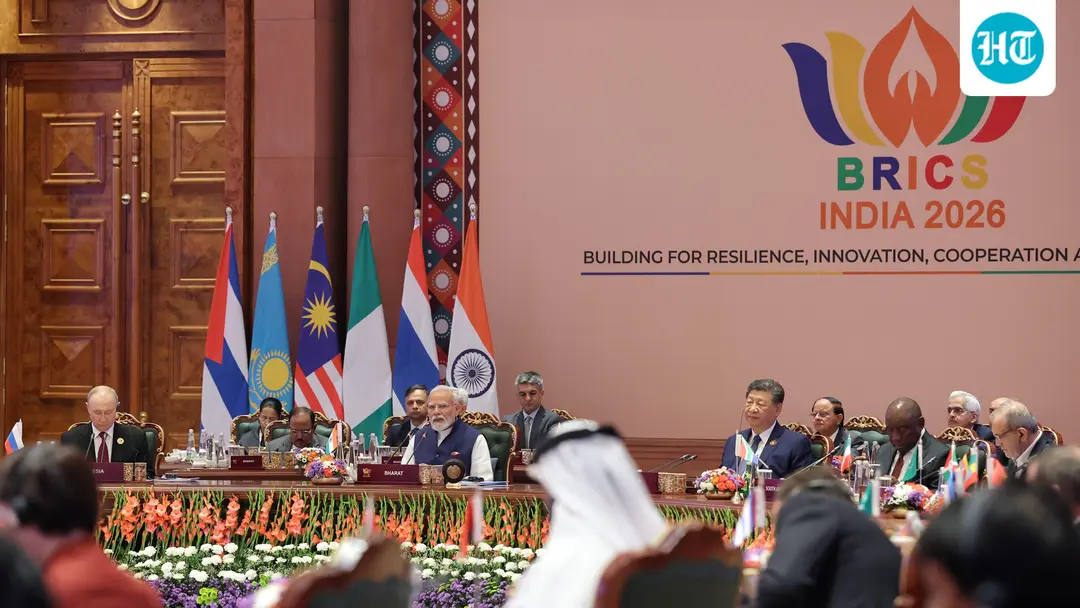
18th BRICS Summit in Delhi ends India's fourth chairship
The 18th BRICS Summit, held in New Delhi on 12–13 September, concluded India's fourth chairship after 2012, 2016 and 2021. The New Delhi Declaration welcomed more than 400 meetings across 30 Indian cities. The BRICS Bharat Innovates Exposition at Bharat Mandapam showcased 37 deep-tech startups. Members discussed health initiatives, tax cooperation, local-currency trade settlement, quantum technologies and artificial intelligence. China takes over the chairship for 2027 and will host the 19th Summit.
Source
BRICS / G20 / SCO / Quad · read the original report ↗
Desk check · some claims need care
What the desk checked (5)
- The 18th BRICS Summit was held in New Delhi on 12-13 September, ending India's fourth chairship after 2012, 2016 and 2021. — Stated in the source article; no external document cited beyond the New Delhi Declaration.
- The Declaration welcomed more than 400 meetings and engagements across 30 Indian cities. — Figure appears in source, attributed to the New Delhi Declaration.
- The BRICS Bharat Innovates Exposition at Bharat Mandapam on 11-12 September showcased 37 Indian deep-tech startups, drawn from 120 ventures presented in Nice, France, in June 2026. — Figures appear in source; the June 2026 date implies a future/forward-dated timeline an editor should check.
- China takes over the BRICS chairship for 2027 and will host the 19th Summit. — Stated in source without separate attribution.
- NIMHANS is to coordinate a BRICS mental health Training Hub Network and Network of Centres of Excellence. — Attributed to the New Delhi Declaration in the source.
Analysts’ view opinion
India's BRICS chairship functioned as a political stage as much as a diplomatic one: taking 400-plus meetings into 30 cities moves foreign policy out of Delhi's conference rooms and makes it visible to voters and state governments. The government's strongest claim is process rather than product — that a larger, more diverse BRICS was brought to consensus on the New Delhi Declaration at all. Yet the Declaration's repeated hedging on local-currency settlement and a new investment platform, framed as phased and consensus-driven, is politically cautious by design. With China taking the 2027 chair, the real test is how much of this agenda survives the handover.
- Turning a multilateral chairship into a nationwide programme lets the government convert a foreign-policy year into a domestic political asset.
- The 37-startup deep-tech exposition and the quantum and AI language align neatly with the 'India as technology power' narrative, though its value stays symbolic until deals follow.
- The insistence on consensus and national circumstances gives New Delhi cover against the charge that BRICS is building an anti-dollar bloc.
- Restating demands for UN reform and greater developing-country representation is how India defends its leadership claim inside an enlarged grouping.
- A Chinese chairship next year means agenda priorities could shift, so India's initiatives will need sustained technical follow-through to stay alive.
What to watch — Watch how many India-pushed items — the incubator network, a startup innovation fund, a grain exchange, the GIFT City risk lab — are still moving by the 19th Summit.
The story establishes no measurable economic outcomes, signed deals or domestic electoral effect, and it rests on a promotional-initiative piece authored by a union minister rather than independent reporting.
Deep dive
Research brief · 8 facts · 6 dates · exam-readyThe brief
Context
BRICS, marking two decades of cooperation and now with an enlarged membership and wider geographical reach, held its 18th Summit in New Delhi on 12–13 September, closing India's 2026 chairship — its fourth after 2012, 2016 and 2021. The chairship's theme was resilience, innovation, cooperation and sustainability, with Prime Minister Narendra Modi describing it as guided by a "people-centric and humanity-first approach". The New Delhi Declaration reaffirmed sovereign equality, mutual respect and consensus, and called for a more representative and responsive multilateral system. China takes over the chairship for 2027 and will host the 19th Summit. (Source: an article by Union Minister Sukanto Mazumadar, published as a promotional consumer connect initiative.)
Key facts
- The 18th BRICS Summit was held in New Delhi on 12–13 September, concluding on 13 September and ending India's 2026 chairship — its fourth after 2012, 2016 and 2021.
- The New Delhi Declaration welcomed more than 400 meetings and engagements across 30 Indian cities, involving ministers, parliamentarians, officials, experts and businesses.
- The BRICS Bharat Innovates Exposition at Bharat Mandapam on 11–12 September, alongside the BRICS Business Forum, showcased 37 Indian deep-tech startups and ventures.
- The 37 ventures were drawn from the 120 presented at the first Bharat Innovates exposition in Nice, France, in June 2026.
- The Declaration welcomed the BRICS Incubator Network, the BRICS Science and Research Repository, work on quantum technologies, and further consideration of a BRICS Startup Innovation Fund.
- India proposed a BRICS Risk Lab at GIFT City's International Financial Services Centre to build capacity in insurance and reinsurance.
- Health outcomes included a BRICS Mission for Healthy Lifestyle, a joint roadmap for 2026–2029, and a mental health Training Hub Network and Network of Centres of Excellence with NIMHANS as coordinating centre.
- The Declaration recognised India's hosting of the AI Impact Summit in February; the BRICS Women Ministerial Meeting was held in Kochi.
Timeline
- 2012, 2016, 2021India's earlier three BRICS chairships.
- June 2026First Bharat Innovates exposition held in Nice, France, presenting 120 ventures.
- FebruaryIndia hosts the AI Impact Summit, recognised in the New Delhi Declaration.
- 11–12 SeptemberBRICS Bharat Innovates Exposition at Bharat Mandapam, alongside the BRICS Business Forum, showcasing 37 deep-tech startups.
- 12–13 September18th BRICS Summit held in New Delhi; New Delhi Declaration adopted; Summit concludes 13 September.
- 2027China takes over the BRICS chairship and will host the 19th Summit.
Who has a stake
- Government of India / Prime Minister Narendra Modi — Hosted the summit and steered a larger, more diverse BRICS to consensus on the New Delhi Declaration under a people-centric, humanity-first framing.
- Ministry of Education and Ministry of External Affairs — Jointly organised the BRICS Bharat Innovates Exposition linking diplomacy to commercial and technology partnerships.
- Indian deep-tech startups — 37 ventures gained exposure to BRICS business leaders, investors and institutions, with market access and investment at stake.
- China — Assumes the 2027 chairship and hosts the 19th Summit; responsible for carrying forward India-initiated workstreams.
- NIMHANS — Designated coordinating centre for the BRICS mental health Training Hub Network and Network of Centres of Excellence.
- Global South / partner countries — Engaged through the Outreach/BRICS Plus Dialogue; seek UN reform and greater representation of developing countries in global decision-making.
- BRICS tax authorities and developing economies — Use the BRICS Tax Support Network and Tax Cross-Learning Lab for shared learning on international taxation and transfer pricing.
Why it matters
An expanded BRICS with diverse economic structures and priorities can only act where consensus is possible, so India's ability to secure the New Delhi Declaration is presented as a diplomatic achievement in itself. The chairship's spread — over 400 meetings in 30 cities plus business, youth, women's and academic forums — signals a shift from foreign-ministry diplomacy to broader societal engagement. The real test, the source argues, is how many initiatives on payments interoperability, local-currency settlement, health, grain security and deep tech survive the handover to China in 2027.
UPSC angle
Prelims pointers
- 18th BRICS Summit: New Delhi, 12–13 September; India's fourth chairship after 2012, 2016 and 2021; theme — resilience, innovation, cooperation, sustainability.
- BRICS Bharat Innovates Exposition: Bharat Mandapam, 11–12 September; 37 deep-tech startups selected from 120 shown at Nice, France, in June 2026.
- New initiatives in the New Delhi Declaration: BRICS Incubator Network, BRICS Science and Research Repository, proposed BRICS Startup Innovation Fund, possible BRICS Grain Exchange.
- Finance: Strategy for BRICS Economic Partnership 2030; New Investment Platform to advance in a phased, consensus-based, member-driven way; BRICS Risk Lab proposed at GIFT City IFSC.
- Health: BRICS Mission for Healthy Lifestyle with a 2026–2029 roadmap; NIMHANS as coordinating centre for mental health networks; Expert Working Group on Traditional, Complementary and Integrative Medicine.
- China assumes the BRICS chairship for 2027 and will host the 19th Summit; BRICS Women Ministerial Meeting was held in Kochi.
Mains framing
India's 2026 BRICS chairship, concluded at the 18th Summit in New Delhi on 12–13 September, illustrates how plurilateral groupings adapt after enlargement: with more members bringing different economic structures, regional experiences and regulatory systems, cooperation shifts from grand declarations to incremental, consensus-based and member-driven workstreams. The chairship's distinguishing feature was breadth of engagement — over 400 meetings across 30 Indian cities, and parliamentary, business, academic, youth, women's business, think-tank and civil society forums — reflecting the idea that researchers, entrepreneurs and young professionals build the more durable links between states. Substantively, outputs clustered around technology (BRICS Incubator Network, Science and Research Repository, quantum technologies, digital public infrastructure, submarine cables, safe and reliable AI), finance (Strategy for BRICS Economic Partnership 2030, payment and messaging interoperability, wider use of local currencies for trade settlement, a phased New Investment Platform, a proposed BRICS Risk Lab at GIFT City IFSC), tax cooperation, health and food security. The Declaration's repeated emphasis on consultation, consensus and national circumstances is best read as a design principle rather than weakness, alongside the call for more representative global governance including UN reform. The way forward lies in sustained technical follow-through so that initiatives in technology, connectivity, health, agriculture and youth cooperation remain active through China's 2027 chairship and the 19th Summit.
Key terms
- New Delhi Declaration
- Outcome document of the 18th BRICS Summit reaffirming sovereign equality, mutual respect and consensus, and calling for a more representative multilateral system.
- BRICS Bharat Innovates Exposition
- Showcase at Bharat Mandapam (11–12 September) of 37 Indian deep-tech startups to BRICS investors, organised by the Ministry of Education with the MEA.
- Strategy for BRICS Economic Partnership 2030
- Framework guiding future BRICS sectoral economic programmes, whose progress the Declaration commended.
- BRICS Risk Lab
- India's proposal at GIFT City's International Financial Services Centre to build capacity in insurance and reinsurance.
- BRICS Tax Support Network / Tax Cross-Learning Lab
- Knowledge-sharing platforms for BRICS tax authorities on international taxation, transfer pricing and revenue statistics.
- Outreach/BRICS Plus Dialogue
- India-hosted engagement with partner countries aimed at advancing the priorities of the Global South.
Practice questions
- Enlargement has made BRICS more representative but harder to steer. Examine this proposition with reference to the outcomes of the 18th BRICS Summit in New Delhi.
- Discuss how India's 2026 BRICS chairship sought to link diplomacy with technology and commerce, and assess the challenges in translating such platforms into concrete outcomes.
- The New Delhi Declaration repeatedly invokes consultation, consensus and national circumstances. Is this a strength or a constraint for BRICS financial cooperation, including local-currency trade settlement? Argue your case.
Grounded only in the source report — figures and dates are the source's, not inferred.