
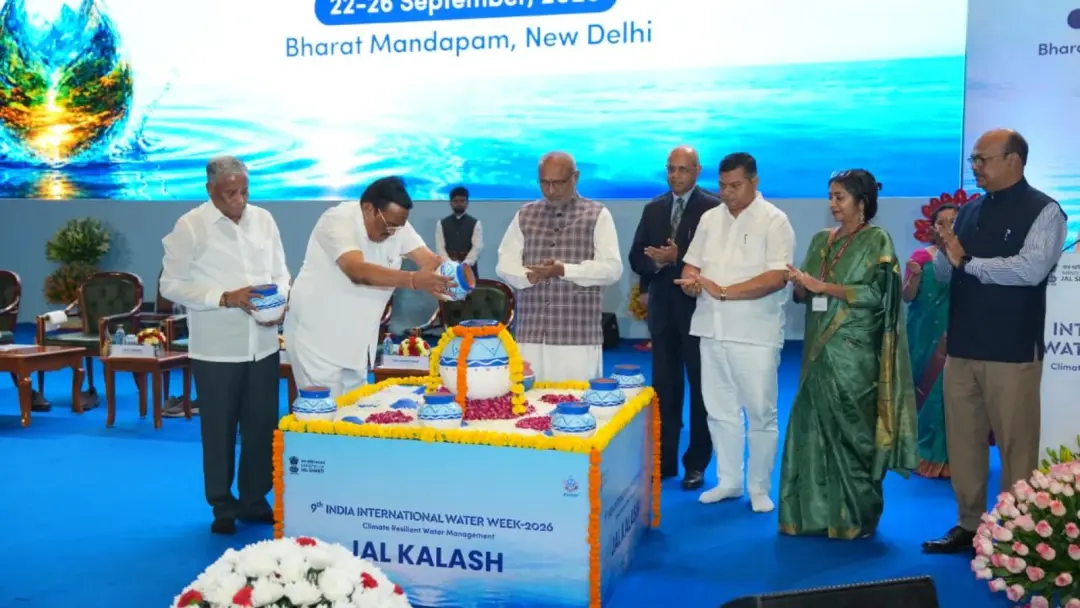
Water security is national security, says Vice President Radhakrishnan
Vice President C P Radhakrishnan, inaugurating the 9th India International Water Week 2026 in Delhi, said water security is intrinsically linked to national security and urged citizens to conserve water for future generations. He called for linking the Ganges with the Cauvery and said 10 inter-state water-sharing MoUs were signed under Prime Minister Narendra Modi, citing Ken-Betwa and Kishau as examples. Agriculture accounts for over 80 per cent of water use, he said. The five-day Jal Shakti Ministry event has 49 sessions.
Source
Indian Express — India · read the original report ↗
Desk check · compared with the source
What the desk checked (5)
- Vice President C P Radhakrishnan inaugurated the 9th India International Water Week 2026 in Delhi on Tuesday. — Attributed to the event as reported in the source; date given only as 'Tuesday'.
- 10 inter-state MoUs for water-sharing have been signed under PM Narendra Modi, including Ken-Betwa and Kishau projects. — Figure and examples stated by Radhakrishnan in his speech; appears in source as his claim, not independently verified.
- Agriculture accounts for more than 80 per cent of water use in India. — Figure appears in source, attributed to Radhakrishnan; no underlying data source cited.
- Radhakrishnan undertook a 19,000 km Rathyatra in Tamil Nadu more than two decades ago with a five-point programme. — Self-reported by the speaker; quoted directly in source.
- The five-day event organised by the Union Ministry of Jal Shakti will have 49 sessions. — Figure appears in source; attributed to event organisers/report, no document cited.
Analysts’ view opinion
Vice President Radhakrishnan turned a technical forum into politically resonant terrain: framing 'Jal Suraksha' as 'Rashtra Suraksha' shifts water from a governance file to emotive, national-security language. By recalling his 19,000-km Rathyatra in Tamil Nadu two decades ago and his conversations from Vajpayee to Modi, he positions himself within a continuous line of advocacy on river linking. Citing 10 inter-state MoUs under Modi, along with Ken-Betwa and Kishau, reinforces a narrative of the Centre as the resolver of long-running water disputes.
- A constitutional office-holder restating a long-held personal agenda — river interlinking — reads as a signal aimed particularly at southern, and specifically Tamil Nadu, audiences.
- Cauvery water is among the most sensitive issues in Tamil Nadu–Karnataka politics, so a Ganga–Cauvery reference is likely to draw both approval and objection there.
- Quantifying '10 MoUs signed' brands dispute resolution as an administrative achievement of the Union government, and the specific praise for Jal Shakti Minister Patil serves the same purpose.
- The note that agriculture accounts for over 80 per cent of water use hints at efficiency reforms that would be politically delicate with farmer constituencies.
- Tying water management to the 2047 developed-nation goal embeds the issue in the government's longer-term political narrative.
What to watch — Watch how parties in Tamil Nadu and Karnataka respond to the Ganga–Cauvery framing, and how far states converge during the 49 sessions of the five-day event.
The story records views expressed in a speech; it does not establish any government decision, funding or state consent for a Ganga–Cauvery link.
Deep dive
Research brief · 8 facts · 6 dates · exam-readyThe brief
Context
Vice President C P Radhakrishnan inaugurated the 9th India International Water Week (IIWW-2026) in Delhi, a five-day event organised by the Union Ministry of Jal Shakti on the theme 'Climate Resilient Water Management'. Speaking at the event, he argued that water security ('Jal Suraksha') is intrinsically tied to national security ('Rashtra Suraksha') and revived the idea of inter-basin river linking, including linking the Ganges with the Cauvery. Union Jal Shakti Minister C R Patil, also present, stressed that water does not respect administrative boundaries and must be managed holistically. The backdrop is India's twin problem of simultaneous floods and droughts, inter-state water disputes and rising climate risk.
Key facts
- Vice President C P Radhakrishnan inaugurated the 9th India International Water Week 2026 in Delhi on Tuesday.
- The five-day event is organised by the Union Ministry of Jal Shakti and will include 49 sessions across various themes in the water sector.
- The theme of the Water Week is 'Climate Resilient Water Management'.
- Radhakrishnan said 10 inter-state MoUs have been signed for water-sharing under Prime Minister Narendra Modi, citing Ken-Betwa and Kishau as 'shining examples'.
- He said agriculture accounts for more than 80 per cent of water use, while industrial demand is also increasing.
- He recalled undertaking a 19,000 km Rathyatra in Tamil Nadu more than two decades ago with a five-point programme, the most important point being river linking.
- He said efficient and sustainable water management will be critical as India moves towards becoming a developed economy by 2047.
- Patil referred to the recent incident in the Himalayan region and the 2023 disaster in Sikkim as reminders that climate change risks are changing.
Timeline
- More than two decades agoRadhakrishnan undertook a 19,000 km Rathyatra in Tamil Nadu with a five-point programme centred on river linking.
- During his term as MPHe discussed river-linking and water issues with then Prime Minister Atal Bihari Vajpayee.
- 2023Disaster in Sikkim, cited by Jal Shakti Minister C R Patil as evidence of shifting climate risks.
- Under PM Narendra Modi's tenure (as stated)10 inter-state MoUs signed for water-sharing, including Ken-Betwa and Kishau projects.
- Tuesday (date not stated in the source)9th India International Water Week 2026 inaugurated in Delhi; five-day event with 49 sessions begins.
- 2047Target year cited for India becoming a developed economy, requiring sustainable water management.
Who has a stake
- Union Ministry of Jal Shakti — Organiser of IIWW-2026; nodal ministry for water resources, river-linking projects and resolving inter-state water disputes.
- Vice President C P Radhakrishnan — Framed water security as national security and pushed the Ganges-Cauvery river-linking idea he has advocated for two decades.
- Union Jal Shakti Minister C R Patil — Called for holistic, boundary-blind water management; credited by the VP for resolving water-sharing disputes.
- State governments — Parties to inter-state water-sharing disputes and MoUs such as Ken-Betwa and Kishau; face floods in some regions and drought in others.
- Farmers and the agriculture sector — Account for more than 80 per cent of water use; central to any push for water-use efficiency, recycling and efficient irrigation.
- Citizens and local communities — Urged to conserve, store, manage and use water wisely; community participation named as part of the multi-stakeholder approach.
Why it matters
With agriculture consuming more than 80 per cent of India's water and industrial demand rising, the country faces floods and droughts simultaneously even as inter-state disputes slow solutions. The Vice President's framing — that Jal Suraksha leads to Jan Suraksha and Rashtra Suraksha — elevates water from a sectoral issue to a strategic one tied to the 2047 developed-economy goal. Recent Himalayan and Sikkim disasters underline that climate change is reshaping water risk faster than institutions are adapting.
UPSC angle
Prelims pointers
- 9th India International Water Week 2026 held in Delhi; organised by Union Ministry of Jal Shakti; theme 'Climate Resilient Water Management'; five days, 49 sessions.
- Ken-Betwa and Kishau were cited as examples among 10 inter-state water-sharing MoUs signed under PM Narendra Modi.
- Agriculture accounts for more than 80 per cent of water use in India, as stated by the Vice President.
- Union Jal Shakti Minister: C R Patil; Vice President: C P Radhakrishnan.
- Integrated water approach named: river-basin management, groundwater recharge, rainwater harvesting and efficient irrigation.
- Tamil poet Subramania Bharatiyar was quoted on sharing the waters of the Ganga and Cauvery.
Mains framing
India's water crisis is structural rather than merely seasonal: rising population and urbanisation, agriculture consuming over 80 per cent of available water, growing industrial demand, and a hydrology that delivers excess rainfall and prolonged dry spells in the same year and often the same country at the same time. Inter-state water-sharing disputes add an institutional bottleneck — as the Vice President noted, while disputes are litigated, some regions endure drought-like conditions and others flood. The government's response, as presented at IIWW-2026, combines cooperative federalism (10 inter-state MoUs, with Ken-Betwa and Kishau held up as models), inter-basin transfer proposals such as linking the Ganges with the Cauvery, and an integrated supply-and-demand approach bringing together river-basin management, groundwater recharge, rainwater harvesting and efficient irrigation, alongside greater water-use efficiency, recycling and reuse. The stated way forward is explicitly multi-stakeholder and multi-dimensional — technological innovation, sound policy, scientific knowledge, local experience and community participation — on the premise that no single institution, sector or state can solve water alone. Climate resilience is the binding constraint: the Himalayan and 2023 Sikkim disasters show risk profiles are shifting, making water security a precondition for the 2047 developed-economy goal.
Key terms
- Jal Suraksha / Rashtra Suraksha
- Water security and national security; the VP argued the two are intrinsically linked, with Jal Suraksha leading to Jan Suraksha (people's security).
- India International Water Week (IIWW)
- Periodic conference on the water sector organised by the Union Ministry of Jal Shakti; the 9th edition was held in Delhi in 2026.
- Ken-Betwa project
- Cited by the Vice President as a shining example of inter-state water-sharing cooperation under an MoU.
- Kishau project
- The other example named by the VP of inter-state cooperation on water-sharing through an MoU.
- River-basin management
- Managing water at the level of an entire river basin rather than administrative units, named as part of the integrated approach.
- Climate Resilient Water Management
- Theme of IIWW-2026: designing water systems to cope with both excessive rainfall and prolonged dry spells.
Practice questions
- "Water security is national security." Examine this proposition in the Indian context, with reference to inter-state water disputes and climate-linked disasters.
- Discuss the case for and against inter-basin river linking projects such as linking the Ganges with the Cauvery, given that agriculture accounts for over 80 per cent of India's water use.
- How can cooperative federalism instruments such as inter-state water-sharing MoUs complement legal mechanisms in resolving India's river water disputes?
Grounded only in the source report — figures and dates are the source's, not inferred.