
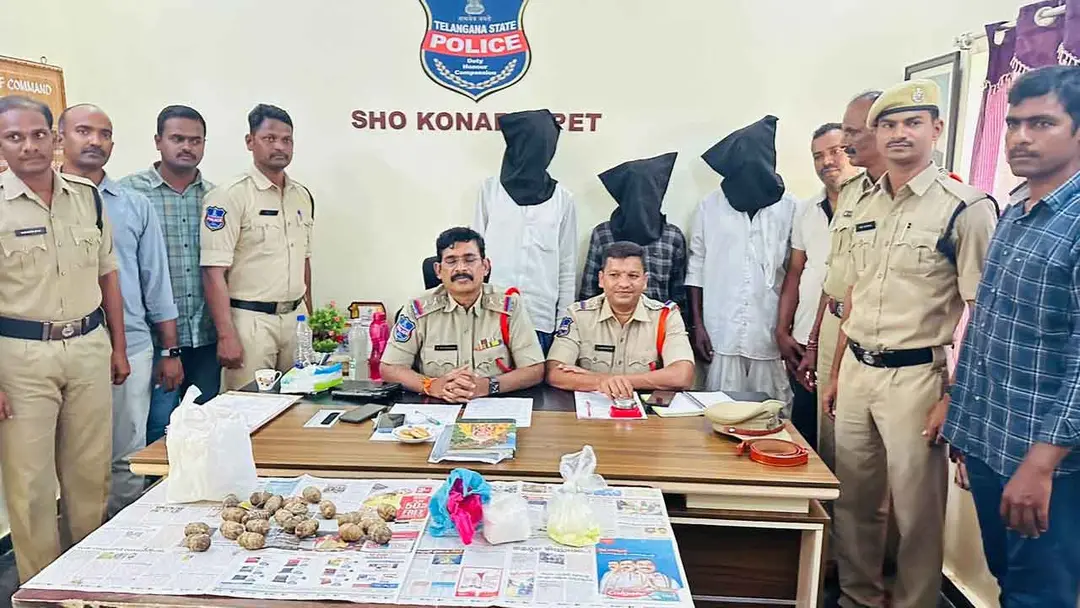
Country bomb maker, poaching gang arrested in Rajanna Sircilla
Police in Telangana's Rajanna Sircilla district arrested a man making country bombs and a gang poaching wild animals. Chandurthi CI Venkateswarlu said a buffalo owned by Dharmaram farmer Mudike Mallesham died after biting a country bomb, and a case was booked on his complaint. Seizures included 7 bombs, gun powder and Rs 2,000 from Pittala Rajalingam, 10 bombs each from Padige Lasmayya and Tummala Kanukaraju, and 40 bombs from Mogili Anjayya. Cases were filed under BNS, Explosives and Wildlife Acts.
Source
Rajanna Sircilla — నేరాలు · read the original report ↗
Desk check · compared with the source
What the desk checked (5)
- Police arrested a man making country bombs along with a gang poaching wild animals in Rajanna Sircilla district. — Attributed to Chandurthi CI Venkateswarlu at Konaraopet police station.
- A buffalo belonging to farmer Mudike Mallesham of Dharmaram died after biting a country bomb. — Stated in source as the complaint that triggered the case; no independent confirmation available.
- Seizures: 7 bombs plus gun powder and Rs 2,000 from Pittala Rajalingam, 10 bombs each from Padige Lasmayya and Tummala Kanukaraju, and 40 bombs from Mogili Anjayya. — Figures appear in the source as police seizure details.
- Cases were registered under BNS, the Explosives Act and the Wildlife Act, and three accused were remanded. — Attributed to police; the source says Anjayya was caught by Sircilla police with a case registered, without stating remand.
- The case was solved within 24 hours. — Police claim as reported in the source; no supporting timeline given.
Analysts’ view opinion
What began as a complaint over the death of a farmer's buffalo has widened into a case against an alleged chain of manufacture and sale of country-made bombs. By registering offences simultaneously under the BNS, the Explosives laws and the wildlife law, police have placed the accused in three distinct legal zones: unlicensed manufacture of explosives, endangering public safety, and prohibited hunting. The claim that arrests and remand followed within 24 hours points to a fast-moving investigation — but at this stage these remain allegations, not findings of guilt.
- Under explosives law, unlicensed manufacture, possession and sale are generally offences in themselves even without resulting injury, and the quantity recovered typically bears directly on the gravity of the charge and the sentencing range.
- A wildlife offence usually turns on which schedule the hunted animal falls under, and the story does not identify the species said to have been killed.
- If the chain from maker to buyers is established, charges could widen under common-intention or conspiracy principles, though the burden of proving each accused's individual role stays with the prosecution.
- Because the animal killed here was livestock, the immediate liability sits closer to negligence and loss of property — the deeper public-safety point is that the same baited device could as easily have killed a person.
- Remand is only custody during investigation; the right to seek bail, to legal representation, and the statutory time limit for filing a charge sheet all continue to apply.
What to watch — Watch whether a charge sheet is filed within the statutory period, whether forensic examination confirms the seized material as explosive, and whether the forest department initiates a separate proceeding.
This reading rests on an initial police briefing; the accused's version, the strength of evidence that will survive in court, and the precise sections invoked are not set out in the story.
Deep dive
Research brief · 8 facts · 6 dates · exam-readyThe brief
Context
Police in Telangana's Rajanna Sircilla district have cracked a case involving the manufacture, sale and use of "country bombs" (natu bombs) as bait to kill wild animals for meat. The trail began when a buffalo belonging to a Dharmaram farmer bit into a bomb-laced bait and was killed. Chandurthi Circle Inspector Venkateswarlu disclosed the details at the Konaraopet police station, saying the case was solved within 24 hours, with the accused arrested and remanded. Cases were registered under the Bharatiya Nyaya Sanhita, the Explosives Act and the Wildlife (Protection) Act.
Key facts
- A buffalo owned by Mudike Mallesham, a farmer of Dharmaram village in Konaraopet mandal, died when a country bomb it bit exploded.
- Police solved the case in under 24 hours, arrested the accused and sent them to remand, as disclosed by Chandurthi CI Venkateswarlu at Konaraopet police station.
- Pittala Rajalingam of Dharmaram had been making and selling country bombs for several years; 7 bombs, gun powder used in making them and Rs 2,000 were seized from him.
- Padige Lasmayya and Tummala Kanukaraju, both of Chinna Bonala in Sircilla Rural mandal, had 10 country bombs each seized from them.
- Sircilla police caught Mogili Anjayya of Sardapur and seized 40 country bombs from him.
- The gang wrapped country bombs in sheep intestines and placed them as bait in forest areas; animals biting them died on the spot and the meat was sold quietly for money.
- Mogili Anjayya had recently placed a country bomb inside groundnut flour (pallipindi) as bait on the outskirts of Dharmaram — the bait that killed Mallesham's buffalo.
- Cases were registered against the three accused under BNS, the Explosives Act and the Wildlife (Protection) Act; the report is dated September 22, 2024.
Timeline
- Over the past few yearsPittala Rajalingam of Dharmaram manufactures and sells country bombs.
- RecentlyPadige Lasmayya, Tummala Kanukaraju and Mogili Anjayya buy country bombs from Rajalingam and set them as bait in forest areas.
- RecentlyMogili Anjayya places a country bomb in groundnut flour as bait on the outskirts of Dharmaram.
- SubsequentlyFarmer Mudike Mallesham's buffalo bites the bomb, which explodes, killing the animal; he lodges a complaint and police register a case.
- Within 24 hoursPolice crack the case, seize bombs and gun powder, arrest the accused and send them to remand.
- September 22, 2024Chandurthi CI Venkateswarlu reveals the case details at Konaraopet police station.
Who has a stake
- Rajanna Sircilla district police (Konaraopet, Chandurthi, Sircilla) — Investigated and cracked the case within 24 hours; responsible for curbing illegal explosives and poaching networks.
- Mudike Mallesham, farmer of Dharmaram — Lost his buffalo to a country bomb bait; his complaint triggered the case.
- Accused: Pittala Rajalingam, Padige Lasmayya, Tummala Kanukaraju, Mogili Anjayya — Face charges under BNS, Explosives Act and Wildlife Act; three arrested and remanded.
- Wild animals and forest areas of the district — Targeted by bomb-laced baits that kill animals on the spot for illegal meat sale.
- Rural residents and livestock owners — Cattle and people face risk of injury or death from explosives hidden as bait in and around villages.
- Consumers of illegally sold meat — Bought meat from animals killed by explosives, sold clandestinely outside any regulation.
Why it matters
Country bombs planted as bait kill indiscriminately — in this case a farmer's buffalo, but equally wild animals, stray cattle or people who stumble on them. The case shows how a local explosives-making cottage industry can feed an organised poaching and illegal meat trade, and why enforcement combines explosives law with wildlife protection law.
UPSC angle
Prelims pointers
- Rajanna Sircilla is a district of Telangana; Konaraopet and Sircilla Rural are mandals named in the case.
- Cases were booked under the Bharatiya Nyaya Sanhita (BNS), the Explosives Act and the Wildlife (Protection) Act.
- Seizures: 7 bombs plus gun powder and Rs 2,000 from Pittala Rajalingam; 10 bombs each from Padige Lasmayya and Tummala Kanukaraju; 40 bombs from Mogili Anjayya.
- Modus operandi: country bombs wrapped in sheep intestines or placed in groundnut flour as bait for animals.
- Chandurthi Circle Inspector Venkateswarlu briefed the media at Konaraopet police station on September 22, 2024.
- The case originated from the death of a buffalo belonging to Dharmaram farmer Mudike Mallesham.
Mains framing
The Rajanna Sircilla case illustrates how small-scale illegal explosives manufacture in rural areas intersects with wildlife crime and the clandestine bushmeat trade. A single local maker supplied country bombs over several years to buyers who concealed them in sheep intestines or groundnut flour as bait in forest fringes; animals that bit the bait died instantly and the meat was sold quietly for profit. The harm is indiscriminate — the case surfaced only because a farmer's buffalo, not a wild animal, was killed, suggesting under-detection of such deaths. Causes include easy availability of gun powder and bomb-making know-how, demand for cheap illegal meat, and weak surveillance of forest peripheries. Implications span animal welfare and biodiversity loss, public safety risks to villagers and livestock, food-safety concerns from unregulated meat, and the strain of multi-statute prosecution under BNS, the Explosives Act and the Wildlife (Protection) Act. The way forward, as the source indicates, rests on prompt complaint-based investigation and arrest — here within 24 hours — combined with seizure of stockpiles; beyond that, the source does not state specific policy measures.
Key terms
- Country bomb (natu bomb)
- Crude, locally made explosive device; here made with gun powder and used as bait to kill animals.
- Bharatiya Nyaya Sanhita (BNS)
- India's criminal code under which the accused were booked, alongside special laws in this case.
- Explosives Act
- Law invoked against the manufacture, possession and sale of the country bombs seized in the case.
- Wildlife (Protection) Act
- Law invoked because the gang used the bombs to hunt wild animals and sell their meat.
- Circle Inspector (CI)
- Police officer in charge of a circle; CI Venkateswarlu of Chandurthi disclosed the case details.
- Remand
- Judicial custody to which the arrested accused were sent after the case was registered.
Practice questions
- Bomb-laced baits used for poaching endanger both wildlife and rural communities. Examine the enforcement challenges in tackling such crimes under the Wildlife (Protection) Act and the Explosives Act.
- Discuss how illegal manufacture of country bombs in rural India links with organised wildlife crime, using the Rajanna Sircilla case as an example.
- What institutional coordination between police, forest departments and local communities would help detect animal deaths caused by explosive baits at an early stage?
Grounded only in the source report — figures and dates are the source's, not inferred.