
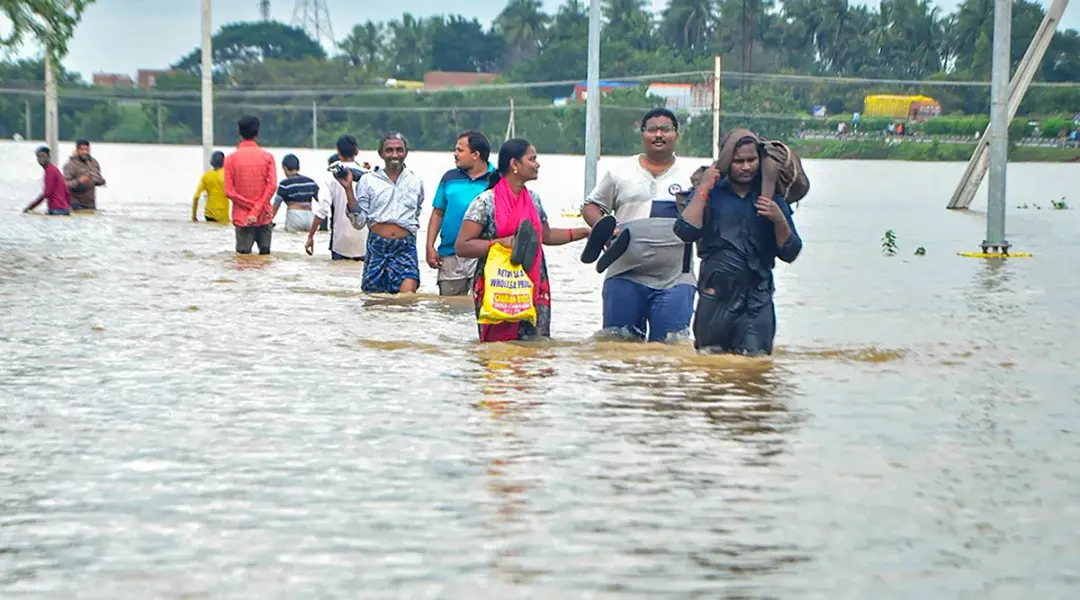
Penna floods cut rail, road links in Andhra Pradesh's Nellore
Main rail and road routes in Andhra Pradesh remained cut off on Sunday as the Penna river flowed in spate. National Highway-16 was closed in SPS Nellore district after a road breach at Padugupadu, where floodwater also overflowed the railway track. At least 17 Express trains were cancelled and three partially cancelled or diverted. The State Disaster Management Authority said over two lakh cusecs was released from Somasila reservoir. A bridge on the Papagni river collapsed at Kamalapuram in Kadapa district.
Source
Nellore — weather · read the original report ↗
Desk check · compared with the source
What the desk checked (5)
- NH-16 (Chennai-Kolkata) closed in SPS Nellore district after a road breach at Padugupadu, and also breached at Kovuru — Figure appears in source; breach at Kovuru attributed to officials/authority context, no named official quoted.
- At least 17 Express trains cancelled and three others partially cancelled or diverted on the Chennai-Vijayawada route — Numbers appear in source with no attribution to railway officials.
- More than two lakh cusecs of floodwater released from Somasila reservoir — Attributed in source to the State Disaster Management Authority.
- Bridge on Papagni river collapsed at Kamalapuram in Kadapa district, cutting Kadapa-Anantapuramu road link — Attributed to officials; cause linked to Veligallu reservoir outflow.
- Three-storied building collapsed in Kadapa city with no casualties; mother and child rescued — Stated in source without named source; internally consistent.
Analysts’ view opinion
The Penna floods are not just a disaster story — they are a direct test of Andhra Pradesh's governance capacity. A breached National Highway-16, 17 cancelled express trains and a collapsed bridge at Kamalapuram are failures citizens see and feel, which is precisely why they linger politically. Expect the coming days' argument between government and opposition to revolve around three things: the speed of flood management, how quickly relief reached people, and the quality of infrastructure.
- The official figure of more than two lakh cusecs released from Somasila opens political space for a debate over whether reservoir operations were timed well.
- Highway breaches at Padugupadu and Kovuru bring the State-Centre division of responsibility to the fore — which can turn cooperative or turn into mutual blame.
- The Papagni bridge collapse at Kamalapuram raises questions about construction quality and maintenance, the kind of issue that becomes a durable local political charge.
- Images of hundreds of passengers stranded at the Nellore RTC bus station and vehicles backed up for kilometres are the sort of visuals that harden public frustration and hand the opposition a talking point.
- On the other side, the policeman carrying an elderly man to safety in Rajampet and the rescue of a mother and child in Kadapa suggest an active field machinery, which offers the administration some cushion.
What to watch — Watch for state relief and compensation announcements, any central assessment of the damage, and how soon NH-16 reopens — the pace of restoration will largely decide the political fallout.
The story does not establish that reservoir management was mishandled or that negligence caused the bridge collapse, nor does it record any party leaders' reactions, compensation details or casualty figures.
Deep dive
Research brief · 8 facts · 2 dates · exam-readyThe brief
Context
Heavy rainfall and large reservoir releases have sent the Penna river into spate in Andhra Pradesh, severing the state's principal north-south and south-east rail and road corridors on Sunday. The Chennai-Kolkata National Highway-16 and the Chennai-Vijayawada grand trunk railway route both pass through SPS Nellore district, where floodwater breached the highway and overflowed the railway track at Padugupadu. Upstream releases from the Somasila reservoir on the Penna and from the Veligallu reservoir in Kadapa district magnified the damage, including a bridge collapse on the Papagni river.
Key facts
- The Chennai-Kolkata National Highway-16 was closed to traffic in SPS Nellore district after a heavy breach of road at Padugupadu.
- At least 17 Express trains were cancelled on the Chennai-Vijayawada grand trunk route as floodwater overflowed the railway track at Padugupadu; three others were partially cancelled or diverted.
- The State Disaster Management Authority said more than two lakh cusecs of floodwater flowed out of the Somasila reservoir in SPS Nellore district, causing the deluge.
- NH-16 was also breached at Kovuru, suspending traffic between Nellore and Vijayawada and stranding hundreds of vehicles for kilometres on both sides.
- Hundreds of passengers were stranded at the Nellore RTC bus station as bus services were disrupted.
- Vehicular traffic from Srikalahasti was stopped at the Tottembedu check post and diverted via Pamuru and Darsi.
- A bridge on the Papagni river collapsed at Kamalapuram in Kadapa district, cutting road links between Kadapa and Anantapuramu districts; floodwater from the Veligallu reservoir was blamed.
- A three-storied building collapsed in the early hours of Sunday in Kadapa city with no casualties; a mother and child trapped on the second floor were rescued by police and fire services.
Timeline
- Wee hours of SundayA three-storied building collapsed in Kadapa city; occupants ran out minutes earlier and a trapped mother and child were rescued.
- SundayPenna river in spate; NH-16 breached at Padugupadu and Kovuru, railway track overflowed, 17 Express trains cancelled, Papagni bridge at Kamalapuram collapsed.
Who has a stake
- Residents of SPS Nellore and Kadapa districts — Flooded homes, evacuation, building collapse risk and loss of road and rail access.
- Andhra Pradesh State Disaster Management Authority — Monitoring reservoir outflows and flood response; reported over two lakh cusecs released from Somasila.
- Indian Railways (Chennai-Vijayawada grand trunk route) — 17 Express trains cancelled and three partially cancelled or diverted due to track inundation at Padugupadu.
- Highway users and freight traffic on NH-16 — Hundreds of vehicles stranded for kilometres as the Chennai-Kolkata corridor was cut at Padugupadu and Kovuru.
- APSRTC and bus passengers — Hundreds stuck at Nellore RTC bus station; services disrupted and traffic diverted via Pamuru and Darsi.
- Police and fire services personnel — Carrying out evacuations, including at Rajampet in Kadapa district, and rescues from the collapsed building.
Why it matters
NH-16 and the Chennai-Vijayawada rail line are among India's busiest freight and passenger corridors, so a single breach at Padugupadu can paralyse movement between the south and the east. The episode shows how large, sudden reservoir releases interact with built infrastructure, bridges and highways to convert heavy rain into a connectivity and safety crisis.
UPSC angle
Prelims pointers
- Penna (Pennar) river flows through SPS Nellore district; Somasila reservoir on it released over two lakh cusecs.
- National Highway-16 is the Chennai-Kolkata highway; it was breached at Padugupadu and Kovuru in SPS Nellore district.
- Papagni river bridge collapsed at Kamalapuram, Kadapa district, cutting Kadapa-Anantapuramu road links.
- Veligallu reservoir releases were blamed for the Papagni bridge collapse.
- Padugupadu lies on the Chennai-Vijayawada grand trunk railway route.
- State Disaster Management Authority is the state-level body reporting flood and reservoir outflow data.
Mains framing
The Penna floods illustrate how extreme rainfall combined with high-volume reservoir releases can disable national-level transport lifelines. Over two lakh cusecs flowing out of Somasila breached NH-16 at Padugupadu and Kovuru and submerged the Chennai-Vijayawada grand trunk railway line, cancelling at least 17 Express trains and stranding hundreds of vehicles and bus passengers; in Kadapa district, releases from Veligallu brought down the Papagni river bridge at Kamalapuram, severing Kadapa-Anantapuramu links, while a building collapse in Kadapa city underlined the risk to older structures. The implications are threefold: economic disruption on a corridor linking south and east India, humanitarian stress requiring police and fire-service evacuations as seen at Rajampet, and questions about the flood-resilience of highway and bridge alignments in river floodplains. A way forward, consistent with what the source shows, lies in better coordination between reservoir operation and downstream warning by the State Disaster Management Authority, pre-planned traffic diversions of the kind used at Tottembedu check post, and flood-proofing of critical highway and rail stretches rather than post-event repair.
Key terms
- Cusec
- A unit of water flow (cubic feet per second) used to measure reservoir outflow; over two lakh cusecs was released from Somasila.
- Somasila reservoir
- Reservoir in SPS Nellore district on the Penna whose large outflow triggered the downstream deluge.
- Veligallu reservoir
- Reservoir in Kadapa district whose gushing floodwater caused the Papagni river bridge collapse at Kamalapuram.
- National Highway-16
- The Chennai-Kolkata national highway, breached at Padugupadu and Kovuru, suspending Nellore-Vijayawada traffic.
- State Disaster Management Authority
- State-level disaster body that reported the Somasila outflow figure and coordinates flood response.
- Grand trunk railway route
- The Chennai-Vijayawada trunk rail corridor where floodwater over the track at Padugupadu forced mass train cancellations.
Practice questions
- Discuss how reservoir operation decisions during extreme rainfall events can amplify downstream flood damage, with reference to the Penna floods in Andhra Pradesh.
- Critical transport corridors such as NH-16 and the Chennai-Vijayawada rail route are vulnerable to single-point flood breaches. Suggest measures to build flood resilience into such infrastructure.
- Examine the role of state disaster management authorities and local police and fire services in flood evacuation and traffic management, drawing on the 2025 Penna flood response.
Grounded only in the source report — figures and dates are the source's, not inferred.