
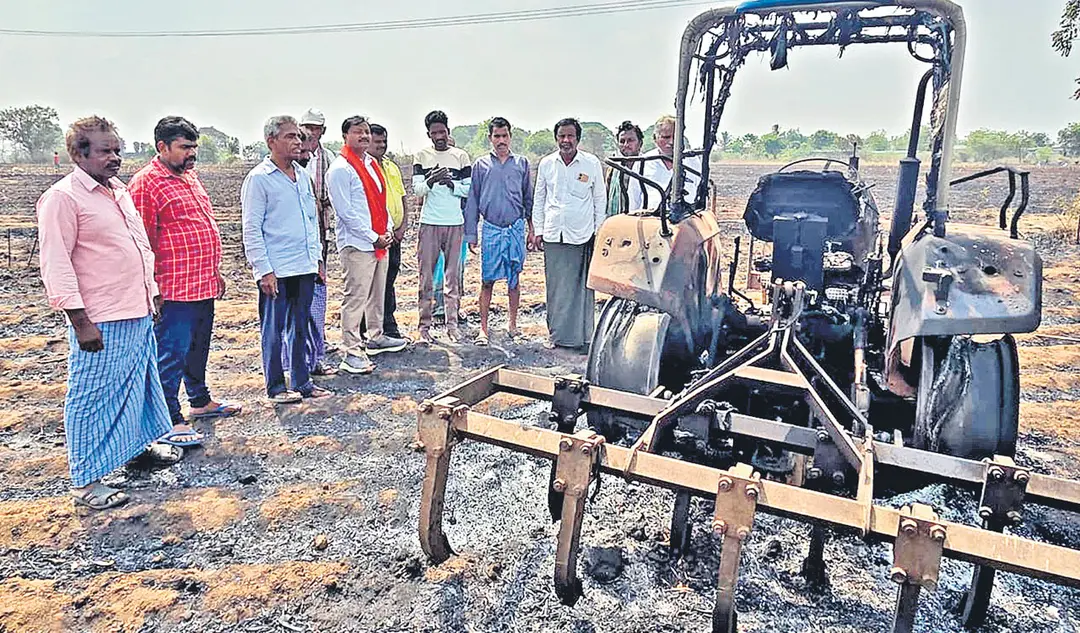
Crop residue burning triggers fires, farmers hit in Khammam
Burning of crop residue by some farmers in Chintakani mandal of Khammam district led to fires on Friday that destroyed crops at Narasimhapuram, Baswapuram, Lachagudem, Chintakani, Seethamapet and Timminenipalem villages. A tractor belonging to farmer D Venkateshwarlu was burnt at Chintakani, while a maize field at Matur in Madhira mandal was gutted after 11KV power lines snapped. CPI(M) leader Madupalli Gopal Rao said crops on about 50 acres were destroyed and sought Rs 50,000 per acre compensation. Agriculture officials inspected the fields.
Source
Khammam — agriculture · read the original report ↗
Desk check · compared with the source
What the desk checked (5)
- Crop residue burning led to fires destroying crops in six villages of Chintakani mandal on Friday. — Stated in source as reporting; no official agency named as source.
- Crops on approximately 50 acres were gutted. — Attributed to CPI(M) Madhira division secretary Madupalli Gopal Rao after a field visit; figure appears in source.
- A tractor belonging to farmer D Venkateshwarlu was burnt at Chintakani. — Named detail present in source; no official confirmation cited.
- A maize field was burnt at Matur in Madhira mandal after 11KV power lines snapped and fell on it. — Figure and location appear in source; no source given for cause.
- Gopal Rao demanded compensation of Rs 50,000 per acre and alleged negligence in procurement. — Clearly attributed to the named political leader; a claim, not verified fact.
Analysts’ view opinion
This is less a fire story than a case study in how expensive post-harvest loss is. Maize lying in threshing yards means the farmer has already sunk seed, fertiliser, labour and harvesting costs; when it burns at that stage the loss is the full value of the crop, not just the input bill. Roughly 50 acres of crops plus a burnt tractor means a season's income and a productive asset gone together — which also erodes the capacity to invest in the next season.
- The story points to a procurement bottleneck — produce sitting in yards, tokens not issued properly, and trucks failing to arrive even where tokens existed — which shifts holding risk onto the farmer.
- Burning residue looks cheap to the individual farmer but pushes the cost onto neighbouring fields and power infrastructure: a textbook negative externality.
- The snapped 11KV line that torched a maize field in Madhira shows the bill is not only private — utility repair costs and supply disruption are borne publicly.
- The demand for Rs 50,000 per acre is a political ask; how it was arrived at, and what official norms would actually pay, is not established in the story.
- Even where compensation comes, it is typically delayed and partial, leaving affected farmers dependent on credit in the interim and adding to rural debt stress.
What to watch — Watch the agriculture officials' damage assessment, the level of compensation the government settles on, and above all whether maize procurement tokens and transport pick up pace.
The story does not establish the total value of losses, the number of farmers affected, whether any insurance cover applies, any action over who set the fires, or the government's response on compensation — and the 50-acre figure is a political leader's estimate, not an official count.
Deep dive
Research brief · 8 facts · 3 dates · exam-readyThe brief
Context
In Chintakani mandal of Telangana's Khammam district, some farmers set fire to crop residue after harvest, and the flames spread to neighbouring fields on Friday, destroying harvested produce, standing crops and oil palm and eucalyptus plantations across six villages. A tractor was burnt at Chintakani, and in nearby Madhira mandal a maize field was destroyed when 11KV power distribution lines snapped and fell on it. CPI(M) leaders who visited on Saturday put the damage at about 50 acres and demanded compensation, while agriculture officials inspected the fields. The incident also exposed a procurement bottleneck, with harvested maize lying exposed in threshing yards.
Key facts
- Fires caused by burning of crop residue hit Narasimhapuram, Baswapuram, Lachagudem, Chintakani, Seethamapet and Timminenipalem villages of Chintakani mandal, Khammam district, on Friday.
- Crops on approximately 50 acres of land were gutted, as noted by CPI(M) leaders who visited the fields.
- Harvested produce, crops ready for harvest, and oil palm and eucalyptus plantations were destroyed in the fires.
- A tractor belonging to farmer D Venkateshwarlu was burnt at Chintakani.
- A maize field at Matur in Madhira mandal was reduced to ashes after 11KV power distribution lines snapped and fell onto the field.
- CPI(M) Madhira division secretary Madupalli Gopal Rao demanded compensation of Rs 50,000 per acre for affected farmers.
- Gopal Rao said the entire maize harvest was lying in threshing yards, procurement tokens were not being issued properly, and trucks failed to arrive even where tokens were issued.
- Agriculture officials visited several affected fields during the day to assess the damage.
Timeline
- Friday (as reported)Fire accidents triggered by crop residue burning destroy harvested produce, standing crops and plantations in six villages of Chintakani mandal; a tractor is burnt at Chintakani and a maize field at Matur is gutted after 11KV lines snap.
- Saturday (as reported)CPI(M) Madhira division secretary Madupalli Gopal Rao and other leaders visit affected fields, estimate 50 acres damaged and demand Rs 50,000 per acre compensation; agriculture officials also inspect fields.
- 2 May 2026, 09:33 PMReport updated.
Who has a stake
- Farmers of Chintakani and Madhira mandals — Lost harvested produce, standing crops, plantations and a tractor; awaiting compensation and timely procurement of maize.
- D Venkateshwarlu, farmer of Chintakani — His tractor was burnt in the fire accident.
- CPI(M) Madhira division (secretary Madupalli Gopal Rao) — Leading the demand for Rs 50,000 per acre compensation and highlighting procurement lapses.
- State government / procurement agencies — Accused of negligence in the purchasing process — improper issue of procurement tokens and non-arrival of trucks; faces compensation demand.
- Agriculture department officials — Responsible for assessing crop damage in the affected fields.
- Power utility (11KV distribution network) — Snapped distribution lines at Matur caused a maize field fire, raising questions on line maintenance.
Why it matters
Crop residue burning is usually debated as an air pollution problem, but this incident shows its immediate local cost — fires that wipe out neighbours' harvested grain, standing crops, plantations and farm machinery. The losses were magnified by a procurement failure: maize lay exposed in threshing yards because tokens were not properly issued and trucks did not arrive, leaving produce vulnerable to fire, unseasonal rain and winds.
UPSC angle
Prelims pointers
- Chintakani and Madhira are mandals in Khammam district, Telangana; affected villages include Narasimhapuram, Baswapuram, Lachagudem, Seethamapet, Timminenipalem and Matur.
- Crops affected: maize, oil palm and eucalyptus plantations, plus harvested produce in threshing yards.
- About 50 acres reported gutted; compensation of Rs 50,000 per acre demanded by CPI(M).
- A maize field at Matur burnt when 11KV power distribution lines snapped and fell on it.
- Procurement tokens are the mechanism through which farmers' produce is scheduled for purchase and transport.
- Agriculture department officials conduct field visits for crop damage assessment.
Mains framing
The Khammam fires illustrate how a single agronomic shortcut — burning crop residue to clear fields quickly — can cascade into collective loss when combined with weak post-harvest infrastructure. Residue burning persists because it is the cheapest and fastest way to prepare land, but in densely cultivated mandals the flames spread to harvested heaps, standing crops and long-gestation plantations such as oil palm and eucalyptus, destroying assets like tractors as well. The damage was compounded by procurement delays: as CPI(M)'s Madupalli Gopal Rao pointed out, the entire maize harvest was lying in threshing yards because tokens were not issued properly and trucks did not turn up, leaving produce exposed to fire, unseasonal rain and gusty winds. The way forward suggested by the episode is threefold — timely, transparent issue of procurement tokens with assured transport so grain does not sit in the open; awareness and enforcement against open residue burning alongside alternatives to residue disposal; and prompt damage assessment by agriculture officials with a clear compensation mechanism, the demand here being Rs 50,000 per acre. Maintenance of rural distribution lines also matters, since snapped 11KV lines themselves ignited a maize field at Matur.
Key terms
- Crop residue burning
- Setting fire to leftover stalks and straw after harvest to clear the field quickly for the next crop.
- Threshing yard
- Open space where harvested crop is threshed and stored temporarily, leaving produce exposed to rain, wind and fire.
- Procurement token
- Slip or booking issued to a farmer fixing when and where his produce will be purchased and lifted by the procurement agency.
- Mandal
- Administrative sub-district unit in Telangana; Chintakani and Madhira are mandals of Khammam district.
- 11KV distribution line
- Medium-voltage power line feeding rural areas; when it snaps and falls, it can ignite dry fields.
Practice questions
- Crop residue burning is discussed mainly as an air-quality issue, but it also imposes direct costs on neighbouring farmers. Discuss with reference to the Khammam incident and suggest remedies.
- How do delays in procurement — such as improper issue of tokens and lack of transport — increase post-harvest losses for farmers? Examine.
- Examine the role of district agriculture officials and local bodies in crop damage assessment and compensation following fire accidents in farmland.
Grounded only in the source report — figures and dates are the source's, not inferred.