
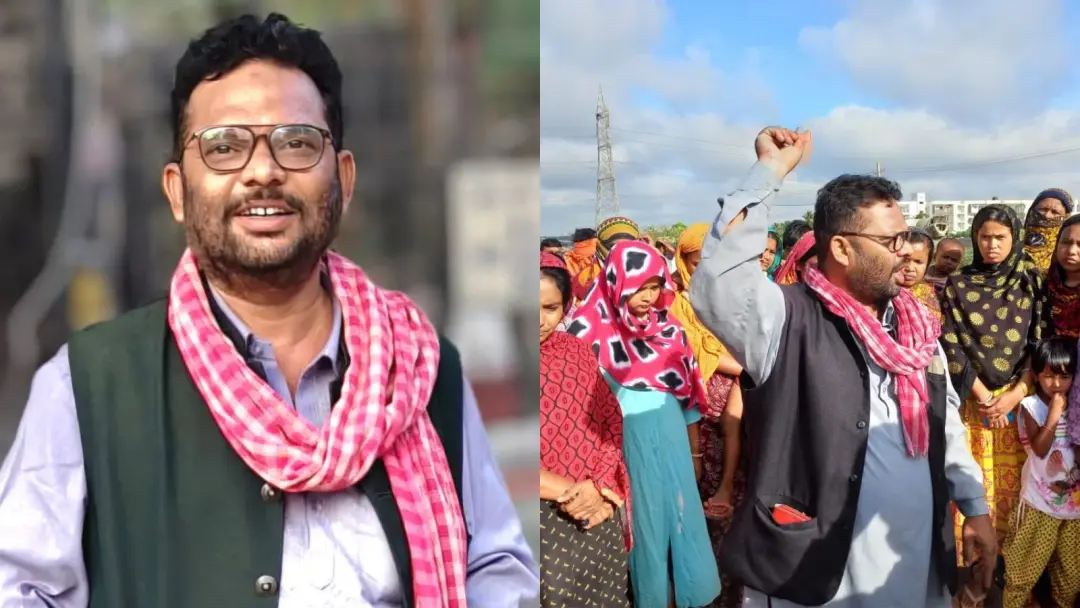
Bengaluru labour activist Kaleemullah honoured for migrant welfare work
R Kaleemullah, 51, national vice-president of the All India Shramik Swaraj Kendra, is among the first people Bengaluru's migrant workers call over unpaid wages, evictions and police cases. He left an Andhra Pradesh village in 1991 with a Class 10 certificate, cleaned refrigerators for Rs 5 a day, and later earned Rs 60 a day at a Shivajinagar garment shop. Over three decades he has aided workers and women's cases. He recently received The Khazi India Foundation – 2026 Lifetime Achievement Award.
Source
Indian Express — Cities · read the original report ↗
Desk check · compared with the source
What the desk checked (5)
- Kaleemullah, 51, is national vice-president of All India Shramik Swaraj Kendra. — Stated in source as fact; designation not independently attributed.
- He earned Rs 5 a day cleaning refrigerators and later Rs 60-100 a day at a Shivajinagar garment shop. — Figures appear in source, based on his own recollection.
- A temple priest in Devanahalli was arrested in 2020 for alleged sexual assault of a 10-year-old and has since been convicted. — Stated in source; no court or police record cited.
- He received the Lifetime Achievement Award (Society Support) from The Khazi India Foundation – 2026. — Attributed to the named foundation in the source.
- He has received several death threats and was called 'kafir' and 'gaddar' after a scholar's arrest. — Attributed to Kaleemullah's own account; unverifiable in text.
Analysts’ view opinion
This is one man's story, but its political message is plain: in Bengaluru, the gaps left by official machinery on migrant workers' problems — unpaid wages, arbitrary detentions, evictions — are being filled by union networks and volunteers. Figures like Kaleemullah function as trusted intermediaries between the political system and a large, unorganised workforce, which is precisely what gives them growing political weight. At the same time, the story shows how rights-based activists get squeezed between identity politics: his work is given a communal colour when he defends Muslim migrant workers, while a case involving an Islamic scholar drew criticism from within his own community.
- The account suggests informal personal networks are, in practice, more usable for unorganised migrant workers than formal grievance channels — a governance gap as much as a human-interest story.
- That workers from Assam, Manipur, Bengal and Tamil Nadu reach out to him indicates a constituency that is politically dispersed and largely unrepresented.
- His union office (national vice-president of All India Shramik Swaraj Kendra) gives him institutional standing, but the story records no affiliation with any political party.
- Intervening in two cases — one involving an Islamic scholar, one a temple priest — makes him a figure who does not fit neatly into any single communal narrative.
- Recognition such as The Khazi India Foundation award adds legitimacy, which in turn strengthens such intermediaries' bargaining position with officialdom.
What to watch — Watch whether any party or labour federation converts migrant wage disputes and arbitrary detentions in Bengaluru into an organised political demand, or whether it stays at the level of individual case-by-case help.
The story rests largely on one individual's recollections and does not establish any party backing, any official response, or any measurable electoral effect.
Deep dive
Research brief · 8 facts · 9 dates · exam-readyThe brief
Context
R Kaleemullah, 51, is a Bengaluru-based labour activist and national vice-president of the All India Shramik Swaraj Kendra, a trade union. Migrant workers in the city contact him over unpaid wages, sudden eviction notices, hospital emergencies and police complaints that go unheard, and he connects them to lawyers, trade unionists and volunteers. He himself arrived in Bengaluru in the early 1990s with only a Class 10 certificate and survived on daily wages of Rs 5 for cleaning refrigerators. He was recently given the Lifetime Achievement Award in the Society Support category by The Khazi India Foundation – 2026 for his work with migrant labourers, Adivasis, Dalits and demolition-affected families.
Key facts
- Kaleemullah, 51, is national vice-president of the labour union All India Shramik Swaraj Kendra and has worked in Bengaluru for more than three decades.
- He left his Andhra Pradesh village in 1991 with only a Class 10 certificate, after a headmaster demanded an unauthorised re-admission fee of Rs 500 following his recovery from severe jaundice around 1990.
- His father's refusal to pay a municipal tax of Rs 700 on a computer led to a legal battle lasting nearly 12 years, during which water and power connections were repeatedly cut.
- In Bengaluru he cleaned domestic refrigerators for Rs 5 a day; by the mid-1990s he earned Rs 60 a day at a Shivajinagar garment shop, later rising to Rs 100.
- At the age of 12 he questioned village elders over unaccounted religious event funds; a complaint was filed and he says he was taken to the police station and beaten.
- By 2002 he had volunteered at relief camps after the Gujarat violence and joined Dalit rights campaigns and anti-slum-demolition efforts in Karnataka.
- Through Vimochana, a Bengaluru women's rights organisation, he assists women in domestic violence, sexual assault and POCSO Act cases.
- In a 2020 Devanahalli case involving the alleged sexual assault of a 10-year-old girl, a temple priest was arrested, booked under POCSO and has since been convicted.
Timeline
- Age 12 (childhood)Questions village elders in Andhra Pradesh over religious event funds; a complaint is filed and he says he was beaten at the local police station.
- Around 1990Severe jaundice interrupts his schooling; a demand for an unauthorised Rs 500 re-admission fee ends his formal education.
- 1991Leaves his village; trains in AC and refrigerator repair in Hyderabad, then takes temporary wage jobs in Mumbai before moving to Bengaluru.
- Early 1990sCleans domestic refrigerators in Bengaluru for Rs 5 a day; struggles to afford food and bus fare.
- Mid-1990sGets steady work at a Shivajinagar garment shop at Rs 60 a day, later Rs 100; begins accompanying workers to police stations.
- 2002Volunteers at relief camps after the Gujarat violence; works with Dalit rights groups and anti-demolition activists.
- 2020Devanahalli case: temple priest arrested and booked under POCSO for alleged assault of a 10-year-old girl; later convicted.
- Covid-19 pandemicHis volunteer network expands across Karnataka, reaching migrant workers from Assam, Manipur, West Bengal, Mumbai and Tamil Nadu.
- RecentlyReceives the Lifetime Achievement Award (Society Support category) from The Khazi India Foundation – 2026.
Who has a stake
- Migrant workers in Bengaluru — Face unpaid wages, sudden evictions, arbitrary detentions and unaffordable medical emergencies; depend on informal networks like Kaleemullah's for redress.
- R Kaleemullah — Has faced death threats during wage disputes, anti-encroachment drives and community disputes, and continues work after major cardiac surgery.
- All India Shramik Swaraj Kendra — The labour union in which he serves as national vice-president, providing the institutional base for his interventions.
- Vimochana — Bengaluru-based women's rights organisation through which he assists women in domestic violence, sexual assault and POCSO cases.
- Bengali Muslim sanitation workers, ragpickers and construction workers — A large share of Bengaluru's informal workforce; their legal rights claims are often viewed through religious identity, he says.
- Children of migrant waste-pickers and construction workers — School dropouts identified by his volunteers and helped to learn so they can enrol in government schools.
- Police, hospitals and labour commission offices — Institutions where complaints, detentions and wage disputes are processed, and where he accompanies workers as an intermediary.
Why it matters
India's urban economies run on migrant labour that lives outside formal protections, where wage theft, arbitrary detention and eviction often go unchallenged for want of language, documents and legal knowledge. Kaleemullah's three decades show how informal intermediaries fill the gap between statutory rights and actual access, and how their work can be communalised. The award also flags the everyday risks borne by grassroots labour and women's rights defenders.
UPSC angle
Prelims pointers
- All India Shramik Swaraj Kendra is a labour union; R Kaleemullah, 51, is its national vice-president.
- The Khazi India Foundation – 2026 gave Kaleemullah the Lifetime Achievement Award in the Society Support category.
- Vimochana is a Bengaluru-based women's rights organisation working on domestic violence and sexual assault cases.
- POCSO Act: Protection of Children from Sexual Offences Act, used in the 2020 Devanahalli case that ended in conviction.
- Kaleemullah left Andhra Pradesh in 1991 with a Class 10 certificate; first Bengaluru wage was Rs 5 a day.
- Covid-19 pandemic: his network assisted migrants from Assam, Manipur, West Bengal, Mumbai and Tamil Nadu.
Mains framing
Interstate migrant workers form the backbone of urban services and construction in cities like Bengaluru, yet the source shows how thin their access to rights remains: employers withhold months of wages, eviction notices come without warning, beat constables pick up workers without explanation, and Dalit and minority workers cannot navigate complaints because they do not know the local language or the procedures. In this gap, individuals and unions act as informal intermediaries — accompanying workers to police stations, sitting in on legal consultations, tracking complaints through government offices and labour commission hearings — a function that is neither institutionalised nor protected, as seen in the death threats and community hostility Kaleemullah describes, including being called "kafir" and "gaddar" after a Hubballi case led to a scholar's arrest. His account also shows overlapping vulnerabilities: women's cases under POCSO and domestic violence law, children of waste-pickers dropping out of school, and the communal framing of rights claims by Bengali Muslim sanitation and construction workers. The way forward suggested by the story is institutional rather than heroic — accessible legal aid, grievance redress that workers can actually use, getting out-of-school children into government schools, and training the next generation of social work, sociology and journalism students in on-ground procedure so that help does not depend on one phone number.
Key terms
- All India Shramik Swaraj Kendra
- The labour union of which Kaleemullah is national vice-president; base for his migrant worker interventions in Bengaluru.
- POCSO Act
- Protection of Children from Sexual Offences Act, under which the Devanahalli temple priest was booked in 2020 and later convicted.
- Vimochana
- Bengaluru-based women's rights organisation through which he assists survivors of domestic violence and sexual assault.
- The Khazi India Foundation – 2026
- Body that awarded him the Lifetime Achievement Award in the Society Support category for work with migrants, Adivasis and Dalits.
- Labour commission hearings
- Forums for wage and labour disputes where he takes interns and accompanies workers.
- Anti-encroachment drives
- Demolition and clearance actions against settlements; one context in which he says he received death threats.
Practice questions
- Informal intermediaries often substitute for formal grievance redress for migrant workers in Indian cities. Examine the reasons for this gap and suggest institutional remedies.
- Discuss how language barriers, caste and religious identity shape access to legal remedies for interstate migrant workers, with reference to Bengaluru's informal workforce.
- Grassroots rights defenders working on labour and women's issues face threats from within the communities they serve. What protections and support systems can address this?
Grounded only in the source report — figures and dates are the source's, not inferred.