
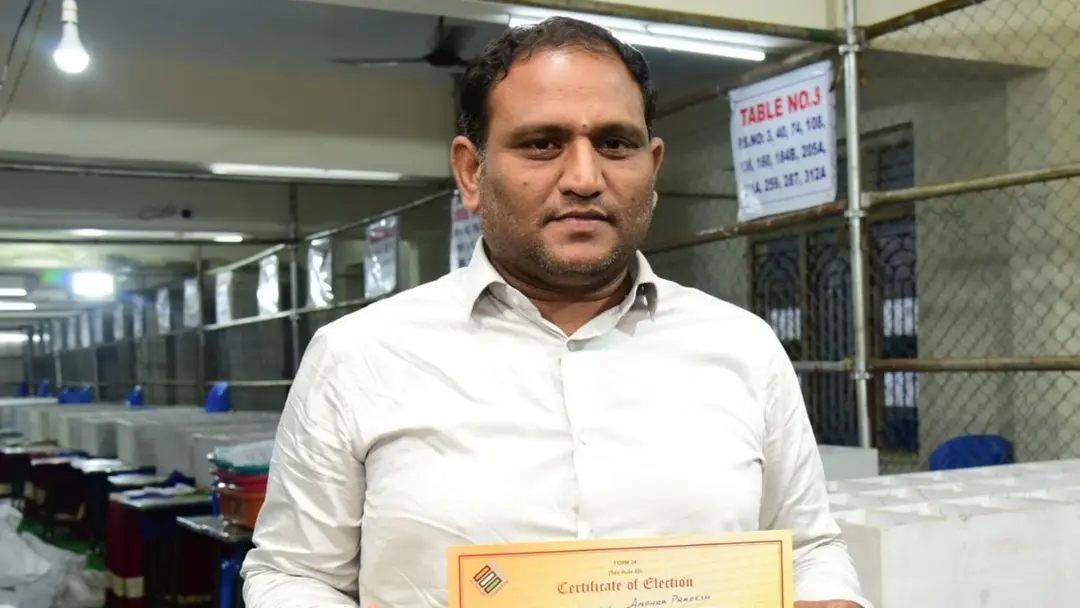
TDP's Kancharla Srikanth wins East Rayalaseema graduates' MLC seat
TDP candidate Kancharla Srikanth has won the East Rayalaseema graduates' MLC seat. Including second-preference votes, he polled 1,12,686 votes against YCP candidate Shyam Prasad Reddy's 85,423, and is reported to have been elected with a margin of 34,110 votes. The constituency covers the erstwhile Chittoor, Nellore and Prakasam districts, where YCP dominated the 2019 assembly polls. Srikanth is from Attantivaripalem in Valetivaripalem mandal, Nellore district, holds BTech, MBA and MIE degrees and received a doctorate in 2018.
Source
Prakasam — రాజకీయాలు · read the original report ↗
Desk check · some claims need care
What the desk checked (5)
- TDP's Kancharla Srikanth won the East Rayalaseema graduates' MLC seat with 1,12,686 votes including second-preference votes. — Figure appears in source; no election authority named as the source.
- YCP candidate Shyam Prasad Reddy polled 85,423 votes, and the winning margin was 34,110 votes. — Figures appear in source; the stated margin is not arithmetically consistent with the two vote totals given (difference is 27,263) — editor must verify.
- In the 2019 assembly elections YCP swept Nellore, TDP won only Kuppam in Chittoor and two seats in Prakasam. — Presented as past results without citation; routine recall but unattributed.
- Srikanth holds BTech, MBA, MIE, received a doctorate in 2018, is treasurer of Prakasam Engineering College, Kandukur, and won ZPTC in 2014 by 1,848 votes. — Biographical details stated in source without attribution.
- Anti-incumbency, personal image and consolidation of second-preference votes caused the win. — Analytical interpretation by the writer, not an attributed finding.
Analysts’ view opinion
A TDP win by 34,110 votes in a region the YSRCP swept in 2019 is politically awkward for the ruling party, whatever the spin. But a graduates' MLC constituency is a small, self-selecting electorate and is not directly comparable to an assembly contest — this signals the mood of one educated segment, not a verified statewide swing. The fact that second-preference votes consolidated behind the TDP candidate strengthens the reading that anti-incumbency votes refused to split.
- Given YSRCP dominance across combined Chittoor, Nellore and Prakasam in 2019, this result hands the opposition a ready-made talking point.
- For a party that held only Chandrababu Naidu's own seat of Kuppam in Chittoor, the win is primarily a morale and momentum gain for TDP cadre.
- Victory via second-preference votes suggests that even where first preferences scattered, anti-government sentiment eventually pooled in one direction.
- This is an electorate of graduates and aspirants, so YSRCP now has to answer the argument that discontent runs through educated and job-seeking voters.
- The winner's personal profile and local base built from ZPTC level upward also mattered, so the outcome cannot be read purely as a party wave.
What to watch — Watch whether the YSRCP frames this as a narrow, local aberration or shifts attention toward educated and job-seeking voters, and whether the TDP scales it into a statewide "the tide is turning" narrative.
The story does not establish turnout, the performance of other candidates, or any evidence that this pattern would repeat in assembly segments — it reflects one restricted voter category.
Deep dive
Research brief · 8 facts · 8 dates · exam-readyThe brief
Context
Andhra Pradesh's Legislative Council includes seats elected by graduates, and the East Rayalaseema graduates' constituency covers the erstwhile Chittoor, Nellore and Prakasam districts. This belt has been treated as a stronghold of the ruling YSR Congress Party (YCP), which swept the region in the 2019 assembly elections and in subsequent local body polls. In the latest graduates' MLC election, opposition Telugu Desam Party (TDP) candidate Kancharla Srikanth defeated the YCP nominee, an outcome the source describes as an unexpected shock to the ruling party.
Key facts
- TDP's Kancharla Srikanth won the East Rayalaseema graduates' MLC seat, polling 1,12,686 votes including second-preference votes.
- YCP candidate Shyam Prasad Reddy secured 85,423 votes.
- The source reports Srikanth was elected as MLC with a majority of 34,110 votes.
- The East Rayalaseema graduates' constituency comprises the erstwhile Chittoor, Nellore and Prakasam districts.
- In the 2019 assembly elections YCP swept Nellore; TDP won only Kuppam in Chittoor, Chandrababu Naidu's own constituency, and two seats in Prakasam.
- Srikanth's native village is Attantivaripalem, Valetivaripalem mandal, Potti Sriramulu Nellore district; he holds BTech, MBA and MIE degrees and received a doctorate in 2018.
- He entered politics in 2008 by joining the TDP, was organisation secretary of the Telugu technical professionals' wing, and was a member of the TDP star campaigning committee for the 2009 assembly elections.
- He won as ZPTC member from Kanduku64 Kandukur mandal in the 2014 local body elections with a majority of 1,848 votes and received the state-level best ZPTC award in 2017 and 2018 from then CM Chandrababu Naidu.
Timeline
- 2008Kancharla Srikanth enters politics and joins the Telugu Desam Party; serves as organisation secretary of the Telugu technical professionals' wing.
- 2009Works as a member of the TDP star campaigning committee for the assembly elections; becomes actively involved in the party.
- 2014Wins as ZPTC member from Kandukur mandal with TDP support by a margin of 1,848 votes.
- 2017 and 2018Receives the state-level best ZPTC member award from then Chief Minister Chandrababu Naidu.
- 2018Awarded a doctorate.
- 2019YCP wave in the assembly elections; sweeps Nellore, TDP wins only Kuppam in Chittoor and two seats in Prakasam.
- 2021Appointed ITDP state spokesperson.
- Latest graduates' MLC election (date not stated in the source)Srikanth defeats YCP's Shyam Prasad Reddy, 1,12,686 votes to 85,423.
Who has a stake
- Kancharla Srikanth (TDP) — Winner of the East Rayalaseema graduates' MLC seat; his personal image and service work are cited as reasons for the victory.
- Telugu Desam Party — Gains a Council seat in a region where it was written off as not even being in the contest.
- YSR Congress Party and candidate Shyam Prasad Reddy — Loses a seat in what was considered its fortress; the result is read as anti-incumbency against the government.
- Graduate voters of erstwhile Chittoor, Nellore and Prakasam districts — The electorate whose second-preference votes consolidated behind the TDP candidate instead of splitting anti-government votes.
- Chandrababu Naidu — TDP leader whose own seat Kuppam was the party's lone Chittoor win in 2019; had earlier honoured Srikanth with best ZPTC awards.
Why it matters
A graduates' constituency loss in a belt the ruling party swept in 2019 and in later local body polls is a signal of shifting sentiment among an educated electorate. The source attributes the result to anti-government feeling, the candidate's personal image, and crucially anti-government votes not splitting, with second preferences flowing to the TDP. It also illustrates how preferential voting in Council polls can decide outcomes.
UPSC angle
Prelims pointers
- East Rayalaseema graduates' MLC constituency covers erstwhile Chittoor, Nellore and Prakasam districts.
- Winner: Kancharla Srikanth (TDP) with 1,12,686 votes including second preferences; YCP's Shyam Prasad Reddy got 85,423.
- Reported winning margin: 34,110 votes.
- Graduates' MLC elections use a single transferable vote system with first and second preference votes.
- TDP's only 2019 assembly win in Chittoor district was Kuppam, Chandrababu Naidu's constituency; it won two seats in Prakasam.
- Srikanth won a ZPTC seat from Kandukur mandal in 2014 with a 1,848-vote majority.
Mains framing
The East Rayalaseema graduates' MLC result shows how upper-house elections with restricted, educated electorates can diverge sharply from general assembly verdicts: a constituency spanning the erstwhile Chittoor, Nellore and Prakasam districts, where the YCP swept the 2019 assembly polls and subsequent local body elections, returned a TDP candidate by a reported margin of 34,110 votes (1,12,686 to 85,423). The source identifies three causes: anti-incumbency against the government, the winner's personal image built on ZPTC work, awards and welfare activity such as student aid, blood donation and medical camps and adult literacy efforts, and the decisive fact that anti-government votes did not split, with second-preference votes accumulating for him. The implication is that graduates' and teachers' constituencies function as a distinct barometer of educated opinion and that the single transferable vote mechanism rewards opposition consolidation. The way forward, on the evidence in the source, lies in parties reading such results as feedback on governance performance rather than as isolated outcomes, and in recognising the weight of preference transfers in Council contests.
Key terms
- MLC
- Member of the Legislative Council, the upper house of a state legislature; some seats are elected by graduates.
- Graduates' constituency
- A Legislative Council seat elected by registered graduate voters of a defined region, here East Rayalaseema.
- Second-preference votes
- Lower-order preferences marked by voters that are transferred and counted when no candidate wins outright on first preferences.
- ZPTC member
- Zilla Parishad Territorial Constituency member, an elected mandal-level representative in the district panchayat body.
- YCP / TDP
- YSR Congress Party, the ruling party in the source's account, and Telugu Desam Party, the opposition party whose candidate won.
Practice questions
- Discuss how graduates' and teachers' constituencies in State Legislative Councils shape representation, using the East Rayalaseema MLC result as an illustration.
- To what extent can results in indirectly or narrowly franchised Council elections be read as indicators of anti-incumbency? Examine with reference to the 2019 assembly outcomes in Chittoor, Nellore and Prakasam.
- Explain the working of second-preference votes in MLC elections and how vote consolidation affected the East Rayalaseema outcome.
Grounded only in the source report — figures and dates are the source's, not inferred.