
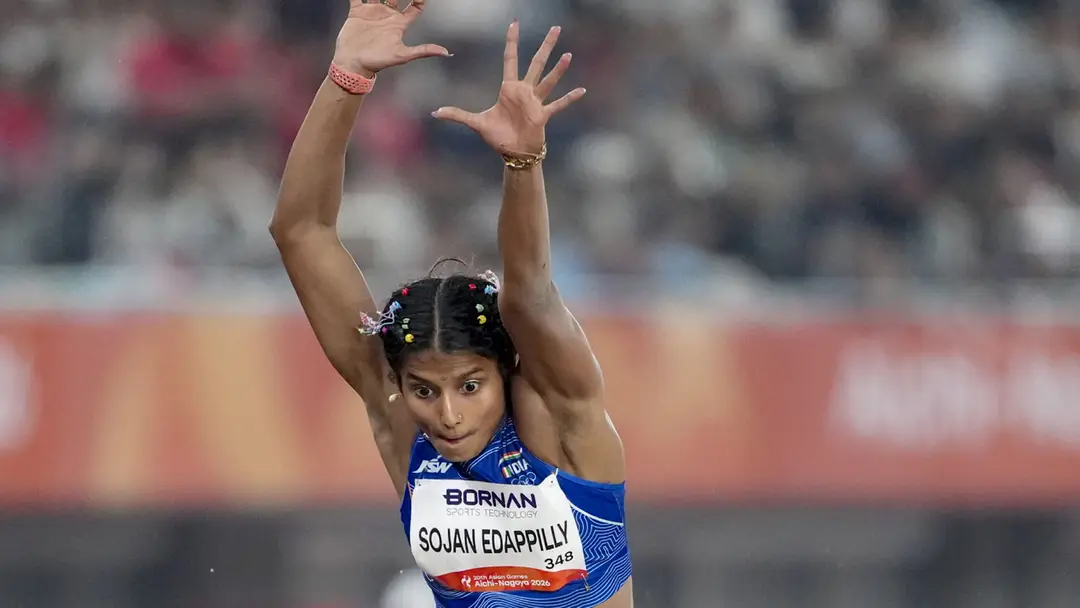
India collects seven medals on day nine of Asian Games
India won four silver and three bronze medals on the ninth day of the Asian Games. Ancy Sojan Edappilly took long jump silver with 6.53m as China's Huang won gold with 6.55m. Sarvesh Kushare cleared 2.25m for high jump silver, India's first medal in the event since 1970. Tejaswin Shankar in decathlon, Parul Chaudhary in steeplechase and Harita in the 200m won bronze. Squash finalists Anahat and Abhay settled for silver.
Source
Namasthe Telangana · read the original report ↗
Desk check · compared with the source
What the desk checked (5)
- India won four silver and three bronze medals on day nine of the Asian Games in Nagoya. — Figures appear in source; no governing-body attribution given, presented as match reporting.
- Ancy Sojan Edappilly took silver in women's long jump with 6.53m, behind China's Huang (6.55m). — Marks stated in source and internally consistent with the described jump sequence.
- Sarvesh Kushare won high jump silver with 2.25m, India's first medal in the event since 1970. — Source gives supporting history (Ajit 1954, Bhim Singh 1966 and 1970); no external source cited.
- Squash players Anahat Singh and Abhay Singh lost their finals to Malaysian players. — Game-by-game scores provided in source; unattributed but internally consistent.
- Three Indian boxers reached the semifinals, assuring at least bronze. — Quarterfinal results listed in source; figure consistent with named boxers.
Analysts’ view opinion
Seven medals on day nine but no gold tells the story of India's campaign right now: the depth is clearly there, the finishing margin is not. Two centimetres in the long jump and a countback on attempts in the high jump were all that separated Ancy Sojan and Sarvesh Kushare from the top step. Still, five athletics medals in a single day across five different events is a genuine signal that India's track-and-field base has widened.
- Sarvesh Kushare's 2.25m silver ends a wait dating back to 1970 in the men's high jump — he cleared the same height as the champion and lost only on the count-back, having needed a second attempt.
- Ancy Sojan led into the final rounds with 6.53m before China's Huang answered with 6.55m; her closing effort of 6.49m underlines how much big-stage long jump is decided in the last round.
- Tejaswini Shankar's 7,934 points for decathlon bronze is India's first medal in the ten-event discipline, but the winning marks from Japan (8,123) and China (8,012) show the gap to the podium's top still to be bridged.
- Anahat Singh and Abhay Singh both reaching squash finals shows real depth, yet straight-games defeats to Malaysian opponents exposed an experience and ranking gap — and the story notes the winners had a possible direct Los Angeles 2028 berth on offer.
- The pipeline for the coming days looks strong: six archery units into the semi-finals, three boxers assured of at least bronze, and the women's hockey team beating Singapore 7-0 — against which badminton was a clear disappointment, with Sindhu and Unnati both out in the quarter-finals.
What to watch — The archery semi-finals, the boxing semi-finals and the women's hockey knockout stage are where India's run of silvers could start converting into gold.
The story covers only day nine's results and does not establish India's overall medal tally, its position on the standings table or the schedule of remaining events.
Deep dive
Research brief · 8 facts · 5 dates · exam-readyThe brief
Context
The Asian Games, being held in Nagoya, Japan, reached its ninth day with India's athletics contingent producing its best single-day haul. On Sunday India added four silver and three bronze medals, with no gold, taking medals in long jump, high jump, decathlon, 3000m steeplechase, 200m and squash singles. Sarvesh Kushare's high jump silver ended a 51-year medal drought in the event, while squash players Anahat Singh and Abhay Singh lost their finals to Malaysian opponents. Indian archers, boxers and the women's hockey team also advanced, setting up more medals.
Key facts
- India won four silver and three bronze medals on day nine of the Asian Games at Nagoya; five of the seven came in athletics on a single day.
- Ancy Sojan Edappilly took long jump silver with 6.53m, losing gold by 2cm to China's Huang (6.55m); China's Mengyi got bronze with 6.46m and India's Shaili Singh finished fourth with 6.42m.
- Sarvesh Kushare, 31, from Maharashtra, cleared 2.25m for high jump silver — India's first Asian Games high jump medal since 1970 (after Ajit in 1954 and Bhim Singh in 1966 and 1970).
- Chinese Taipei's Chao Hsuan-Fu also cleared 2.25m but won gold as he did it on his first attempt, while Kushare needed a second attempt.
- Tejaswin Shankar won India's first medal of these Games in decathlon with 7,934 points; Japan (8,123) and China (8,012) took gold and silver.
- Parul Chaudhary won 3000m steeplechase bronze in 9:08.67; Harita Badra took 200m bronze in 23.20s behind Singapore (22.78) and China (22.93).
- In squash, Abhay Singh lost 0-3 (9-11, 5-11, 5-11) to defending champion Eain Yow of Malaysia; Anahat Singh lost 4-11, 4-11, 7-11 to world No. 5 Sivasangari Subramaniam.
- India's women's hockey team beat Singapore 7-0 in its last pool match; boxers Parveen Hooda (65kg), Ankush (80kg) and Narender Berwal (90+kg) reached semifinals to assure three medals.
Timeline
- 1954Ajit won an Asian Games high jump medal for India.
- 1966 and 1970Bhim Singh won high jump medals for India; no Indian high jump medal followed until 2026.
- Day nine (Sunday), Asian Games, NagoyaIndia wins four silver and three bronze; athletics yields five medals in one day; squash finals lost.
- September 28, 2026, 03:56 AM ISTReport published on India's day-nine medal haul.
- 2028, Los AngelesSquash final winners earned direct Olympic berths — an opportunity India's players missed.
Who has a stake
- Sarvesh Kushare — Maharashtra high jumper whose 2.25m silver ended India's 51-year wait for an Asian Games high jump medal.
- Ancy Sojan Edappilly — Kerala long jumper who led until the final round and lost gold by 2cm, finishing with 6.53m silver.
- Tejaswin Shankar — Decathlete who gave India its first medal of these Games with 7,934 points.
- Anahat Singh and Abhay Singh — Squash finalists who took silver and forfeited direct 2028 Los Angeles Olympic berths tied to winning the final.
- Indian archery squads (compound and recurve) — All teams reached semifinals, keeping multiple medals within reach.
- Indian boxers Parveen Hooda, Ankush, Narender Berwal — Semifinal entries assure at least bronze each, adding three certain medals.
- Indian women's badminton players (PV Sindhu, Unnati Hooda, Treesa-Gayatri, Dhruv Kapila-Tanisha Crasto) — Exited without medals after team and individual failures, a setback for the shuttle contingent.
Why it matters
India's medal tally is rising even as golds prove elusive, and athletics has become the engine of that haul with five medals in one day. Kushare's high jump silver breaks a five-decade drought in a technical event India had long ceded, while the squash finals show how narrow margins can also cost Olympic qualification, since the winners earned direct 2028 Los Angeles berths.
UPSC angle
Prelims pointers
- Asian Games day nine: India won 4 silver + 3 bronze, including five athletics medals in one day.
- Sarvesh Kushare: 2.25m high jump silver, India's first Asian Games high jump medal since 1970; earlier medallists Ajit (1954) and Bhim Singh (1966, 1970).
- Ancy Sojan Edappilly: long jump silver with 6.53m; gold to China's Huang with 6.55m.
- Tejaswin Shankar: decathlon (10 events) bronze with 7,934 points.
- Parul Chaudhary: 3000m steeplechase bronze in 9:08.67; Harita Badra: 200m bronze in 23.20s.
- Squash singles gold medallists received direct qualification for the 2028 Los Angeles Olympics.
Mains framing
India's day-nine performance at the Nagoya Asian Games illustrates both the deepening of its track-and-field base and the persistent difficulty of converting podium finishes into gold. Five athletics medals in a single day, including Tejaswin Shankar's decathlon bronze and Sarvesh Kushare's high jump silver that ended a drought stretching back to 1970, indicate that Indian athletes are now competitive in technical and multi-discipline events long dominated by East Asian nations. Yet the margins were unforgiving: Ancy Sojan lost gold by two centimetres, Kushare tied the winner's 2.25m but lost on attempts, and Shaili Singh missed bronze by four centimetres. In squash, two finalists returned with silver against Malaysian opponents, also losing direct 2028 Los Angeles Olympic berths reserved for winners, while the women's badminton campaign collapsed in both team and individual draws. The way forward, on the evidence of this single day, lies in fine-margin preparation \u2014 attempt efficiency, final-round execution and depth in events such as archery, boxing and hockey where India has again reached the semifinal stage \u2014 rather than in expanding participation alone.
Key terms
- Decathlon
- A men's ten-event athletics competition scored on points; Tejaswin Shankar scored 7,934 for bronze.
- 3000m steeplechase
- Distance running event over barriers and water jumps; Parul Chaudhary clocked 9:08.67 for bronze.
- Compound and recurve archery
- The two bow categories in Asian Games archery; India reached semifinals in men's, women's and mixed sections of both.
- Countback on attempts
- High jump tiebreak rule — Chao Hsuan-Fu got gold over Kushare at 2.25m by clearing it on the first attempt.
- Direct Olympic berth
- Automatic qualification for the 2028 Los Angeles Games offered to Asian Games squash singles champions.
Practice questions
- India's athletics contingent is increasingly winning medals but narrowly missing golds at continental events. Examine the factors behind this pattern and suggest measures to improve medal conversion.
- Discuss the significance of Sarvesh Kushare's high jump silver ending a 51-year medal drought for India in the event, in the context of investment in technical athletics disciplines.
- How do continental multi-sport events such as the Asian Games function as qualification pathways for the Olympics? Illustrate with the example of squash at Nagoya.
Grounded only in the source report — figures and dates are the source's, not inferred.