
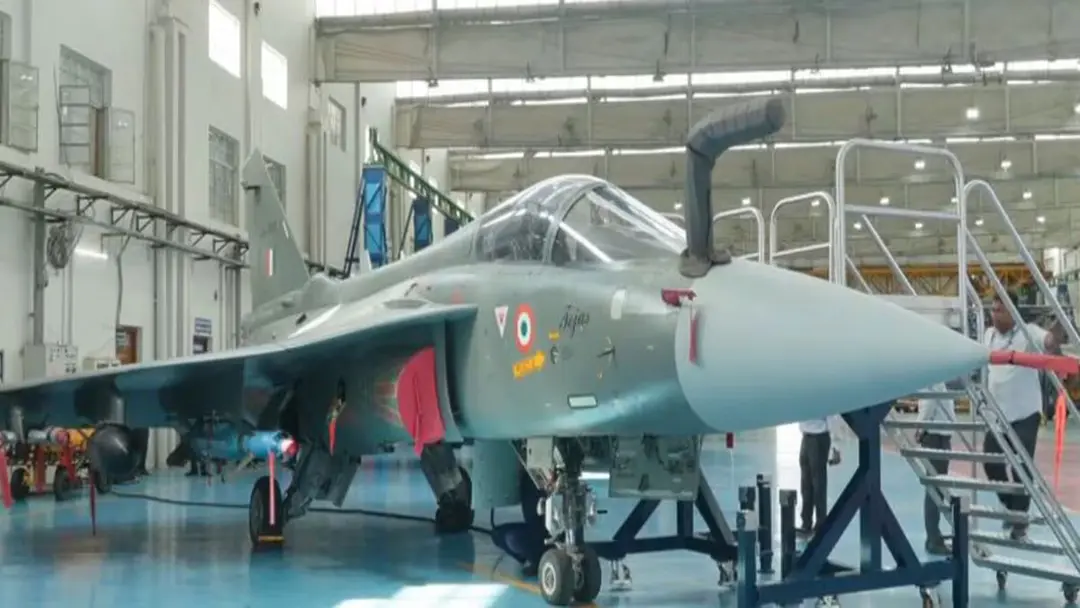
HAL hands over Tejas trainers, HTT-40 aircraft to Indian Air Force
HAL on Friday handed over the final two LCA Tejas Mk-1 FOC twin-seater trainers and the first batch of three HTT-40 basic trainer aircraft to the Indian Air Force at its Bengaluru facility, completing the original 40-aircraft Tejas Mk-1 contract. Four Dhruv NG helicopters were delivered to Pawan Hans. Defence Minister Rajnath Singh and Civil Aviation Minister K. Rammohan Naidu attended. The HTT-40 contract covers 70 trainers worth Rs 6,838 crore.
Source
News18 — India · read the original report ↗
Desk check · compared with the source
What the desk checked (5)
- HAL handed over the final two LCA Tejas Mk-1 FOC twin-seater trainers and the first three HTT-40 basic trainers to the IAF in Bengaluru, completing the 40-aircraft Tejas Mk-1 contract. — Stated in source and repeated in its own AI summary; attributed to HAL and PTI inputs.
- Four civil-certified Dhruv NG helicopters were delivered to Pawan Hans Limited; the 5.5-tonne twin-engine helicopter has DGCA type certification. — Figure and certification detail appear in the source; attributed to HAL statement.
- The HTT-40 order covers 70 trainers under a Rs 6,838-crore contract signed in March 2023, with 67 remaining to be delivered in four to five years. — Contract value, quantity and timeline appear in source; source of the delivery projection given as HAL expectation.
- 180 Tejas Mk-1A jets ordered across 2021 and 2025 under a programme valued at Rs 1.15 lakh crore. — Figures appear in source without direct attribution to a named official.
- Over 60% of components on both Tejas and HTT-40 are sourced locally. — Unattributed percentage in source; editor may flag as needing sourcing.
Analysts’ view opinion
Technically this is a handover ceremony; politically it is a stage built for the 'Aatmanirbhar Bharat' narrative. The presence of both Defence Minister Rajnath Singh and Civil Aviation Minister K. Rammohan Naidu signals an attempt to showcase indigenous manufacturing across defence and civil aviation under one roof. Announcing completion of the 40-aircraft Tejas Mk-1 contract gives the government a 'promise delivered' message, and also answers past criticism over HAL's delivery pace.
- The Centre gains presentationally — it can now claim a fully indigenous pilot training-to-fighter chain.
- For HAL's leadership this is a credibility reset and political cover as it shifts focus to the 180 Tejas Mk-1A jets.
- Production at Bengaluru and Nashik plus MSME sourcing feeds a jobs-centred political narrative in Karnataka and Maharashtra.
- Only three of the 70 HTT-40s under the ₹6,838-crore contract have arrived, with 67 over four to five years — space for the opposition to question delivery speed.
- The reference to foreign engine supply-chain disruptions is a reminder of the limits of the full self-reliance claim.
What to watch — Watch the pace of Tejas Mk-1A deliveries and how Parliament and the opposition frame questions on squadron strength depletion.
The story does not establish that production timelines will be met, nor does it record any political party's reaction to the handover.
Deep dive
Research brief · 8 facts · 5 dates · exam-readyThe brief
Context
Hindustan Aeronautics Limited (HAL), India's state-owned aerospace manufacturer, made three simultaneous handovers at its Bengaluru facility on Friday: the last two LCA Tejas Mk-1 Final Operational Clearance (FOC) twin-seater trainers and the first three series-production HTT-40 basic trainers to the Indian Air Force, and four civil-certified Dhruv NG helicopters to Pawan Hans Limited. The Tejas handover completes the original 40-aircraft LCA Tejas Mk-1 contract, freeing HAL's fighter assembly line for the 180 Tejas Mk-1A jets ordered in 2021 and 2025. The HTT-40 induction gives the IAF an indigenous Stage-1 basic trainer, replacing reliance on foreign basic trainers such as the Swiss Pilatus PC-7 MkII. Defence Minister Rajnath Singh and Civil Aviation Minister K. Rammohan Naidu attended the ceremony.
Key facts
- The final two LCA Tejas Mk-1 FOC twin-seater trainers completed the original 40-aircraft LCA Tejas Mk-1 contract signed by the IAF.
- HAL delivered the first batch of three series-production HTT-40 basic trainers - two built in Bengaluru and one in Nashik; the first was named 'Ankur'.
- The HTT-40 order is for 70 trainers under a Rs 6,838-crore contract signed in March 2023; the remaining 67 are expected over the next four to five years.
- HAL will now shift its full fighter assembly infrastructure to the Rs 1.15 lakh-crore Tejas Mk-1A programme covering 180 aircraft ordered across 2021 and 2025.
- Four Dhruv NG helicopters were handed to Pawan Hans Limited; the 5.5-tonne twin-engine multi-role helicopter has DGCA type certification.
- HTT-40 deliveries were earlier delayed by global supply chain issues affecting American-sourced Honeywell TPE331-12B turboprop engines, since resolved.
- Over 60% of components on both the Tejas and the HTT-40 are sourced locally, channelling defence spending to Indian MSMEs.
- The Tejas FOC trainer is described as a lightweight, all-weather, multi-role 4.5-generation aircraft that can also undertake fighter operations.
Timeline
- 2021First tranche of Tejas Mk-1A fighters ordered (part of the 180 aircraft ordered across 2021 and 2025).
- March 2023Rs 6,838-crore contract signed for 70 HTT-40 basic trainer aircraft.
- 2025Second tranche of Tejas Mk-1A fighters ordered, taking the total to 180 aircraft.
- September 18, 2026HAL hands over final two Tejas Mk-1 FOC trainers and first three HTT-40s to the IAF, and four Dhruv NG helicopters to Pawan Hans, at Bengaluru.
- Next four to five yearsHAL expects to deliver the remaining 67 HTT-40 trainers.
Who has a stake
- Indian Air Force — Gains indigenous Stage-1 to Stage-3 training platforms and awaits faster Tejas Mk-1A deliveries to arrest squadron depletion as MiG-21, MiG-29 and Jaguar fleets retire.
- Hindustan Aeronautics Limited (HAL) — Closes the baseline Tejas Mk-1 order, frees its assembly line, jigs and workforce for Mk-1A output, and establishes itself as a dual-use military and civil manufacturer.
- Pawan Hans Limited — Receives four civil-certified Dhruv NG helicopters for VVIP transport, air ambulance, offshore support and pilgrimage transit.
- Ministry of Defence / Defence Minister Rajnath Singh — Showcases the Aatmanirbhar Bharat push in military aerospace - design, avionics, propulsion, training and certification within an integrated ecosystem.
- Indian MSMEs and private defence vendors — Benefit from over 60% local content on Tejas and HTT-40, with defence rupees retained domestically.
- Foreign manufacturers (Pilatus, Airbus, Bell, Honeywell) — Lose ground as India substitutes the PC-7 MkII basic trainer and challenges foreign dominance in the civil helicopter market; engine supply remains imported.
- DGCA — Certifying authority - granted type certification to Dhruv NG and, per the Defence Minister, certified its indigenous Shakti engine.
Why it matters
The handovers mean India can now train military pilots from day one to combat readiness entirely on home-built platforms - HTT-40 for Stage-1, Kiran/IJT for Stage-2 and the Tejas twin-seater for Stage-3 - insulating foundational training from foreign supply chain shocks. Closing the 40-aircraft Mk-1 contract removes a manufacturing bottleneck at a time when the IAF's fighter squadron strength is depleting as older MiG and Jaguar fleets retire. The civil-certified Dhruv NG delivery signals HAL's entry into a commercial helicopter market long dominated by foreign makers.
UPSC angle
Prelims pointers
- LCA Tejas Mk-1 FOC trainer: lightweight, all-weather, multi-role 4.5-generation aircraft; original IAF contract was for 40 aircraft.
- HTT-40 basic trainer: 70 aircraft for Rs 6,838 crore, contract signed March 2023; powered by Honeywell TPE331-12B turboprop engines; first unit named 'Ankur'.
- Tejas Mk-1A programme: 180 aircraft ordered across 2021 and 2025, valued at Rs 1.15 lakh crore.
- Dhruv NG: 5.5-tonne twin-engine multi-role helicopter with DGCA type certification, delivered to Pawan Hans Limited.
- IAF pilot training stages: Stage-1 HTT-40, Stage-2 Kiran/IJT, Stage-3 LCA Tejas twin-seater.
- HTT-40 replaces reliance on the Swiss-made Pilatus PC-7 MkII basic trainer; over 60% local content in Tejas and HTT-40.
Mains framing
HAL's triple handover illustrates both the progress and the limits of India's defence indigenisation. The completion of the 40-aircraft Tejas Mk-1 FOC contract and the arrival of the HTT-40 close a decades-old gap in the pilot training pipeline, allowing the IAF to move from Stage-1 basic to Stage-3 advanced fighter training on wholly Indian platforms and ending dependence on imported basic trainers such as the Pilatus PC-7 MkII. With over 60% local content, the programmes push defence spending into domestic MSMEs, while DGCA-certified Dhruv NG helicopters extend HAL into civil aviation roles such as air ambulance, offshore support and disaster relief. Yet the constraints are visible: HTT-40 deliveries slipped because of global supply chain disruption in American-sourced Honeywell TPE331-12B engines, only 3 of 70 trainers have been delivered with 67 expected over four to five years, and the IAF's squadron strength continues to fall as MiG-21, MiG-29 and Jaguar fleets retire. The way forward, as the source suggests, lies in reallocating the freed assembly line, jigs and engineering workforce to the Rs 1.15 lakh-crore, 180-aircraft Tejas Mk-1A programme, deepening indigenous propulsion and certification capability, and sustaining the IAF-HAL-private vendor synergy that enabled HTT-40's rapid journey from concept to series production.
Key terms
- Final Operational Clearance (FOC)
- The certification standard marking full operational configuration of the Tejas Mk-1, including the twin-seater trainer variant handed over to the IAF.
- HTT-40
- HAL's indigenous Stage-1 basic trainer with glass cockpit, modern avionics and zero-zero ejection seats, for foundational flying, night navigation and aerobatics.
- Tejas Mk-1A
- Upgraded Light Combat Aircraft variant; 180 jets ordered across 2021 and 2025 under a programme valued at Rs 1.15 lakh crore.
- Dhruv NG
- Dhruv Next Generation, a 5.5-tonne twin-engine multi-role helicopter, DGCA type-certified, for VVIP transport, air ambulance, offshore and pilgrimage use.
- Pawan Hans Limited (PHL)
- Civil helicopter operator that received the first fleet of four Dhruv NG helicopters from HAL.
- Zero-zero ejection seat
- An ejection seat that can safely eject a pilot at zero altitude and zero speed; fitted on the HTT-40.
Practice questions
- Discuss how the induction of the HTT-40 and the LCA Tejas twin-seater changes India's military pilot training pipeline and reduces foreign dependence.
- Completing the baseline Tejas Mk-1 contract is described as removing a manufacturing bottleneck. Examine the challenges HAL faces in scaling up Tejas Mk-1A production for the IAF.
- Evaluate the significance of HAL's entry into the civil helicopter market with the DGCA-certified Dhruv NG for India's aerospace self-reliance and regional connectivity.
Grounded only in the source report — figures and dates are the source's, not inferred.