
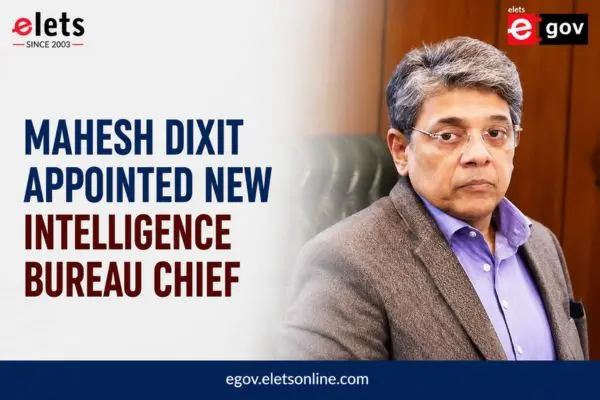
Mahesh Dixit appointed new Intelligence Bureau Director
Senior IPS officer Mahesh Dixit has been appointed Director of the Intelligence Bureau, succeeding Tapan Kumar Deka. The Appointments Committee approved his appointment for a tenure of two years. A 1993-batch IPS officer of the Andhra Pradesh cadre, Dixit is currently Special Director in the Intelligence Bureau. He earlier headed the Subsidiary Intelligence Bureau in Srinagar, playing an important role in intelligence operations across Jammu & Kashmir and Leh following the abrogation of Article 370.
Source
Intelligence Bureau (IB) · read the original report ↗
Desk check · some claims need care
What the desk checked (4)
- Mahesh Dixit appointed Director of the Intelligence Bureau for a two-year tenure — Stated in source and repeated in its key highlights; attributed only to 'the Appointments Committee' with no order number or date given.
- He succeeds Tapan Kumar Deka as IB Director — Appears consistently in the source text; no official source cited.
- Dixit is a 1993-batch IPS officer of the Andhra Pradesh cadre, currently Special Director in the IB — Figures and designation appear in the source and are internally consistent; not independently verifiable here.
- He earlier headed the Subsidiary Intelligence Bureau in Srinagar, covering Jammu & Kashmir and Leh after the abrogation of Article 370 — Described in source without attribution; characterisation of his role rests on unnamed 'officials'.
Analysts’ view opinion
By picking a serving insider to head the Intelligence Bureau, the Centre has signalled continuity rather than a reset. Giving Mahesh Dixit, currently Special Director, a fixed two-year tenure points to a preference for stability in the internal security establishment at a time of evolving threats. That the government has highlighted his Srinagar SIB stint and his role in Jammu & Kashmir and Leh after the abrogation of Article 370 also indicates where its attention remains anchored.
- Choosing from within the IB rather than bringing in an outsider suggests the government values institutional continuity over course correction.
- A defined two-year tenure reduces uncertainty at the top of the agency and makes smoother government-agency coordination likely.
- The emphasis on post-Article 370 intelligence work in Kashmir can be read as a political signal that the region remains a central priority.
- Because the IB chief works closely with the Prime Minister's Office and the Home Ministry, the appointment reflects the trust of the top political leadership.
- An Andhra Pradesh cadre officer reaching this post may draw symbolic mentions at the state level, but this is a merit-based central appointment and should not be tied to state politics.
What to watch — Watch how the new chief's priorities line up across Kashmir, left-wing extremism and cyber threats, and how coordination with state police forces evolves.
The story does not establish the reasoning behind the selection, any other names considered, or whether any policy shift is intended — that reading is inference from general context.
Deep dive
Research brief · 8 facts · 4 dates · exam-readyThe brief
Context
The Intelligence Bureau (IB), India's premier internal intelligence agency, is getting a new chief. Senior IPS officer Mahesh Dixit, currently Special Director in the IB, has been appointed Director of the Intelligence Bureau for a two-year tenure, succeeding Tapan Kumar Deka. The Appointments Committee approved the appointment. Dixit is an insider with long service in the organisation, including a stint heading the Subsidiary Intelligence Bureau (SIB) in Srinagar covering Jammu & Kashmir and Leh after the abrogation of Article 370.
Key facts
- Mahesh Dixit has been appointed the next Director of the Intelligence Bureau (IB), succeeding Tapan Kumar Deka.
- The Appointments Committee approved his appointment for a tenure of two years.
- Dixit is a 1993-batch IPS officer of the Andhra Pradesh cadre.
- He is currently serving as Special Director in the Intelligence Bureau.
- He earlier headed the Subsidiary Intelligence Bureau (SIB) in Srinagar, supervising intelligence operations across Jammu & Kashmir and Leh.
- During his Srinagar tenure he monitored the security situation following the abrogation of Article 370.
- His experience spans counter-terrorism, intelligence collection, security assessments and coordination with multiple law enforcement agencies.
- As IB Director he will lead gathering of intelligence on terrorism, extremism, espionage, cyber threats and other national security issues.
Timeline
- 1993Dixit joins the IPS as a 1993-batch officer of the Andhra Pradesh cadre.
- After the abrogation of Article 370 (year not stated in the source)As head of the Subsidiary Intelligence Bureau, Srinagar, he supervises intelligence operations in Jammu & Kashmir and Leh.
- Current (before taking over)Serves as Special Director in the Intelligence Bureau.
- Latest developmentAppointments Committee approves his appointment as IB Director for two years; he will take over from Tapan Kumar Deka.
Who has a stake
- Mahesh Dixit — Takes charge of India's primary internal intelligence organisation for a two-year tenure.
- Tapan Kumar Deka — Outgoing IB Director; his tenure focused on counter-terrorism, intelligence gathering and centre-state agency coordination.
- Intelligence Bureau — Continuity of leadership from within the organisation as it faces evolving internal security challenges.
- Appointments Committee — The body that approved the appointment and its two-year tenure.
- Central and state security and law enforcement agencies — Depend on IB for intelligence coordination on terrorism, extremism, espionage and cyber threats.
- Jammu & Kashmir and Leh — Regions where the new Director previously supervised intelligence operations and stability efforts post-Article 370.
Why it matters
The IB Director heads India's principal internal intelligence agency, whose work spans terrorism, extremism, espionage and cyber threats, making the appointment central to national security decision-making. By elevating a serving Special Director with deep field experience in conflict-sensitive regions, the government has signalled continuity in the agency's functioning rather than a change of course.
UPSC angle
Prelims pointers
- Mahesh Dixit: new Director, Intelligence Bureau; 1993-batch IPS officer, Andhra Pradesh cadre.
- He succeeds Tapan Kumar Deka; tenure approved for two years by the Appointments Committee.
- Dixit was serving as Special Director in the IB before the appointment.
- Subsidiary Intelligence Bureau (SIB), Srinagar covers intelligence operations in Jammu & Kashmir and Leh; Dixit headed it.
- IB is described as India's premier internal intelligence agency, handling terrorism, extremism, espionage and cyber threats.
Mains framing
The appointment of Mahesh Dixit as Director of the Intelligence Bureau illustrates how India staffs and stabilises its internal intelligence architecture. The choice of a serving Special Director, with prior charge of the Subsidiary Intelligence Bureau in Srinagar covering Jammu & Kashmir and Leh in the period after the abrogation of Article 370, reflects a preference for institutional continuity and field-tested operational experience over lateral change. The IB's mandate as described spans terrorism, extremism, espionage and cyber threats, which requires not just collection capability but coordination among central and state security agencies, a focus attributed to the outgoing Director Tapan Kumar Deka. A fixed two-year tenure approved by the Appointments Committee provides predictability at the top, useful for long-gestation intelligence work. The way forward, on the evidence of the source, lies in sustaining counter-terrorism and intelligence-gathering capacity, deepening centre-state coordination, and adapting the agency to emerging challenges such as cyber threats while retaining strength in conflict-sensitive regions.
Key terms
- Intelligence Bureau (IB)
- India's premier internal intelligence agency, gathering intelligence on terrorism, extremism, espionage and cyber threats.
- Subsidiary Intelligence Bureau (SIB)
- Regional/state-level unit of the IB; the Srinagar SIB covers intelligence operations in Jammu & Kashmir and Leh.
- Appointments Committee
- The body that approved Dixit's appointment as IB Director for a tenure of two years.
- Special Director
- Senior rank within the Intelligence Bureau; the post Dixit held before being named Director.
- Abrogation of Article 370
- The change in the constitutional status of Jammu & Kashmir, after which Dixit supervised intelligence operations in the region.
- IPS cadre and batch
- Indian Police Service officers are identified by year of recruitment and state cadre; Dixit is 1993-batch, Andhra Pradesh cadre.
Practice questions
- Discuss the role of the Intelligence Bureau in India's internal security framework. How does leadership continuity affect the effectiveness of intelligence agencies?
- Fixed tenures for heads of intelligence and investigative agencies are meant to insulate them from uncertainty. Examine, with reference to the two-year tenure of the IB Director.
- Intelligence coordination between central and state agencies remains a key challenge in counter-terrorism. Critically analyse.
Grounded only in the source report — figures and dates are the source's, not inferred.