
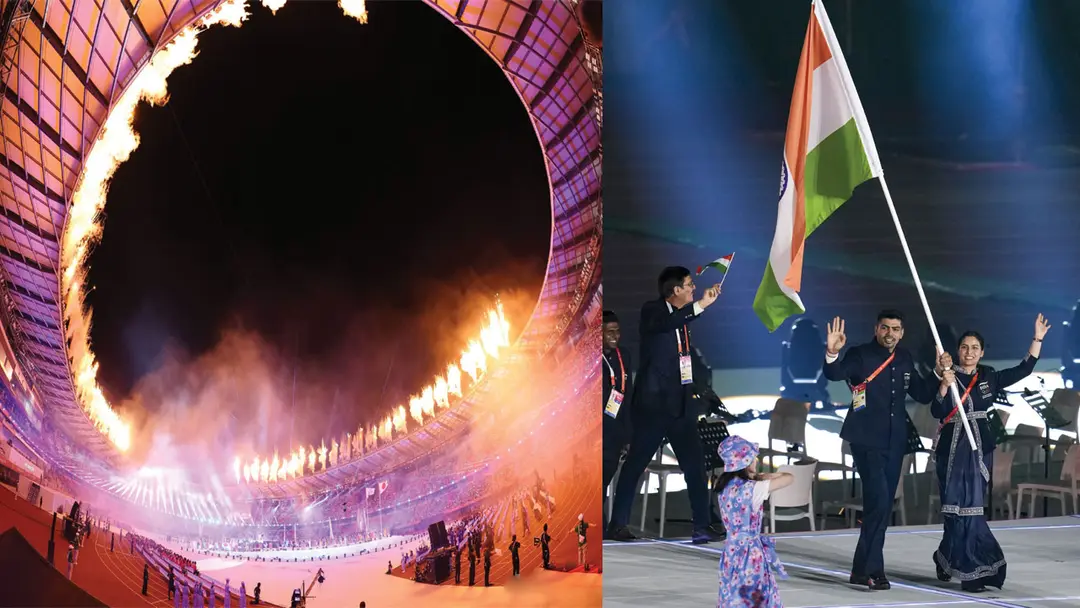
20th Asian Games open in Aichi-Nagoya with grand ceremony
The 20th Asian Games opened Saturday at the Mizuho Park Athletic Stadium in Aichi-Nagoya under the theme 'Harmonic Heartbeat'. Japan's Emperor Naruhito declared the Games open in the presence of IOC head Coventry and Olympic Council of Asia president Al Thani. Until October 4, about 11,000 athletes from 45 countries will compete in 43 sports. Manu Bhaker and Pawan Sehrawat led India's 150-member contingent; Sehrawat replaced Tajinder Singh after a ceremonial kit delay.
Source
Namasthe Telangana · read the original report ↗
Desk check · compared with the source
What the desk checked (5)
- The 20th Asian Games opened Saturday at Mizuho Park Athletic Stadium in Aichi-Nagoya with the theme 'Harmonic Heartbeat'. — Stated in source as event reporting; no official source cited.
- Japan's Emperor Naruhito declared the Games open in the presence of IOC head Coventry and OCA president Al Thani. — Named in source; IOC chief's name appears in Telugu transliteration and should be verified.
- About 11,000 athletes from 45 countries will compete in 43 sports until October 4. — Figures appear in the source; no issuing authority named.
- Manu Bhaker and Pawan Sehrawat led India's 150-member contingent; Tajinder Singh missed the ceremony after a delay in the ceremonial kit's arrival at Nagoya airport. — Source says the Indian Olympic Association named the replacement; the name appears as both Tajinder Singh and Tajinderpal in the text.
- Japan is hosting the Asiad for the third time after 1958 (Tokyo) and 1994 (Hiroshima) and is fielding over 900 athletes. — Figures and years appear in source without attribution.
Analysts’ view opinion
The opening ceremony of the 20th Asian Games was a spectacle, but for India the real story begins now. In an event with 45 nations, some 11,000 athletes and 43 sports, the story says India has sent a contingent of just 150 — a strikingly small squad next to host Japan's more than 900 athletes. Choosing Manu Bhaker and Pawan Sehrawat as flagbearers symbolically puts India's two most dependable strengths, shooting and kabaddi, out front.
- The flagbearer choice itself hints at India's medal template: precision sports like shooting plus traditionally strong kabaddi.
- Sehrawat stepping in for Tajinder Singh because the ceremonial kit was delayed exposes a logistics slip that must not repeat on competition days.
- Crucially, this was a ceremony absence only — the story does not suggest any impact on Tajinder's events.
- The report notes pre-existing complaints about organisational lapses and cramped accommodation, issues that at big Games can affect athlete recovery.
- Hosting for a third time after Tokyo 1958 and Hiroshima 1994, Japan is clearly looking to convert home advantage with a very large team.
What to watch — Through to October 4, watch whether India's lean contingent can still convert in its core disciplines such as shooting and kabaddi, and how dominant the host nation turns out to be.
The story does not establish why India's contingent is limited to 150, which sports it will contest, what its medal target is, or who was responsible for the kit delay.
Deep dive
Research brief · 8 facts · 5 dates · exam-readyThe brief
Context
The 20th edition of the Asian Games opened on Saturday at the Mizuho Park Athletic Stadium in Aichi-Nagoya, Japan, under the theme "Harmonic Heartbeat". The continental multi-sport event, run under the Olympic Council of Asia, is being hosted by Japan for the third time after Tokyo 1958 and Hiroshima 1994. The ceremony went ahead despite controversies over organisational lapses and cramped accommodation. India marched with a 150-member contingent, with a last-minute change of flagbearer after a ceremonial kit delay.
Key facts
- The 20th Asian Games opened Saturday at Mizuho Park Athletic Stadium, Aichi-Nagoya, with the theme 'Harmonic Heartbeat'.
- Japan's Emperor Naruhito formally declared the Games open in the presence of IOC head Coventry and Olympic Council of Asia president Al Thani.
- Nearly 11,000 athletes from 45 countries will compete in 43 sports till October 4.
- This is Japan's third time hosting the Asiad, after Tokyo 1958 and Hiroshima 1994.
- The opening ceremony ran nearly two hours; the main stage was shaped like a heart to symbolise an emotionally connected Asia.
- 240 dancers emerged from beneath the stage to form the word 'WELCOME'; violinist Taro Hakase performed as heart-winged drones and lasers lit the stadium.
- 46 teams took part in the march-past; Japan, entering last by tradition, is fielding over 900 athletes, the largest contingent.
- India's 150-member contingent was led by shooter Manu Bhaker in a dark blue saree and kabaddi star Pawan Sehrawat in a bandhgala jacket.
Timeline
- 1958Japan hosts the Asian Games for the first time, in Tokyo.
- 1994Japan hosts the Asian Games a second time, in Hiroshima.
- Before the ceremonyCeremonial kit luggage is delayed in reaching Nagoya airport; Tajinder Singh cannot reach the venue on time and is replaced as flagbearer by Pawan Sehrawat.
- Saturday (story dated September 20, 2026)20th Asian Games open at Mizuho Park Athletic Stadium, Aichi-Nagoya; Emperor Naruhito declares the Games open and the main cauldron is lit at the end of the torch relay.
- October 4Scheduled conclusion of the Games.
Who has a stake
- Olympic Council of Asia (OCA), president Al Thani — Owns and oversees the Asian Games; its credibility is tested by complaints of organisational lapses and cramped accommodation.
- Host Japan / Aichi-Nagoya organisers — Showcasing high-tech industrial strength and ancient culture; fielding over 900 athletes, its largest contingent.
- Indian Olympic Association — Managing the 150-member contingent; had to name a replacement flagbearer after the kit delay.
- Manu Bhaker and Pawan Sehrawat — Flagbearers leading India's march-past; Sehrawat is a defending Asiad gold medallist in kabaddi.
- Tajinder Singh — Veteran athlete chosen as flagbearer who lost the honour due to the ceremonial kit's late arrival.
- International Olympic Committee (head Coventry) — Presence signals global Olympic movement's stake in the continental Games.
Why it matters
The Asian Games are the largest multi-sport event after the Olympics and a key qualification and benchmarking stage for Indian athletes, so India's 150-member showing and its medal prospects carry national significance. The opening also put a spotlight on host-country readiness, since the ceremony proceeded amid disputes over organisational lapses and cramped accommodation. The flagbearer switch caused by delayed kit baggage highlights how logistics failures can affect a contingent's showpiece moment.
UPSC angle
Prelims pointers
- 20th Asian Games: hosted at Aichi-Nagoya, Japan; theme 'Harmonic Heartbeat'; opened at Mizuho Park Athletic Stadium.
- Japan has hosted the Asiad thrice: Tokyo 1958, Hiroshima 1994, Aichi-Nagoya (20th edition).
- Scale: about 11,000 athletes, 45 countries, 43 sports; Games end October 4; 46 teams in the march-past.
- Games declared open by Emperor Naruhito; OCA president Al Thani and IOC head Coventry present.
- India's flagbearers: shooter Manu Bhaker and kabaddi player Pawan Sehrawat, leading a 150-member contingent.
- Pawan Sehrawat replaced Tajinder Singh, who missed the ceremony due to delayed ceremonial kit luggage at Nagoya airport.
Mains framing
The Aichi-Nagoya Asian Games illustrate how mega sporting events function simultaneously as sport, soft power and logistics test. Japan used a two-hour ceremony blending traditional Kabuki theatre with a giant flag-waving robotic hand, drones, laser and LED shows to project both ancient cultural roots and industrial-technological strength, reinforcing host-city branding. Yet the Games opened against the backdrop of complaints about organisational lapses and cramped accommodation, a reminder that athlete welfare and village infrastructure are integral to event quality, not peripheral. For India, the event is a competitive benchmark: a 150-member contingent led by Manu Bhaker and defending kabaddi gold medallist Pawan Sehrawat, against a host fielding over 900 athletes, underlines the gap in depth of participation. The last-minute flagbearer change after the ceremonial kit's delayed arrival at Nagoya airport points to gaps in contingent logistics planning. The way forward lies in tighter pre-departure logistics and kit management by the Indian Olympic Association, broader athlete participation across the 43 sports, and stronger accountability from the Olympic Council of Asia on accommodation standards.
Key terms
- Asian Games (Asiad)
- Continental multi-sport event for Asian nations; this 20th edition features about 11,000 athletes from 45 countries in 43 sports.
- Olympic Council of Asia (OCA)
- The body governing the Asian Games; headed by president Al Thani, who attended the opening.
- Harmonic Heartbeat
- Theme of the 20th Asian Games opening ceremony; the main stage was shaped like a heart to signal a connected Asia.
- Indian Olympic Association
- India's national Olympic body; it named Pawan Sehrawat as replacement flagbearer after Tajinder Singh missed the ceremony.
- Ceremonial kit
- Special outfits flown in for the opening ceremony; its delayed luggage at Nagoya airport forced India's flagbearer change.
- Kabuki
- Traditional Japanese theatre form showcased in the opening ceremony alongside a robotic hand symbolising industrial Nagoya.
Practice questions
- Discuss how hosting mega sporting events like the Asian Games serves as an instrument of cultural diplomacy and soft power, with reference to the Aichi-Nagoya opening ceremony.
- India sent a 150-member contingent to the 20th Asian Games while host Japan fielded over 900 athletes. What does this gap suggest about the depth of India's competitive sports ecosystem, and how can it be addressed?
- Logistical lapses such as delayed ceremonial kits and cramped accommodation recur at multi-sport events. Suggest institutional reforms for national Olympic bodies and event organisers.
Grounded only in the source report — figures and dates are the source's, not inferred.