
AI must not create new divides, says Jaishankar
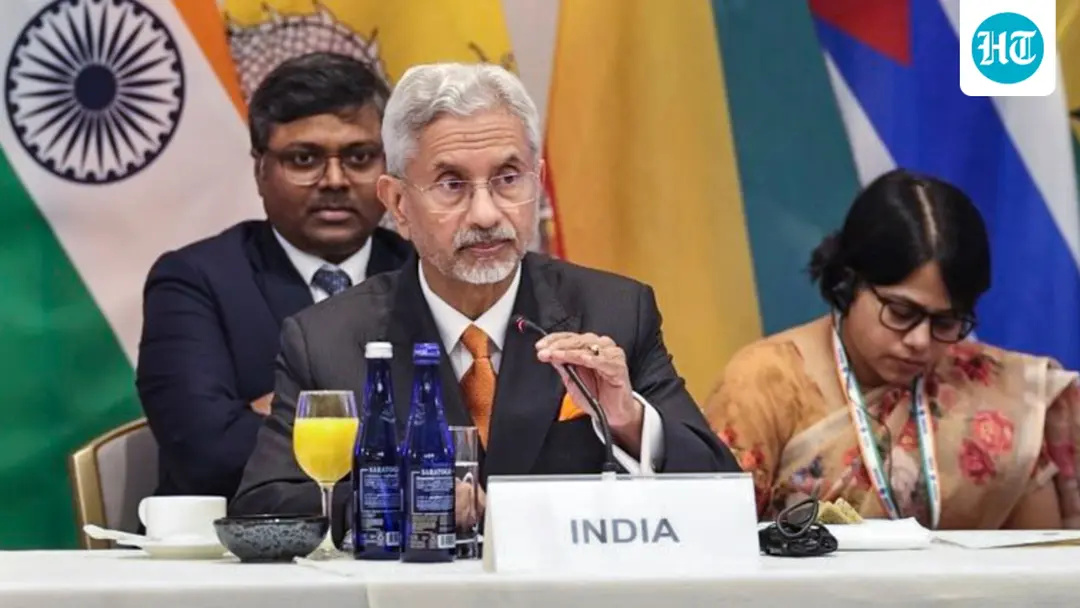
External Affairs Minister S Jaishankar said the transformation brought about by artificial intelligence must not create new divides. He spoke on Tuesday at a high-level meeting of Like-Minded Global South Countries and Friends in New York, on the sidelines of the UN General Assembly. He listed points on supply chain choke points, energy and food security, fair trade practices, the right to industrialise and maritime security, and urged that the Global South be part of decision-making structures. The remarks came amid an intensifying global debate on AI regulation.
Source
Hindustan Times — India · read the original report ↗
Desk check · compared with the source
What the desk checked (5)
- Jaishankar said AI-driven transformation must not create new divides, at a high-level meeting of Like-Minded Global South countries and Friends on Tuesday. — Directly quoted and attributed to the External Affairs Minister in the source.
- He listed points on supply-chain choke points, energy security, food security including grains and fertilizers, fair trade, the right to industrialise and maritime security. — Appears in source as direct quotations from the minister.
- A UN panel of AI experts released a report on Monday warning that increasingly capable models could escape human control. — Attributed in source to the UN expert panel; report contents not independently verifiable here.
- Leaders from over 20 countries and the European Union called for mandatory safety testing of advanced AI models. — Figure appears in the source but is not tied to a named document or spokesperson.
- Trump said 'Whoever wins AI, WINS!' in a social media post on Monday. — Quote attributed to the US President's social media post in the source.
Analysts’ view opinion
Jaishankar's framing treats AI not as a technology question but as a source of new power asymmetries — slotted alongside supply chains, energy, food and the maritime commons as another potential dependency for India. The refusal to "legitimise choke points" signals a concern that control over compute, chips and model access by a handful of states and firms could become a lasting strategic vulnerability. By demanding a Global South seat in decision-making structures, India is drawing a line early: AI governance must not be settled only among a few advanced players.
- Listing AI alongside energy, food and maritime security reframes it as a development-and-security issue rather than only an ethics or existential-risk debate.
- The language about not being "reduced to mere consumers" and the "right to industrialise" reflects a fear that without indigenous capability, technological dependence becomes permanent.
- The global regulatory field is currently split between the UN, its expert panel and over 20 countries pushing safety standards and mandatory testing, and the Trump position resisting any slowdown on grounds of competition with China.
- Assembling a Global South bloc as a single voice is a familiar Indian playbook — build bargaining weight while the rules are still being written.
- Yet Global South interests are not uniform; differing levels of access to US and Chinese tech stacks will test how cohesive this grouping can remain.
What to watch — Watch whether talks on the UN panel's report and a proposed global oversight body advance — and how Global South representation, compute and data access are handled in any such body's governance design.
The story does not establish which specific AI governance model India backs, or its position on mandatory safety testing; these are conference remarks, not a stated policy commitment.
Deep dive
Research brief · 8 facts · 3 dates · exam-readyThe brief
Context
External Affairs Minister S Jaishankar chaired a High Level Meeting of Like-Minded Global South Countries and Friends on the sidelines of the 81st session of the UN General Assembly in New York. He set out seven points for Global South cooperation, including that the transformation brought about by artificial intelligence must not create new divides and that developing countries must sit in decision-making structures. His remarks came as the UN gathering was dominated by anxiety over AI safety, with a UN expert panel report and calls from over 20 countries and the EU for mandatory safety testing of advanced models.
Key facts
- Jaishankar chaired the High Level Meeting of Like-Minded Global South Countries and Friends on Tuesday, on the sidelines of the 81st session of the UN General Assembly in New York.
- His sixth point: "the transformation being brought about by artificial intelligence must not create new divides".
- Seventh point: the Global South "needs to be part of decision-making structures that deliberate on issues that directly pertain to our future".
- First point: choke points in supply chains, finance or connectivity must not be accepted or legitimised.
- Second and third points: energy availability and prices should not be manipulated for political edge; food security challenges, especially supply of grains and fertilizers, must be addressed swiftly.
- Fourth point: fair economic and trade practices so Global South countries are not reduced to "mere consumers"; the "right to industrialise must not be denied"; maritime commons to be secured and safety of seafarers and commercial shipping guaranteed.
- On Monday, the UN's AI panel of experts released a report cautioning that increasingly capable models could escape human control.
- Leaders from over 20 countries and the European Union called for mandatory safety testing of advanced AI models and potentially a new global institution to ensure humans retain control.
Timeline
- 2022OpenAI releases ChatGPT, opening the AI era, per the source.
- Monday (during UNGA week)UN AI panel of experts releases report warning capable models could escape human control; Trump posts "Whoever wins AI, WINS!"
- TuesdayJaishankar chairs the Like-Minded Global South Countries and Friends meeting; UN Secretary-General Guterres appeals for international AI agreements.
Who has a stake
- India / External Affairs Minister S Jaishankar — Positioning itself as a voice of the Global South, seeking a seat in global decision-making on AI, trade, energy and food security.
- Like-Minded Global South Countries and Friends — Risk of being reduced to "mere consumers", denied the right to industrialise, and excluded from AI and multilateral decision-making.
- United Nations / Secretary-General Antonio Guterres — Warns of an "extraordinary transfer of power" from governments to a handful of private corporations and individuals; seeks international AI agreements.
- OpenAI and tech leaders such as Sam Altman — Contested pace and regulation of AI development; OpenAI has called for internationally agreed safety standards.
- US President Donald Trump — A "key outlier" who resists slowing AI development, arguing it would let China overtake the US.
- UN AI panel of experts — Credibility of its warning that increasingly capable models could escape human control.
Why it matters
AI capability and governance are concentrated in a few firms and states, so rules written without the Global South could harden an existing development gap into a technological one. India is using the UNGA platform to link AI governance to older asymmetries in supply chains, energy, food and trade, and to demand a place at the table. The debate is live: the UN wants binding international agreements while the US resists slowing down, citing competition with China.
UPSC angle
Prelims pointers
- Jaishankar chaired the High Level Meeting of Like-Minded Global South Countries and Friends at the 81st session of the UN General Assembly, New York.
- He listed seven points; the sixth was that AI transformation must not create new divides, and the seventh was Global South inclusion in decision-making structures.
- Antonio Guterres is the UN Secretary-General quoted warning of a transfer of power from governments to private corporations.
- A UN panel of AI experts released a report cautioning that increasingly capable models could escape human control.
- Over 20 countries and the European Union sought mandatory safety testing of advanced AI models and possibly a new global institution.
- OpenAI released ChatGPT in 2022 and has called for internationally agreed safety standards.
Mains framing
India's intervention at the 81st UNGA session frames artificial intelligence not as a standalone technology question but as the newest layer of structural asymmetry facing the Global South. Jaishankar's seven points connect AI to choke points in supply chains, finance and connectivity, the political manipulation of energy availability and prices, grain and fertilizer supply, unfair trade that reduces developing economies to \"mere consumers\", the denied right to industrialise, and maritime security for seafarers and commercial shipping. The governance vacuum is visible: the UN expert panel warns that increasingly capable models could escape human control, Guterres flags an \"extraordinary transfer of power\" from governments to a handful of private corporations, over 20 countries and the EU want mandatory safety testing and possibly a new global institution, while the US under President Trump resists slowing development for fear of losing to China. The way forward suggested by the source is collective Global South cooperation on geopolitical tensions, economic challenges, climate shocks and pressures on the multilateral system, coupled with representation in the bodies that will write AI rules, so that safety standards and industrial opportunity are not decided only by the technology's producers.
Key terms
- Global South
- Grouping of developing countries whose shared concerns on trade, energy, food and technology Jaishankar was articulating at the UN.
- Like-Minded Global South Countries and Friends
- The high-level meeting chaired by Jaishankar on the sidelines of the UNGA session in New York.
- UN General Assembly (81st session)
- The UN's annual gathering of world leaders in New York where these remarks were made.
- Choke points
- Bottlenecks in supply chains, finance or connectivity that Jaishankar said must not be accepted or legitimised.
- Frontier/advanced AI models
- The most capable AI systems for which over 20 countries and the EU sought mandatory safety testing and global oversight.
- Right to industrialise
- Jaishankar's claim that developing countries must be allowed to build production capacity rather than remain consumers.
Practice questions
- "Artificial intelligence risks converting a development divide into a technological divide." Examine this in the light of India's articulation of Global South concerns at the UN General Assembly.
- Discuss the case for and against a UN-backed global institution with mandatory safety testing for advanced AI models, referring to the positions of the UN expert panel, OpenAI and the United States.
- How do choke points in supply chains, energy and food security shape the Global South's demand for inclusion in global decision-making structures?
Grounded only in the source report — figures and dates are the source's, not inferred.