
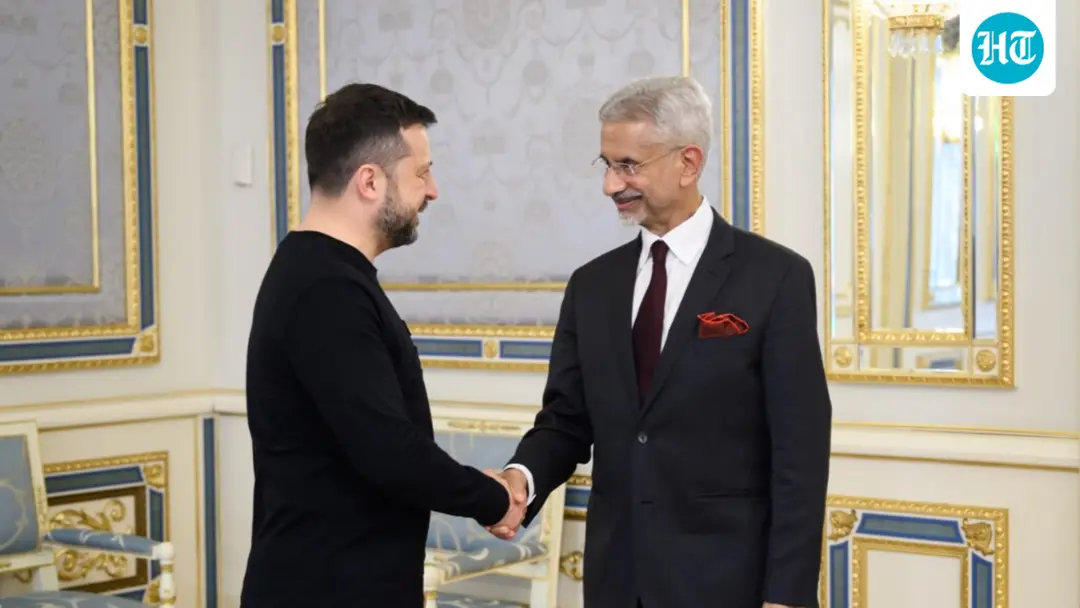
Zelensky says Russia's economy depends on India, seeks oil trade halt
Ukrainian President Volodymyr Zelensky told the Wall Street Journal that Russia bases its economy on India, and sometimes Turkey and China, and that Moscow would have to stop fighting if these countries ended energy trade with it. His remarks followed US President Donald Trump signing a Russia sanctions law allowing tariffs up to 100% on top Russian oil buyers, including India, China, Slovakia, Hungary and Azerbaijan. Russian supplies form roughly one-third to nearly half of India's crude imports.
Source
Hindustan Times — India · read the original report ↗
Desk check · compared with the source
What the desk checked (5)
- Zelensky said Russia bases its economy on India, sometimes Turkey and China, and would have to stop the war if they halted energy trade. — Direct quote attributed to Zelensky in a Wall Street Journal interview.
- Trump signed the Lindsey O Graham Sanctioning Russia and Iran Act, allowing tariffs up to 100% on top Russian oil buyers including India, China, Slovakia, Hungary and Azerbaijan. — Stated in source; named legislation and country list appear as reported facts without further citation.
- Zelensky hoped Trump would use the sanctions law if Putin declined to de-escalate. — Attributed to news agency Reuters in the source.
- Russian supplies account for roughly one-third to nearly half of India's crude imports recently. — Range figure appears in source with no agency or dataset cited.
- Russian Ambassador Denis Alipov said New Delhi buys oil for its own development, not to help Moscow. — Attributed by name and position; timing given only as 'earlier this month'.
Analysts’ view opinion
Zelensky's remarks are an attempt to shift pressure from the battlefield to Russia's economic supply chains — squeezing Moscow's oil revenue through its buyers rather than its front lines. For India this is a classic strategic bind: cheap crude underpins energy security and price stability, while the threat of US tariffs weighs on ties with Washington. Notably, the law Trump signed gives him authority for tariffs of up to 100%, and as leverage that threat may be worth more held in reserve than actually used.
- With Russia supplying roughly a third to nearly half of India's crude imports, any abrupt shift carries real strategic risk on price and supply security.
- Kyiv's aim is to close off Russian revenue streams rather than to cast India as an adversary, but the consequence lands directly on Delhi's strategic autonomy.
- India's stated position has been consistent: energy purchases follow market offers and sovereign energy security, a long-standing refusal to accept third-party sanctions logic.
- The episode of US tariffs on Indian goods doubling to 50% last year before being cut back suggests both sides understand that economic coercion imposes mutual costs.
- The story notes Turkey trimmed imports after drone attacks disrupted supply — a reminder that energy infrastructure is now a war target, and that is a supply-risk factor for Asian buyers too.
What to watch — Watch whether Trump actually invokes the tariff authority or keeps it as negotiating leverage, and whether Indian refiners quietly diversify sourcing as a hedge.
The story does not establish that India intends to cut Russian imports, nor when, against whom or at what level tariffs might be applied — and Zelensky's claim that halting oil trade would stop the war is his assessment, not an established fact.
Deep dive
Research brief · 8 facts · 5 dates · exam-readyThe brief
Context
Ukrainian President Volodymyr Zelensky, in an interview with the Wall Street Journal, argued that Russia's war economy rests on energy sales to countries such as India, and sometimes Turkey and China, and that Moscow would have to stop fighting if those buyers halted the trade. His comments came days after US President Donald Trump signed the Lindsey O Graham Sanctioning Russia and Iran Act, which empowers him to impose tariffs of up to 100% on the largest buyers of Russian oil — India, China, Slovakia, Hungary and Azerbaijan. India has become one of the biggest importers of Russian crude, which now accounts for roughly one-third to nearly half of its crude imports, and New Delhi defends this as a sovereign energy-security decision based on market offers.
Key facts
- Zelensky told the Wall Street Journal: "Russia is basing its economy on India, sometimes Turkey and China," and said Russia "will have to stop fighting the war" if they end energy trade with it.
- Trump signed the Lindsey O Graham Sanctioning Russia and Iran Act into law, granting him power to impose tariffs of up to 100% on top Russian oil buyers.
- The countries named as top Russian oil buyers under the law are India, China, Slovakia, Hungary and Azerbaijan.
- Russian supplies account for roughly one-third to nearly half of India's crude imports in recent times.
- The US doubled tariffs on Indian imports to 50% last year over the Russian energy trade, before eventually cutting them down.
- Turkey reportedly cut back on Russian energy imports after Ukrainian drone attacks disrupted supply; it is a major buyer of CPC Blend, Kazakh KEBCO and Urals grades.
- Speaking on the sidelines of the UNGA in New York, Zelensky said: "We need to do this as soon as possible, before winter, better before winter."
- Per Reuters, Zelensky said he hoped Trump would use the sanctions law if President Vladimir Putin declined to de-escalate the war.
Timeline
- Last yearThe US doubled tariffs on Indian imports to 50% over the Russian energy trade, before eventually reducing them.
- Earlier this month (as stated in the source)Russian Ambassador to India Denis Alipov defended India's purchases and slammed the US sanctions threat, saying Moscow remains committed to meeting New Delhi's energy demands.
- Days before Zelensky's remarksTrump signed the Lindsey O Graham Sanctioning Russia and Iran Act into law, allowing tariffs up to 100% on top Russian oil buyers.
- On the sidelines of the UNGA session in New YorkZelensky said he hoped the war would end before winter and that Trump would help end it.
- Same periodIn a Wall Street Journal interview, Zelensky said Russia bases its economy on India, sometimes Turkey and China, and urged an end to their energy trade with Russia.
Who has a stake
- Ukraine / President Zelensky — Wants Russia's oil revenues choked and the sanctions law used to pressure Putin so the war ends, preferably before winter.
- India — Faces risk of US tariffs up to 100% on exports while defending discounted Russian crude, which is one-third to nearly half of its imports, as sovereign energy security.
- United States / President Trump — Holds new statutory power to impose up to 100% tariffs on Russian oil buyers; must balance pressure on Moscow against ties with India and others.
- Russia — Its economy and war financing depend on energy exports to buyers like India, China and Turkey; Ambassador Alipov has publicly backed continued supplies to India.
- China, Slovakia, Hungary, Azerbaijan — Named among top Russian oil buyers and therefore exposed to the tariff provisions of the new US law.
- Turkey — A major buyer of CPC Blend, KEBCO and Urals grades that reportedly cut back imports after Ukrainian drone attacks disrupted supply.
Why it matters
India's crude sourcing has become a front in the Russia-Ukraine war, with a new US law creating the legal basis for tariffs of up to 100% on countries buying Russian oil. For India, which draws roughly one-third to nearly half of its crude from Russia, the issue links energy affordability and security directly to trade relations with Washington. The episode also shows how third countries' purchasing decisions are being framed as levers to shorten or prolong the war.
UPSC angle
Prelims pointers
- Lindsey O Graham Sanctioning Russia and Iran Act: US law signed by Trump allowing tariffs up to 100% on top buyers of Russian oil.
- Countries named as top Russian oil buyers: India, China, Slovakia, Hungary, Azerbaijan.
- Russian crude accounts for roughly one-third to nearly half of India's crude imports in recent times.
- US had doubled tariffs on Indian imports to 50% last year before cutting them down.
- Oil grades linked to Turkey's imports: CPC Blend, Kazakh KEBCO and Urals.
- Denis Alipov is Russia's Ambassador to India; Zelensky's remarks were made to the WSJ and on the UNGA sidelines in New York.
Mains framing
Zelensky's assertion that \"Russia is basing its economy on India, sometimes Turkey and China\" reframes India's crude imports as a variable in the Russia-Ukraine war rather than a purely commercial choice. The causes are structural: discounted Russian barrels met India's large import dependence, and Russian supplies came to constitute roughly one-third to nearly half of India's crude imports, while Moscow, through Ambassador Denis Alipov, committed to meeting Indian demand. The implications are now legal and economic — the Lindsey O Graham Sanctioning Russia and Iran Act gives the US President discretion to levy tariffs of up to 100% on top Russian oil buyers including India, and the precedent of last year's doubling of tariffs on Indian goods to 50%, later rolled back, shows how quickly energy policy can spill into trade. India's stated position is that import decisions follow market offers and sovereign energy security, which suggests a way forward built on diversifying crude sources, sustaining strategic autonomy through sanctions-compliant transactions, and negotiating with Washington so that secondary-tariff threats are not converted into action while the political track on ending the war, which Zelensky wants concluded before winter, plays out.
Key terms
- Lindsey O Graham Sanctioning Russia and Iran Act
- US law signed by Trump giving him power to impose tariffs of up to 100% on the biggest buyers of Russian oil.
- Secondary tariffs
- Duties imposed on third countries for trading with a sanctioned state, as envisaged against top Russian oil buyers in the new US law.
- Urals
- A Russian crude oil grade; named in the source among grades bought by Turkey.
- CPC Blend / KEBCO
- Oil grades linked to Caspian and Kazakh supplies that Turkey is a major buyer of, as per the source.
- UNGA
- United Nations General Assembly, on whose New York sidelines Zelensky spoke about ending the war before winter.
- Sovereign energy security
- India's stated basis for import decisions — choosing supplies according to market offers and its own energy needs.
Practice questions
- Critically examine how India's import of Russian crude, which accounts for roughly one-third to nearly half of its crude imports, tests the principle of strategic autonomy in a sanctions-driven global order.
- Discuss the implications of secondary tariffs of up to 100% under the Lindsey O Graham Sanctioning Russia and Iran Act for India's energy security and trade relations with the United States.
- "Energy trade decisions of third countries can shape the duration of conflicts." Evaluate this claim in light of Zelensky's statement on Russia's dependence on India, China and Turkey.
Grounded only in the source report — figures and dates are the source's, not inferred.