
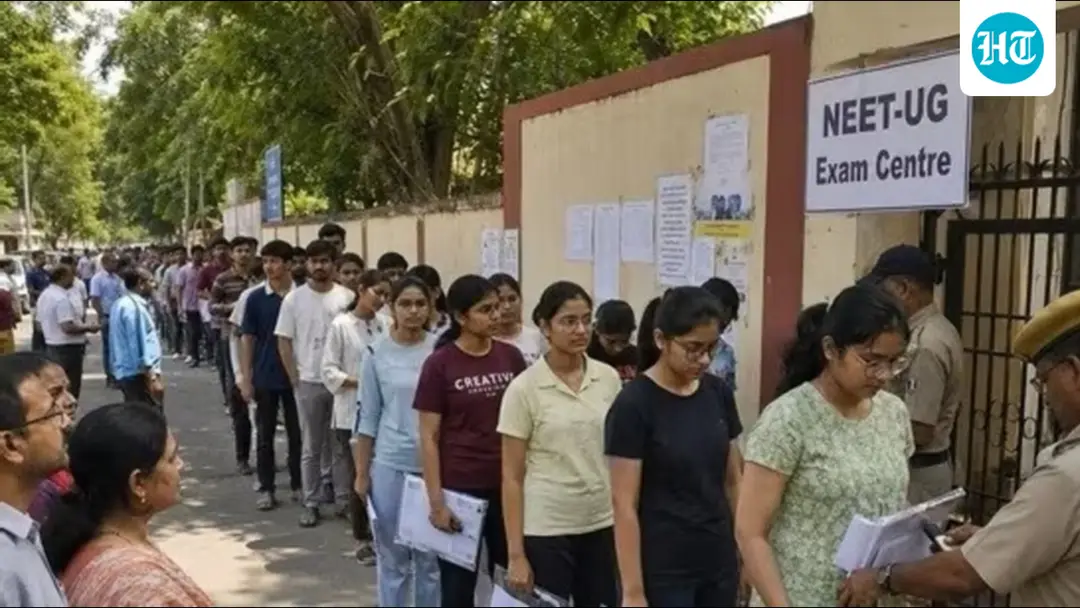
Two-stage NEET, permanent exam body among reform proposals
Stakeholders have submitted proposals to the Nandan Nilekani-led High-Powered Task Force (HPTF) on public examination reforms. These include a two-stage NEET, a permanent statutory examination authority through an Act of Parliament, an independent body to audit examination standards and encrypted transmission of question papers. Suggestions came from the ABVP, United Doctors Front and Educators Federation of India. The Centre constituted the six-member task force in July to examine the conduct, security, design and governance of public examinations, including those held by the NTA.
Source
Hindustan Times — India · read the original report ↗
Desk check · compared with the source
What the desk checked (5)
- A two-stage NEET, a permanent statutory national examination authority and an independent exam-standards audit body are among proposals submitted to the High-Powered Task Force. — Attributed in source to submissions by named stakeholder groups; contents of submissions not independently shown.
- ABVP proposed a two-stage model for major competitive exams and suggested examining the feasibility of holding NEET twice a year with the better score counted. — Attributed to ABVP in source, with quoted phrasing on question-paper security.
- UDF sought a permanent statutory examination authority through an Act of Parliament with divisions for cybersecurity, digital forensics, psychometrics, statistics and logistics. — Attributed to UDF; direct quotes cited in source.
- Educators Federation of India president Keshav Agarwal submitted a 15-page document proposing a two-stage NEET pilot with offline prelims and a single-day mains. — Specific figure and name appear in source, attributed to the document.
- The six-member HPTF was constituted by the Centre in July under Nandan Nilekani. — Stated as fact in source without citing an order or official document.
Analysts’ view opinion
The common thread running through these submissions is institutional: shift examination governance from ad-hoc arrangements to a permanent, statutory structure. A national exam authority created by an Act of Parliament, paired with an audit body kept away from day-to-day operations, is an attempt to fix an old design flaw — the operator and the regulator being the same entity — using a governance template already familiar from other sectors. But design changes such as a two-stage NEET cut both ways: they may shrink the high-security testing footprint while adding another hurdle, cost and coaching dependency for candidates, and that trade-off is not yet settled.
- The statutory-authority proposal rests on the argument that specialised capacity — cybersecurity, digital forensics, psychometrics, statistics, logistics — needs permanent trained staff rather than borrowed hands.
- Separating a standards-and-audit council from examination operations addresses the conflict of an agency effectively auditing itself.
- Encrypted transmission, GPS tracking, documented chain of custody and centre/room/booklet identifiers aim not only at prevention but at traceability, so a breach can be located rather than guessed at.
- The demand for predefined, objective criteria on cancellation versus re-examination is a direct response to the ambiguity seen in past exam crises, with proportionate remedies pitched against blanket re-tests.
- The contributors — a student organisation, a doctors' body and coaching-sector representatives — have differing stakes, so who a two-stage model ultimately serves deserves independent scrutiny.
What to watch — Watch which of these proposals survive into the Nilekani task force's recommendations, and in particular whether the Centre opts for a fresh legislative route or simply strengthens the existing NTA.
These are stakeholder suggestions only; the story does not establish that the task force or the government has accepted any of them, or when any change might take effect.
Deep dive
Research brief · 8 facts · 4 dates · exam-readyThe brief
Context
After repeated controversies over national entrance tests, including the NEET UG paper leak that led the National Testing Agency (NTA) to order a retest amid a CBI probe, the Centre in July constituted a six-member High-Powered Task Force (HPTF) headed by Infosys co-founder Nandan Nilekani to recommend reforms in the conduct, security, design and governance of public examinations, including those run by the NTA. The task force invited inputs from students, parents, teachers, academic institutions, examination bodies and technology experts to make the system "robust, secure, transparent, equitable and future-ready". Stakeholders such as the ABVP, United Doctors Front (UDF) and the Educators Federation of India have now submitted proposals. These range from a two-stage NEET and encrypted question-paper transmission to a permanent statutory examination authority created by an Act of Parliament.
Key facts
- The six-member High-Powered Task Force on public examination reforms was constituted by the Centre in July under Nandan Nilekani, Infosys co-founder.
- The HPTF's mandate covers the conduct, security, design and governance of public examinations, including those conducted by the National Testing Agency (NTA).
- ABVP, the RSS-affiliated student body, has proposed a two-stage model for major competitive exams: stage one for shortlisting, stage two for final selection.
- ABVP has also asked that the feasibility of holding NEET twice a year be examined, with the better score considered.
- UDF has sought a permanent statutory examination authority through an Act of Parliament, with divisions for cybersecurity, digital forensics, psychometrics, statistics and exam logistics.
- UDF has proposed a standardised chain of custody for question papers recording identities, time, location and condition, with GPS tracking and tamper-evident packaging for physical transport.
- A 15-page document from Educators Federation of India president Keshav Agarwal proposes a two-stage NEET pilot: a broad offline prelims followed by a secured single-day mains.
- The Educators Federation has proposed a permanent 'National Assessment Integrity and Standards Council', separate from daily exam operations, to set technical standards, accredit centres, empanel auditors and review psychometric reports.
Timeline
- Earlier (undated in source)NTA orders a retest for NEET UG as the CBI probes a paper leak; reports trace how NEET questions moved from NTA's Delhi building to Pune.
- JulyThe Centre constitutes the six-member High-Powered Task Force under Nandan Nilekani on public examination reforms.
- After constitution of HPTFHPTF invites inputs from students, parents, teachers, institutions, examination bodies and technology experts.
- Latest developmentABVP, United Doctors Front and Educators Federation of India submit proposals on exam security, design, governance, technology and student well-being.
Who has a stake
- High-Powered Task Force (HPTF) under Nandan Nilekani — Must convert stakeholder proposals into a credible reform blueprint for exam conduct, security, design and governance.
- National Testing Agency (NTA) — Its capacity, staffing and processes are under review; proposals could replace or restructure it with a permanent statutory authority.
- Aspirants for NEET-UG and JEE — Exam architecture, number of attempts, centre standards, normalisation and re-examination rules directly affect their careers.
- ABVP (RSS-affiliated student body) — Pushing two-stage exams, twice-yearly NEET, stronger paper security and independent security audits.
- United Doctors Front (UDF) — Doctors' and medical students' body seeking a statutory exam authority and predefined rules for compromised examinations.
- Educators Federation of India (coaching sector) — Proposes two-stage NEET pilot, encrypted transmission and an oversight council; coaching industry is shaped by exam design.
- Union government / Parliament — Would have to legislate a statutory examination authority and fund infrastructure and oversight bodies.
Why it matters
NEET-UG and JEE decide the fate of millions of aspirants each year, and leaks and cancellations shake public trust in merit-based selection. The proposals shift the debate from ad hoc firefighting to institutional design: a statutory exam body with specialised manpower, auditable paper custody and predefined rules on cancellation or re-examination. How the Nilekani task force weighs these ideas will shape the credibility of India's high-stakes testing system for years.
UPSC angle
Prelims pointers
- High-Powered Task Force on public examination reforms: six members, constituted by the Centre in July, chaired by Nandan Nilekani, Infosys co-founder.
- HPTF mandate: conduct, security, design and governance of public examinations, including those held by the NTA.
- NTA conducts NEET-UG and JEE; it ordered a NEET UG retest while the CBI probed a leak.
- UDF proposal: permanent statutory national examination authority via an Act of Parliament, with cybersecurity, digital forensics and psychometrics divisions.
- Educators Federation of India proposal: 'National Assessment Integrity and Standards Council' for standards, centre accreditation and auditor empanelment.
- ABVP proposal: two-stage competitive exams (shortlisting + final selection) and feasibility of NEET twice a year with the better score counted.
Mains framing
India's national entrance examinations have suffered a credibility crisis, exemplified by the NEET-UG leak that forced a retest under CBI investigation, exposing weaknesses in paper custody, centre standards and institutional capacity. The proposals before the Nilekani-led HPTF diagnose the problem as structural rather than incidental: the NTA is seen as lacking permanent, specialised manpower, hence UDF's demand for a statutory authority created by an Act of Parliament with divisions for cybersecurity, digital forensics, psychometrics, statistics and logistics. Design reform is the second strand: two-stage examinations, with a broad offline prelims narrowing the field before a secured single-day mains, would cut the number of candidates needing high-security computer-based testing infrastructure, while a twice-yearly NEET with the better score counted addresses fairness to candidates. Third, process integrity is sought through encrypted transmission to secure print cells, printing shortly before the exam under CCTV and dual custody, centre-room-booklet identifiers for traceability, GPS tracking and tamper-evident packaging. Fourth, oversight must be separated from operations, hence a permanent National Assessment Integrity and Standards Council to set standards, accredit centres and empanel auditors. Finally, predefined, proportionate remedies based on objective criteria, with wider re-examination only for systemic breaches, would reduce the arbitrariness that harms lakhs of innocent candidates.
Key terms
- High-Powered Task Force (HPTF)
- Six-member panel set up by the Centre in July under Nandan Nilekani to recommend reforms in public examinations.
- National Testing Agency (NTA)
- Central body conducting national entrance tests such as NEET-UG and JEE, whose functioning is within the HPTF's remit.
- Two-stage NEET
- Proposed structure with a broad prelims for shortlisting followed by a secured mains for final selection.
- Chain of custody
- Documented record of who handed over and received question papers, with time, location and condition of the material.
- National Assessment Integrity and Standards Council
- Permanent oversight body proposed by the Educators Federation to issue technical standards, accredit centres and empanel auditors.
- Normalisation
- Statistical adjustment of scores across exam shifts or sessions; ABVP wants it made transparent.
Practice questions
- Examine whether a permanent statutory national examination authority created by an Act of Parliament would address the structural weaknesses exposed by recent entrance-test irregularities.
- Discuss the advantages and risks of restructuring NEET into a two-stage examination and of conducting it twice a year.
- 'Integrity of high-stakes examinations depends as much on process design as on punishment.' Critically analyse with reference to proposals on question-paper custody, encrypted transmission and independent audits.
Grounded only in the source report — figures and dates are the source's, not inferred.