
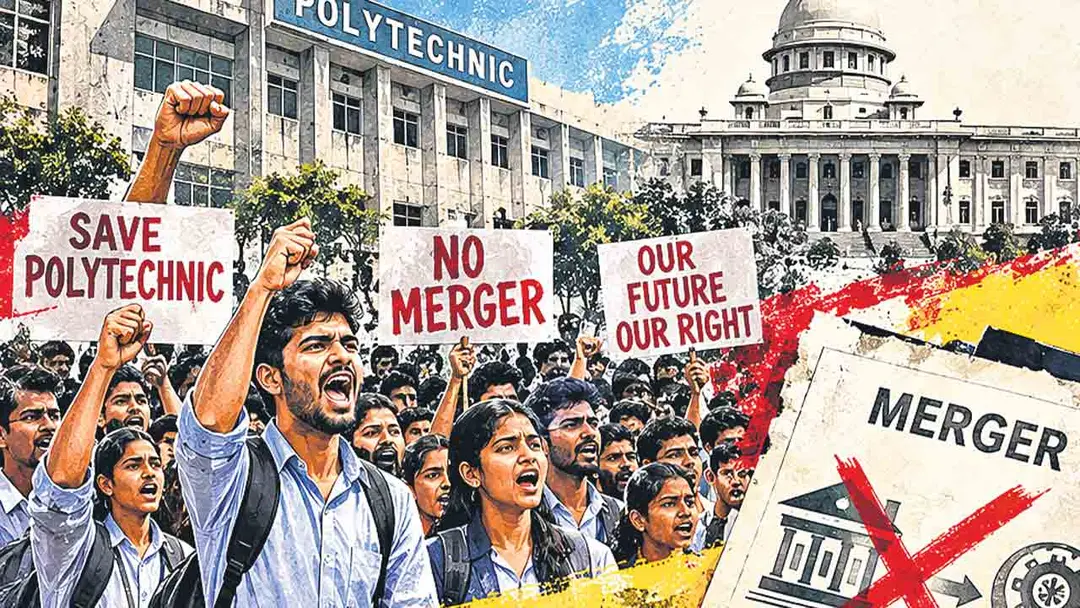
Telangana withdraws polytechnic merger decision after student protest
Following an agitation by students and lecturers, the Telangana government has withdrawn its decision to merge polytechnic colleges into Young India Skill University and place staff under the Shakti (labour) department. The government clarified that the colleges will remain under the technical education department and that diploma courses, AICTE norms and examination procedures stay unchanged. Government advisor Dr K Keshava Rao conveyed this to polytechnic JAC leaders on Sunday. The protest against GO 97 ran 38 days.
Source
Namasthe Telangana · read the original report ↗
Desk check · some claims need care
What the desk checked (4)
- Telangana government withdrew the decision to merge polytechnic colleges into Young India Skill University and to place staff under the Shakti (labour) department. — Reported by the source; attributed to information given to polytechnic JAC leaders by government advisor Dr K Keshava Rao — no official order text quoted.
- Students and lecturers protested for 38 days against GO 97. — Internally inconsistent — headline and lead say 38 days, a subhead says 35 days and the body says 37 days.
- Polytechnic colleges will remain under the technical education department, with no change to diploma courses, AICTE norms or exam pattern. — Attributed to a government clarification as reported; no named official quoted verbatim.
- A high-level committee chaired by Keshava Rao held talks with lecturers and with students at the SCERT auditorium, Basheerbagh, on Saturday, and submitted a report to CM Revanth Reddy on Sunday. — Dates and venue appear in the source; the report's recommendation is stated as 'according to information', i.e. unattributed.
Analysts’ view opinion
This reads less like a bad policy idea and more like a badly sequenced one: consolidating skill and technical education under one roof has a defensible logic, but the 38-day agitation suggests GO 97 went out without consulting students and faculty or spelling out transition effects. The questions students reportedly put to the committee — AICTE recognition, diploma course conduct, exam pattern, employees' service future — are precisely the things a well-drafted order should have answered up front. Withdrawing the merger and restoring the status quo on the high-level committee's advice shows a government willing to correct course; it also means the reform agenda is back at square one.
- Merging institutions into a skill university while shifting staff to the Labour (Shakti) department meant changing two different jurisdictions — academic and service — at once, which multiplies implementation risk.
- The protest's core was not sentiment alone but the absence of upfront clarity on recognition, course delivery, examinations and job security during transition.
- Diploma students largely come from smaller towns and weaker economic backgrounds, so even uncertainty over recognition feels like a high-stakes loss for a cohort with little cushion to absorb risk.
- Setting up a high-level committee, negotiating with the JAC and then withdrawing is a familiar consult-after-conflict pattern in Indian administrative restructuring.
- Restoring the old arrangement is relief, not resolution — the underlying question of aligning polytechnic education with industry demand remains on the policy table.
What to watch — Watch for whether a formal order rescinding or amending GO 97 is issued, and how the government takes forward the rest of the KK committee's recommendations.
The story records an assurance conveyed by the government advisor to JAC leaders; it does not establish that a formal order revoking GO 97 has been issued, or whether the merger idea is abandoned outright or merely deferred.
Deep dive
Research brief · 8 facts · 6 dates · exam-readyThe brief
Context
The Telangana government had issued GO 97 proposing to merge government polytechnic colleges into the Young India Skill University and to shift polytechnic staff to the Shakti (labour) department. Students and lecturers launched an agitation against the order, with lecturers resorting to non-cooperation, arguing that courses, examinations, AICTE recognition, employee futures and student interests were left unclear. The government set up a high-level committee headed by government advisor Dr K Keshava Rao, which held talks with lecturers' and students' JAC leaders. After the committee's report to Chief Minister Revanth Reddy, the government withdrew the merger decision and announced that polytechnic education would continue under the technical education department as before.
Key facts
- The Telangana government withdrew its decision to merge polytechnic colleges into the Young India Skill University and to place staff in the Shakti (labour) department.
- The student agitation against GO 97 ran for 38 days; the report also refers to 37 days of joint student-lecturer protest.
- Government advisor Dr K Keshava Rao conveyed the withdrawal to polytechnic JAC leaders on Sunday (September 20, as datelined from Hyderabad).
- The government clarified that polytechnic colleges will remain within the (government) technical education ambit, and the technical education department and board will continue as they are.
- It stated there will be no change in conducting diploma courses and that AICTE-related matters and examination procedures will remain in the old pattern.
- A high-level committee chaired by Keshava Rao included Professor Kodandaram, Shantha Sinha, Naveen Mittal, technical education commissioner Sridevasena and Shakti department commissioner Harichandana.
- The committee first held talks with lecturers' JAC leaders and met students on Saturday at the SCERT auditorium, Bashirbagh.
- Polytechnic JAC chairman Nagaraju, secretary general Sravan Kumar, co-chairman Abhinav, convener Suresh and Sriram thanked the committee.
Timeline
- Before the agitationGO 97 issued proposing merger of polytechnic colleges into Young India Skill University and shifting staff to the Shakti (labour) department.
- For 38 days (37 days of joint protest)Students agitate across colleges and lecturers observe non-cooperation demanding withdrawal of GO 97.
- During the agitationGovernment constitutes a high-level committee chaired by advisor Dr K Keshava Rao; it first holds talks with lecturers' JAC leaders.
- SaturdayCommittee holds talks with students at the SCERT auditorium, Bashirbagh; students pose dozens of questions and refuse to accept the merger.
- SundayKeshava Rao meets the Chief Minister, submits a comprehensive report recommending continuation of the old system and withdrawal of the merger proposal.
- SundayKeshava Rao informs polytechnic JAC leaders that the merger decision is withdrawn; September 21, 2026, 04:41 AM IST timestamp on the report.
Who has a stake
- Polytechnic students — Clarity on diploma courses, examinations, AICTE recognition and the value of their qualifications; they led the 38-day agitation.
- Polytechnic lecturers and employees — Their service conditions and department of posting; they resisted transfer to the Shakti (labour) department through non-cooperation.
- Telangana government / Chief Minister Revanth Reddy — Credibility of its skill-education restructuring via GO 97, which it had to roll back under protest pressure.
- Young India Skill University — Was to absorb polytechnic colleges; the merger stands withdrawn.
- High-level committee (Dr K Keshava Rao, Kodandaram, Shantha Sinha, Naveen Mittal, Sridevasena, Harichandana) — Tasked with talks and recommendations; its report preceded the government's reversal.
- Technical education department and board — Retain control of polytechnic colleges, diploma courses and examinations as before.
- Polytechnic JAC (Nagaraju, Sravan Kumar, Abhinav, Suresh, Sriram) — Led negotiations as the representative body of the agitation and secured the withdrawal.
Why it matters
Polytechnic diplomas are AICTE-linked technical qualifications, so shifting colleges to a skill university and staff to the labour department raised unresolved questions about course recognition, examinations and employee futures. The rollback shows how a sustained, peaceful student-teacher agitation, combined with a consultative committee mechanism, can force a government to reverse an administrative order. It also underlines that structural reform in technical education needs prior clarity for students before implementation.
UPSC angle
Prelims pointers
- GO 97 (Telangana): order proposing merger of polytechnic colleges into Young India Skill University and staff into the Shakti (labour) department; now withdrawn.
- AICTE norms and examination procedures for diploma courses continue unchanged under the technical education department.
- High-level committee on the issue was chaired by government advisor Dr K Keshava Rao.
- Committee members named: Professor Kodandaram, Shantha Sinha, Naveen Mittal, technical education commissioner Sridevasena, Shakti department commissioner Harichandana.
- Students' talks with the committee were held at the SCERT auditorium, Bashirbagh, Hyderabad.
- The protest against GO 97 lasted 38 days before the withdrawal was announced on Sunday.
Mains framing
The Telangana rollback of GO 97 illustrates the tension between skill-oriented restructuring of technical education and the institutional safeguards students depend on. The government's intent was to bring polytechnic colleges under the Young India Skill University and locate staff in the Shakti (labour) department, but the order did not settle questions on diploma course conduct, examination systems, AICTE recognition, employee service conditions and student benefits — the very issues students placed before the high-level committee, which the source says officials could not answer. A 38-day peaceful agitation plus lecturers' non-cooperation converted an administrative decision into a political cost, and the Keshava Rao committee's report to the Chief Minister recommended continuing the old system. The way forward suggested by the episode is process-led reform: stakeholder consultation before issuing orders, explicit protection of statutory recognition and examination continuity, written clarity on staff redeployment, and institutional grievance mechanisms rather than post-facto committees. It also raises the broader question of how skill universities can complement, rather than absorb, existing regulated diploma institutions.
Key terms
- GO 97
- Telangana government order providing for merger of polytechnic colleges into the skill university and staff into the Shakti department; effectively withdrawn.
- Young India Skill University
- Telangana skill university into which polytechnic colleges were to be merged under GO 97.
- Shakti (labour) department
- Telangana department to which polytechnic employees were to be allotted; the allotment has been put on hold.
- AICTE
- All India Council for Technical Education; its norms govern diploma/technical courses and remain unchanged, per the government.
- Polytechnic JAC
- Joint Action Committee of polytechnic students/lecturers that led the agitation; led by chairman Nagaraju and secretary general Sravan Kumar.
- High-level committee
- Panel chaired by government advisor Dr K Keshava Rao formed to hold talks and report to the Chief Minister on the merger issue.
Practice questions
- Examine how stakeholder consultation deficits in administrative orders can derail education reform, using the withdrawal of Telangana's GO 97 as a case study.
- Skill universities are seen as the future of vocational education, but existing polytechnic institutions carry statutory recognition. Discuss how the two can be integrated without harming student interests.
- Evaluate the role of committees headed by government advisors in resolving agitations, with reference to the Keshava Rao committee on polytechnic education in Telangana.
Grounded only in the source report — figures and dates are the source's, not inferred.