
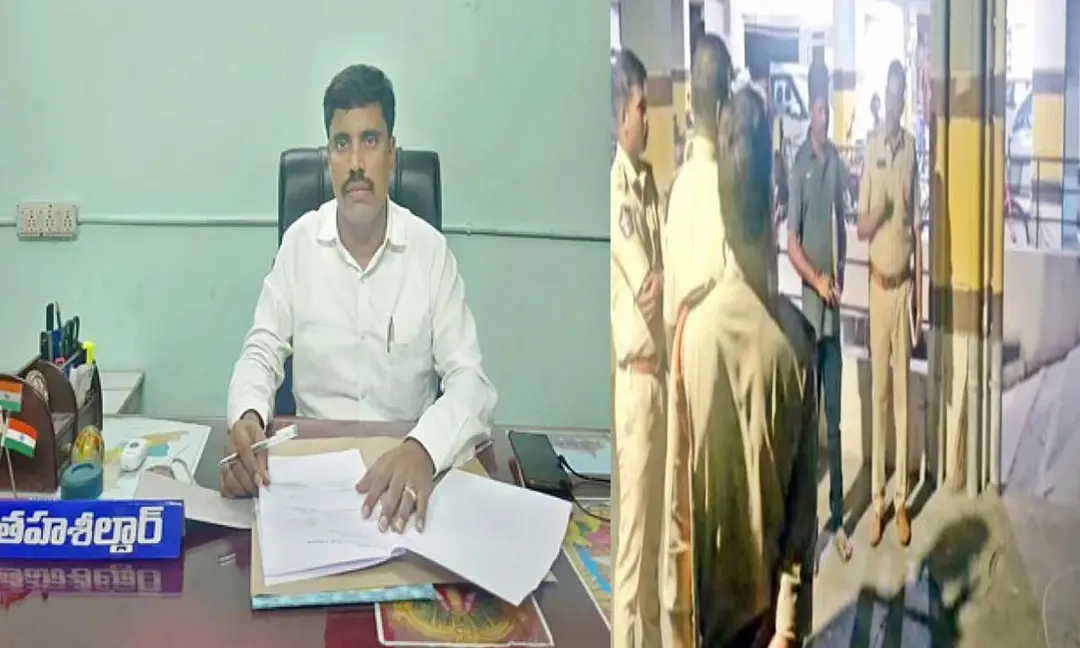
Visakhapatnam tahsildar killed in iron rod attack
Chinagadili rural tahsildar Ramanaiah died after being attacked with an iron rod in Visakhapatnam district. An unidentified man came to Charan Castor Apartment in Kommadi on Friday night and spoke with Ramanaiah before an argument broke out, after which he struck him with a rod and fled. Ramanaiah suffered severe head injuries and died while under treatment at a private hospital. Police registered a case and are searching for the accused. The city commissioner inspected the spot. Ramanaiah, from Srikakulam district, is survived by his wife and two children.
Source
Visakhapatnam — నేరాలు · read the original report ↗
Desk check · some claims need care
What the desk checked (5)
- Chinagadili rural tahsildar Ramanaiah was attacked with an iron rod at Charan Castor Apartment in Kommadi on Friday night and died during treatment at a private hospital. — Stated as fact in the source; no investigating officer or hospital named.
- An unidentified man came to the apartment, spoke with Ramanaiah, and attacked him after an argument before fleeing. — Narrative detail given without attribution to police or eyewitnesses.
- Residents of the apartment tried to catch the assailant but failed. — Appears in source; no named witness.
- Police have registered a case and begun a search for the accused; the city police commissioner inspected the spot and the collector and CP visited the hospital. — Official actions reported in source; officials not named.
- Ramanaiah was from Srikakulam district, earlier served as Visakha rural tahsildar, and is survived by his wife and two children. — Biographical details stated in source without attribution.
Analysts’ view opinion
On the facts as reported, this will be investigated as a homicide: a blow to the head with an iron rod, followed by death in hospital, falls squarely within the law on culpable homicide. But with the assailant still unidentified and no motive established, it is premature to say which offence will ultimately be charged — whether murder or the lesser category of culpable homicide not amounting to murder turns on intention, premeditation and any question of provocation. Because the deceased was a serving revenue official, whether the attack was connected to his official duties is likely to become a central line of inquiry.
- The account says the assailant arrived already carrying the iron rod, and that element of prior preparation will matter to how investigators frame intent — though it is something that must be proved in court, not assumed.
- Since death occurred during hospital treatment, the post-mortem findings and the causal link between the assault and the death will form the evidentiary spine of the case.
- With an unidentified attacker, identification evidence — eyewitness residents, any CCTV, call records — becomes the most sensitive part of the process, and identification procedures carry their own legal safeguards.
- The killing of a government officer brings political and administrative pressure for quick results; speed is legitimate, but it cannot be allowed to erode the presumption of innocence or fair-trial protections for whoever is arrested.
- The family left behind — a wife and two children — may have avenues under victims' rights provisions regarding information on the investigation and compensation, though the story says nothing on this.
What to watch — Watch for an arrest and, crucially, which sections are invoked in the charge documents, and whether investigators treat the motive as personal or duty-related.
The story establishes neither the motive, nor the assailant's identity or relationship to the victim, nor the specific offences registered in the FIR.
Deep dive
Research brief · 8 facts · 5 dates · exam-readyThe brief
Context
A serving revenue official in Andhra Pradesh was murdered at his residence in Visakhapatnam. Ramanaiah, tahsildar of Chinagadili (rural) mandal, was attacked with an iron rod late on Friday night at the Charan Castor Apartment in Kommadi where he lived, and died while undergoing treatment at a private hospital. A tahsildar is the mandal-level revenue officer who handles land records, revenue collection and certificates, work that often brings officials into conflict with parties in land disputes. The report, published on 3 February 2024, says the accused is unidentified, a case has been registered and police are searching for him; the source does not state a motive.
Key facts
- Ramanaiah, tahsildar of Chinagadili rural in Visakhapatnam district, was attacked with an iron rod and died during treatment.
- The attack took place late on Friday night at Charan Castor Apartment in Kommadi, where Ramanaiah lived.
- An unidentified man came to the apartment; the two spoke briefly before an argument escalated and he struck Ramanaiah with an iron rod he had brought.
- The assailant fled the spot; apartment residents tried to catch him but failed.
- Ramanaiah suffered severe head injuries and was shifted to a nearby private hospital, where he died.
- Ramanaiah had earlier served as Visakha rural tahsildar and was described by others as honest in discharging his duties.
- Police registered a case, began investigation and are searching intensively for the accused; the city Commissioner of Police inspected the scene.
- The District Collector and the CP visited the hospital to enquire about the incident.
Timeline
- Friday night (late)An unidentified man arrives at Charan Castor Apartment, Kommadi; after an argument he attacks tahsildar Ramanaiah with an iron rod and flees.
- Immediately after the attackResidents try but fail to catch the assailant; family members shift the severely injured Ramanaiah to a local private hospital.
- While under treatmentRamanaiah dies of severe head injuries.
- After the deathPolice register a case and launch a manhunt; the city CP inspects the spot and the Collector and CP visit the hospital.
- 3 February 2024Report published stating the incident has caused alarm across the state.
Who has a stake
- Tahsildar Ramanaiah (deceased) — Lost his life in the attack; was the mandal revenue officer of Chinagadili rural, earlier Visakha rural tahsildar.
- Ramanaiah's family — Wife and two children survive him; family members were the ones who rushed him to hospital.
- Visakhapatnam city police / Commissioner of Police — Registered the case, investigating and searching for the absconding accused; CP inspected the crime scene.
- District Collector, Visakhapatnam — Administrative head of the revenue machinery to which the victim belonged; visited the hospital to enquire.
- Revenue department officials in Andhra Pradesh — Safety of field-level officers handling land and revenue work; the source says the incident caused alarm statewide.
- Apartment residents of Charan Castor Apartment, Kommadi — Witnesses to the attack who attempted to catch the fleeing assailant.
Why it matters
The killing of a serving mandal-level revenue officer at his own residence raises questions about the personal security of field officials who deal with land records and revenue disputes. The source notes the incident created alarm across Andhra Pradesh, and with the accused still unidentified and absconding, the police response and the motive remain central to the case.
UPSC angle
Prelims pointers
- Tahsildar is the mandal-level revenue officer in Andhra Pradesh and Telangana, working under the District Collector.
- Victim: Ramanaiah, Chinagadili rural tahsildar, Visakhapatnam district; earlier Visakha rural tahsildar.
- Crime scene: Charan Castor Apartment, Kommadi, Visakhapatnam; weapon used was an iron rod.
- Ramanaiah's native district was Srikakulam; report published 3 February 2024.
- Officials who responded: city Commissioner of Police (inspected the spot) and the District Collector (visited the hospital).
Mains framing
The murder of Chinagadili rural tahsildar Ramanaiah with an iron rod at his residential apartment in Kommadi illustrates the vulnerability of frontline revenue functionaries, who form the interface between the citizen and the state on land records, revenue collection and certification. As the source records, the assailant came to the apartment, spoke with the officer, and attacked him after an argument before escaping despite residents' attempts to stop him; he remains unidentified, so motive cannot be attributed on available evidence. The implications are twofold: a law-and-order question of prompt detection and prosecution, reflected in the police case, the manhunt and the visits by the Commissioner of Police and the District Collector, and an administrative question of protecting officers who take decisions in contested matters, especially those described, as the victim was, as honest in discharging duties. A grounded way forward lies in swift and transparent investigation, threat-assessment and protection protocols for revenue staff both in office and at residence, and institutional support to the bereaved family, while avoiding conclusions about cause until the investigation establishes facts.
Key terms
- Tahsildar
- The revenue officer in charge of a mandal/tehsil, responsible for land records, revenue and certificates; the victim held this post at Chinagadili rural.
- Chinagadili
- The rural mandal in Visakhapatnam district where Ramanaiah was serving as tahsildar.
- Kommadi
- The locality in Visakhapatnam where Charan Castor Apartment, the victim's residence and the crime scene, is situated.
- Commissioner of Police (CP)
- Head of the city police; the Visakhapatnam CP inspected the crime scene and visited the hospital with the Collector.
- District Collector
- The district's chief revenue and administrative officer, under whom tahsildars function; visited the hospital after the attack.
Practice questions
- Discuss the security and institutional challenges faced by mandal-level revenue officials in India, using the killing of the Chinagadili tahsildar as a reference point.
- What is the role of a tahsildar in the revenue administration of a district, and how does the District Collector supervise this tier?
- Examine how prompt investigation and protection protocols for public servants can strengthen public confidence in land and revenue administration.
Grounded only in the source report — figures and dates are the source's, not inferred.