
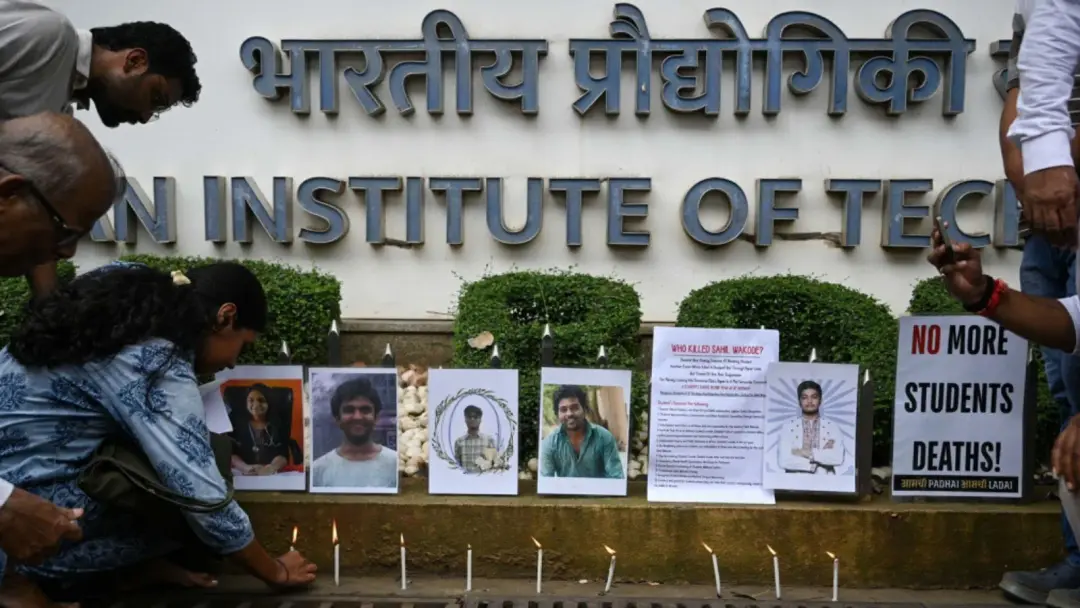
IIT faculty seek clear rules, counselling in exam malpractice cases
Faculty at several IITs have begun discussions on clear protocols for handling examination malpractice after IIT Bombay student Sahil Wakode's alleged death by suicide on September 18. The IIT Kharagpur Teachers Association, in a statement on Tuesday, urged all IITs to frame "clear, compassionate guidelines", including on unauthorised digital devices and generative AI, and said reported students must get immediate counselling. Faculty from IIT Madras, Delhi, Kharagpur, Indore and Kanpur backed invigilator Professor Suryanarayana Doolla.
Source
Indian Express — India · read the original report ↗
Desk check · some claims need care
What the desk checked (5)
- IIT Bombay student Sahil Wakode died on September 18, allegedly by suicide, after allegedly being found using a mobile phone and ChatGPT during a test. — Source reports it as alleged throughout; no police or institute statement cited — must stay attributed and hedged.
- IIT Kharagpur Teachers Association statement on Tuesday urged all IITs to frame clear, compassionate guidelines on malpractice, including unauthorised devices and generative AI. — Attributed to a dated written statement by the named association; quoted directly in source.
- Faculty from IIT Madras, Delhi, Kharagpur, Indore and Kanpur backed invigilator Professor Suryanarayana Doolla. — Stated in source; individual faculty other than V Ramgopal Rao are unnamed or anonymous.
- Former IIT Delhi director V Ramgopal Rao proposed a flexible five-year BTech model. — Attributed to a post on X by a named person, with direct quotes in source.
- The August 2025 IIT Council meeting recommended a structured mental health cadre with sanctioned posts for counsellors, psychologists and psychiatrists. — Attributed to meeting minutes referenced in the source; figures for posts not given.
Analysts’ view opinion
This is less a disciplinary incident story than the exposure of a policy vacuum. What IIT faculty bodies are pointing to is the absence of clear, uniform protocols covering every stage — from the moment malpractice is detected, through inquiry and penalty, to the student's psychological care. The debate also reveals that old "copying" rules no longer fit an era of unauthorised digital devices and generative AI tools.
- The demand cuts both ways: dignity and immediate counselling for the accused student, and clear protection for the invigilator doing his job — without written rules, both are left exposed.
- The core design gap is definitional: what exactly counts as a violation involving digital devices or AI tools, and what graded penalty follows, remains unsettled.
- The August 2025 IIT Council recommendation for a structured mental health cadre shows intent, but the minutes themselves concede it depends on creating sanctioned posts for counsellors, psychologists and psychiatrists — and on funding.
- Faculty proposals to place counsellors in hostels and dining halls are sensible outreach design, but staffing numbers and linguistic diversity are serious implementation constraints.
- The former IIT Delhi director's flexible five-year BTech idea — pace set by performance within the institute rather than entrance rank — is a structural reform, but it would require changes to credit, fee and hostel norms.
What to watch — Watch the senate/director meeting the IIT Delhi Faculty Forum is seeking and the next IIT Council decisions, to see whether these demands harden into guidelines common to all IITs or remain institution-by-institution discretion.
The circumstances of Sahil Wakode's death remain at the level of allegation, and the story establishes only that faculty bodies are discussing and recommending changes — no IIT has yet announced formal new rules.
Deep dive
Research brief · 8 facts · 4 dates · exam-readyThe brief
Context
IIT Bombay student Sahil Wakode allegedly died by suicide on September 18, the same day he was allegedly found using a mobile phone and ChatGPT during a test. The death sparked widespread protests at the institute and put the invigilator, Professor Suryanarayana Doolla, who allegedly detected the violation, at the centre of public criticism. Faculty across several IITs have since begun discussions on framing clear protocols for handling examination malpractice sensitively and ensuring students get timely emotional support.
Key facts
- IIT Bombay student Sahil Wakode allegedly died by suicide on September 18, the same day he was allegedly caught using a mobile phone and ChatGPT during a test.
- His death sparked widespread protests at IIT Bombay.
- The IIT Kharagpur Teachers Association, in a statement on Tuesday, said the tragedy 'underscores an urgent, systemic imperative'.
- The association urged all IITs to frame 'clear, compassionate guidelines' on examination malpractice, including unauthorised digital devices and generative AI tools.
- It said any student reported for malpractice should immediately receive counselling and wellness monitoring.
- Faculty from IIT Madras, Delhi, Kharagpur, Indore and Kanpur extended support to invigilator Professor Suryanarayana Doolla.
- Former IIT Delhi director V Ramgopal Rao, in a post on X, called Doolla 'one of the finest faculty members' in the IIT system and proposed a flexible five-year BTech format.
- The last IIT Council Meeting in August 2025 recommended creating a structured mental health cadre within IITs, with sanctioned posts for counsellors, psychologists and psychiatrists.
Timeline
- August 2025IIT Council Meeting discusses mental health and wellness; recommends a structured mental health cadre with sanctioned posts for counsellors, psychologists and psychiatrists; IIT Gandhinagar asked to refer to Rehabilitation Council of India guidelines.
- September 18IIT Bombay student Sahil Wakode allegedly dies by suicide, the same day he was allegedly found using a mobile phone and ChatGPT during a test; protests erupt at the institute.
- Days after the deathFaculty across IIT Madras, Delhi, Kharagpur, Indore and Kanpur begin discussions on malpractice protocols and back Professor Doolla.
- Tuesday (after the death)IIT Kharagpur Teachers Association issues statement seeking clear, compassionate guidelines and immediate counselling for students reported for malpractice.
Who has a stake
- Sahil Wakode's family and IIT Bombay students — Loss of a student; protests at the institute over how the alleged malpractice case was handled.
- Professor Suryanarayana Doolla, invigilator — Allegedly detected the violation and is being publicly vilified; faculty across IITs have extended support.
- IIT Kharagpur Teachers Association — Demanding systemic, compassionate guidelines on malpractice, digital devices and generative AI, plus immediate counselling for reported students.
- IIT Delhi Faculty Forum — Planning to seek a meeting with the director and a senate meeting; faculty say they are 'in a fix' about performing invigilation duties.
- IIT Council — Recommended a structured mental health cadre; must ensure sanctioned posts and funding for counsellors, psychologists and psychiatrists.
- IIT Gandhinagar — Asked to refer to Rehabilitation Council of India guidelines while developing a framework for mental health professionals across IITs.
- Former IIT Delhi director V Ramgopal Rao — Backing Doolla and pushing a flexible five-year BTech model to address classroom heterogeneity.
Why it matters
A single exam-hall incident has exposed the absence of agreed, humane procedures in India's premier technical institutes for dealing with malpractice at a time when generative AI tools like ChatGPT blur the line between help and cheating. It also pits two legitimate concerns against each other: academic integrity and invigilators' ability to do their job, versus student dignity and mental health. How the IITs respond will set the template for disciplinary and wellness practice across higher education.
UPSC angle
Prelims pointers
- IIT Bombay student Sahil Wakode allegedly died by suicide on September 18 after allegedly being found using a mobile phone and ChatGPT in a test.
- IIT Kharagpur Teachers Association (Tuesday statement) sought 'clear, compassionate guidelines' on malpractice including unauthorised digital devices and generative AI.
- IIT Council Meeting, August 2025: recommended a structured mental health cadre in IITs with sanctioned posts for counsellors, psychologists and psychiatrists.
- IIT Gandhinagar was asked to use Rehabilitation Council of India (RCI) guidelines for a framework on mental health professionals in IITs.
- Former IIT Delhi director V Ramgopal Rao proposed a flexible five-year BTech, with pace decided by performance within the IIT, not admission category or entrance rank.
- Professor Suryanarayana Doolla was the invigilator who allegedly detected the violation at IIT Bombay.
Mains framing
The IIT Bombay case shows how an unregulated grey zone — examination malpractice involving unauthorised digital devices and generative AI tools — can turn into a mental health crisis when institutions lack codified, compassionate procedures. Contributing factors cited by faculty include highly heterogeneous classrooms produced by an intensive coaching culture, with JEE Advanced ranks ranging from single digits to five digits, language barriers, and the difficulty first-year students from different cities face in adjusting, alongside the public humiliation risk in disciplinary handling. The implications are twofold: students reported for malpractice may face acute stress alone, while invigilating faculty feel deterred from performing statutory duties, as the IIT Delhi Faculty Forum's remarks suggest. The way forward being discussed within the system includes uniform malpractice protocols across IITs with immediate counselling and wellness monitoring, greater involvement of faculty, parents and peers, counsellors reaching students in hostels and dining halls, sensitisation activities and language support, the IIT Council's structured mental health cadre with sanctioned posts, an RCI-referenced framework being developed via IIT Gandhinagar, and academic flexibility such as a five-year BTech option with recorded lectures and online material.
Key terms
- Examination malpractice
- Violation of exam rules, here allegedly the use of a mobile phone and ChatGPT during a test at IIT Bombay.
- Generative AI tools
- AI systems such as ChatGPT that produce text or answers; the Kharagpur teachers' body wants guidelines covering their misuse in exams.
- IIT Council
- Apex coordinating body for IITs; in its August 2025 meeting it recommended a structured mental health cadre in the institutes.
- Mental health cadre
- Proposed sanctioned posts for counsellors, psychologists and psychiatrists within IITs, requiring created posts to ensure funding.
- Rehabilitation Council of India (RCI)
- Body whose guidelines IIT Gandhinagar was asked to refer to while framing norms for mental health professionals across IITs.
- Flexible five-year BTech
- Rao's proposal allowing students to graduate in four years or spread coursework over five, with pace set by in-IIT performance.
Practice questions
- Should Indian higher education institutions adopt uniform, codified protocols for handling examination malpractice? Discuss with reference to the use of generative AI tools in assessments.
- Examine how classroom heterogeneity and coaching culture in the IITs affect student wellbeing, and evaluate the proposal for a flexible five-year BTech programme.
- Critically assess the adequacy of institutional mental health support in India's premier technical institutes in light of the IIT Council's August 2025 recommendations.
Grounded only in the source report — figures and dates are the source's, not inferred.