
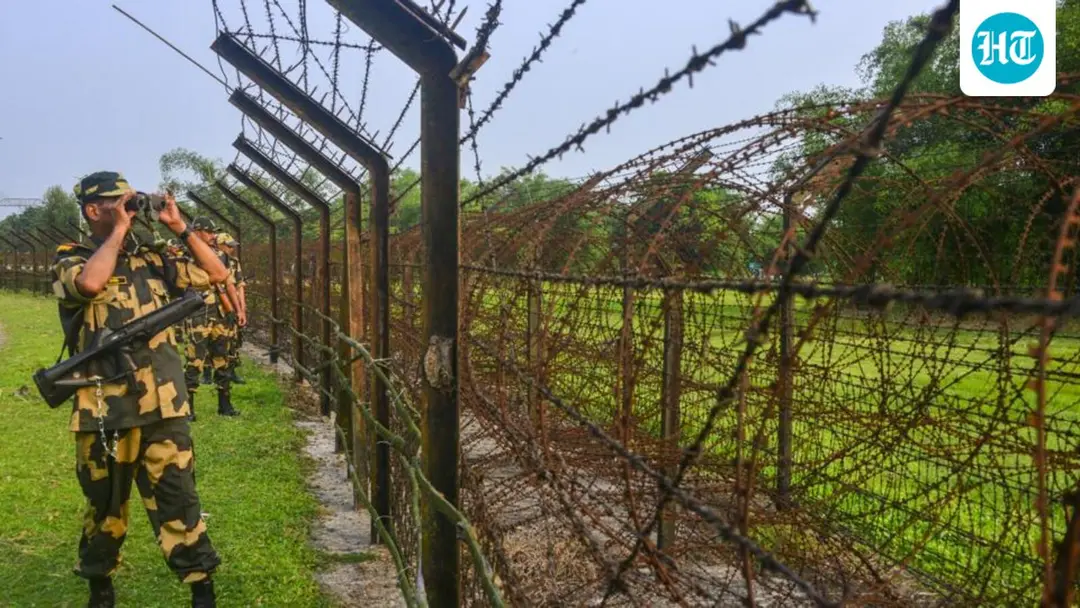
Tripura HC waives jail terms of four Bangladeshis, orders repatriation
The Tripura High Court has waived the remaining jail sentences of four Bangladeshi nationals convicted of illegally entering India and directed the government to repatriate them. Justice T Amarnath Goud passed the orders on Monday in two cases. An Unakoti court had sentenced Ratilal Das and Binita Rani Das to two years' rigorous imprisonment and a Rs 10,000 fine. A Dhalai court had sentenced Lija and Mansura Aktar to five years. Until repatriation, they will not be treated as convicts.
Source
Hindustan Times — India · read the original report ↗
Desk check · compared with the source
What the desk checked (5)
- Justice T Amarnath Goud waived the remaining sentences of four Bangladeshi nationals and ordered their repatriation. — Attributed to the Tripura High Court order delivered Monday; order text quoted in source.
- Ratilal Das and Binita Rani Das were among 13 people detained by BSF at Srirampur Manu bridge on February 27, 2025. — Specific figure and date appear in source; attributed to police/BSF action, no document cited.
- An Unakoti court on November 1, 2025 sentenced the couple to two years' rigorous imprisonment and a Rs 10,000 fine. — Figures and date appear in source as court record; internally consistent.
- Lija and Mansura Aktar, detained at Ambassa railway station on October 6, 2024, were sentenced to five years by a Dhalai court for forgery and Passport Act violation. — Details appear in source; consistent with the second case described.
- The state government said it would not object to repatriation before completion of the prison term. — Attributed to the state government's submission in court.
Analysts’ view opinion
This is a judicial order, but in a border state like Tripura it carries political weight. The key line is that the state government told the court it would not object to repatriation without completion of the prison term — signalling a preference for sending people back over keeping them incarcerated. That may be a pragmatic call on cost, prison capacity and administrative ease, but it is the kind of decision both sides of the political divide can use.
- Infiltration and border security are recurring themes in Tripura's electoral politics, so a ruling like this resonates beyond the courtroom.
- The government's own submission that it would not oppose early repatriation points to a practical stance that prioritises removal over punishment.
- The court's direction that the four not be treated as convicts until pushed back tilts the framing from criminal punishment toward administrative deportation.
- Critics could brand the approach as soft on illegal entry, while defenders can argue it eases prison burden and is diplomatically simpler.
- The same remedy applied despite different sentences (two years and five years) could become a practical benchmark for similar future appeals.
What to watch — Watch for a rise in similar appeals, whether the state formalises this stance as policy, and whether opposition parties turn it into a border-security talking point.
The story does not record any party's reaction, does not establish whether this reflects a wider government policy or is confined to these cases, and gives no timeline for the actual repatriation.
Deep dive
Research brief · 8 facts · 4 dates · exam-readyThe brief
Context
The Tripura High Court has intervened in two cases involving Bangladeshi nationals convicted by lower courts for illegally entering India without valid travel documents. Tripura shares a long border with Bangladesh, and the Border Security Force routinely detains persons crossing without papers; such cases are prosecuted under the Passport (Entry into India) Act and the Foreigners Act. Convicted foreigners normally serve their full sentence before deportation, which keeps them in Indian jails long after conviction. Justice T Amarnath Goud waived the remaining prison terms of four Bangladeshis and directed the state to push them back to Bangladesh.
Key facts
- A bench of Justice T Amarnath Goud of the Tripura High Court delivered orders in two cases on Monday, waiving the remaining sentences of four Bangladeshi citizens.
- Ratilal Das and his wife Binita Rani Das were among 13 people detained by the BSF at Srirampur Manu bridge in Unakoti district on February 27, 2025, on suspicion of being Bangladeshi nationals.
- Three Indian nationals accused of trying to smuggle the 13 persons were also caught in the Unakoti case.
- The couple, residents of Moulvibazar in Bangladesh's Sylhet division, produced no valid identity document and later admitted entering India from Bangladesh.
- On November 1, 2025, an Unakoti court sentenced Ratilal Das and Binita Rani Das to two years' rigorous imprisonment and a Rs 10,000 fine for illegal entry.
- The state government told the High Court it would not object to their repatriation without completion of the prison term.
- The order says the appellants shall stay in jail custody until pushed back to Bangladesh, but shall not be treated as convicts.
- In the second case, Lija and Mansura Aktar were detained by the BSF on October 6, 2024, at Ambassa railway station in Dhalai and later sentenced by a Dhalai court to five years for forgery and violating the Passport (Entry into India) Act.
Timeline
- October 6, 2024BSF detains two women, Lija and Mansura Aktar, at Ambassa railway station in Dhalai district for failing to produce Indian identity papers.
- February 27, 2025BSF detains 13 suspected Bangladeshi nationals, including Ratilal Das and Binita Rani Das, at Srirampur Manu bridge in Unakoti; three Indians accused of smuggling them are also caught.
- November 1, 2025An Unakoti court convicts the couple of illegal entry and awards two years' rigorous imprisonment with a Rs 10,000 fine.
- Monday (date of order)Tripura High Court modifies both sentences and orders the state to push back all four appellants to Bangladesh.
Who has a stake
- Tripura High Court (Justice T Amarnath Goud) — Balancing enforcement of immigration law with proportionality, ordering repatriation instead of continued imprisonment.
- The four Bangladeshi nationals (Ratilal Das, Binita Rani Das, Lija, Mansura Aktar) — Release from remaining jail terms and return to Bangladesh; status changed from convicts to persons awaiting push-back.
- Government of Tripura — Told the court it would not object to repatriation; now responsible for taking all necessary steps to push them back as per procedure.
- Border Security Force (BSF) — Detained the persons in both cases along the India-Bangladesh border; frontline agency for preventing illegal entry.
- Trial courts in Unakoti and Dhalai — Their sentences of two years and five years respectively were modified on appeal.
- Three Indian nationals accused of smuggling — Face charges of attempting to smuggle the 13 detained persons into India.
Why it matters
Foreign nationals convicted of illegal entry often remain in Indian jails long after conviction, adding to prison congestion without serving any deterrent purpose once identity and nationality are established. By waiving the remaining terms and ordering push-back, the High Court signals that repatriation can be a proportionate remedy where the accused did not misrepresent their identity. The rulings also underline the continuing challenge of unauthorised crossings and organised smuggling along the India-Bangladesh border in Tripura.
UPSC angle
Prelims pointers
- Passport (Entry into India) Act and the Foreigners Act are the laws used to prosecute illegal entry into India.
- Tripura High Court bench of Justice T Amarnath Goud ordered push-back of four Bangladeshi nationals in two cases.
- Unakoti and Dhalai are border districts of Tripura; Ambassa is in Dhalai district.
- Moulvibazar lies in Bangladesh's Sylhet division, the home district of the convicted couple.
- Border Security Force (BSF) is the agency guarding the India-Bangladesh border and made the detentions.
- Unakoti court sentence: 2 years' rigorous imprisonment plus Rs 10,000 fine; Dhalai court sentence: 5 years.
Mains framing
The Tripura High Court orders raise the question of how India should treat foreign nationals convicted only of unauthorised entry. The immediate causes are porous stretches of the India-Bangladesh border, organised facilitation by touts (three Indians were accused of smuggling 13 persons in the Unakoti case) and the absence of valid travel documents among those crossing. Prosecution under the Passport (Entry into India) Act and the Foreigners Act results in multi-year sentences of two years in one case and five in the other, after which deportation still has to be arranged; the detainee thus occupies prison space without advancing either deterrence or border management. The Court's approach, backed by the state government's statement that it would not object to repatriation before completion of the sentence, treats push-back as the substantive relief and expressly directs that the appellants not be treated as convicts while awaiting transfer. The way forward suggested by the facts is faster verification of nationality, coordination between the state, the BSF and the receiving country for time-bound repatriation, and concentrating punitive action on the smuggling networks rather than on those who admit their identity from the outset.
Key terms
- Passport (Entry into India) Act
- Law requiring valid passport or travel documents for entry into India; violation was charged in both Tripura cases.
- Foreigners Act
- Law regulating the entry, stay and departure of foreigners in India; invoked against the couple detained in Unakoti.
- Push-back
- Sending a foreign national back across the border to their native country; ordered here in place of serving the rest of the sentence.
- Rigorous imprisonment
- A prison sentence involving hard labour; the Unakoti court awarded two years of it to the convicted couple.
- Border Security Force (BSF)
- Central armed police force guarding India's borders with Bangladesh and Pakistan; it detained all four persons in these cases.
- Repatriation
- Formal return of a person to their country of nationality, here Bangladesh, carried out by the state as per procedure.
Practice questions
- Discuss the legal and humanitarian considerations involved when courts substitute repatriation for the remaining jail term of foreign nationals convicted of illegal entry.
- Examine the challenges of managing the India-Bangladesh border in the Northeast, with reference to detentions by the BSF and the role of smuggling networks.
- Do provisions of the Foreigners Act and the Passport (Entry into India) Act adequately balance deterrence with proportionality in cases of undocumented entry? Critically analyse.
Grounded only in the source report — figures and dates are the source's, not inferred.