
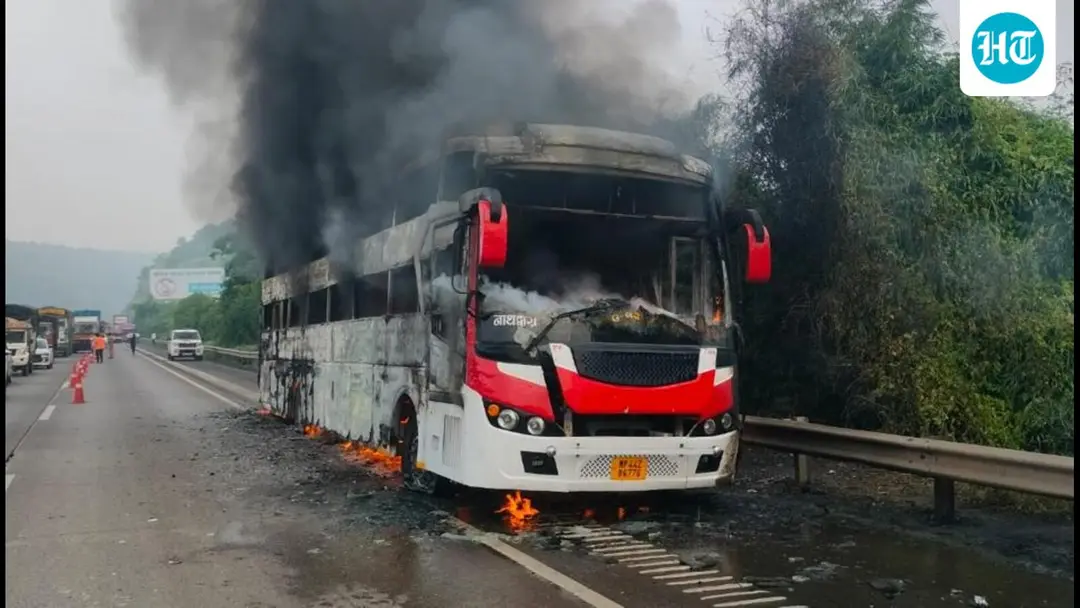
Bus catches fire on Mumbai-Pune Expressway, all 14 passengers safe
A long-distance bus caught fire on the Mumbai-Pune Expressway at about 7:25 am Thursday near kilometre 16.600 on the Mumbai-bound carriageway. Police said driver Chhatrapal Singh Kishor Singh Vahia noticed smoke from the air-conditioning system, pulled over and evacuated all 14 passengers safely. The bus, registered in Madhya Pradesh, was going from Udaipur to Pune. Fire vehicles doused the blaze. Hours earlier, nine of 35 passengers died when a Bihar-registered bus burned on the Yamuna Expressway in Greater Noida at 11pm Wednesday.
Source
Hindustan Times — India · read the original report ↗
Desk check · compared with the source
What the desk checked (4)
- All 14 passengers escaped unharmed after a bus caught fire on the Mumbai-Pune Expressway around 7:25 am Thursday near km 16.600. — Figures, time and location appear in the source; incident details attributed to police.
- The driver was identified as Chhatrapal Singh Kishor Singh Vahia. — Named identification explicitly attributed to police in the source.
- The bus, registered in Madhya Pradesh, was travelling from Udaipur to Pune, and smoke was first noticed in the air-conditioning system. — Stated in source; cause of smoke not independently established.
- Nine people, including a woman, died in a bus fire on the Yamuna Expressway in Greater Noida at 11pm Wednesday, with 35 passengers onboard. — Attributed to Jewar station house officer Ajay Kumar Singh, quoted in the source.
Analysts’ view opinion
Two long-distance buses catching fire in two states within roughly 24 hours — one with no casualties, the other with nine deaths — turns what would be a routine accident item into a potential political question about bus safety regulation. The Mumbai-Pune escape, where a driver's quick thinking got 14 passengers out, sits alongside police saying the Greater Noida fire also appeared to start in the air-conditioning system, which strengthens the argument that this is a systemic weakness rather than individual luck. Because the buses were registered in Madhya Pradesh and Bihar while running on Rajasthan, Uttar Pradesh and Maharashtra routes, the political fight is likely to be about who owns accountability.
- With no deaths in Maharashtra, political pressure there stays limited; the fatal Uttar Pradesh incident is the more likely political flashpoint.
- Two incidents in a single news cycle sharpen demands for inspections of interstate long-distance buses, their AC wiring and onboard fire equipment.
- When a bus is registered in one state and burns in another — Madhya Pradesh and Bihar plates, Maharashtra and Uttar Pradesh roads — responsibility can be passed between state governments and between states and the Centre.
- Governments can point to driver Chhatrapal Singh Kishor Singh Vahia's actions as proof the system worked, but the detail that the onboard extinguisher failed to contain the fire is an equally usable opposition talking point.
- Expressways are marketed as infrastructure success stories, so their becoming the setting for such incidents can put that messaging on the defensive.
What to watch — Watch whether transport departments announce targeted checks or surprise audits of AC buses, and whether opposition parties bundle the two incidents into a single accountability demand.
The story does not establish the actual cause of either fire, the fitness status of the buses, or any regulatory failure, and it reports no government response or political reaction at all.
Deep dive
Research brief · 8 facts · 3 dates · exam-readyThe brief
Context
Two long-distance passenger buses caught fire within hours of each other on Indian expressways, with fires in both cases appearing to begin in the vehicle's air-conditioning system. On the Mumbai-Pune Expressway early Thursday, a Madhya Pradesh-registered bus travelling from Udaipur to Pune was gutted, but the driver's quick evacuation saved all 14 passengers. Hours earlier, a Bihar-registered bus burned on the Yamuna Expressway in Greater Noida, killing nine of 35 passengers. The contrast between the two outcomes turns on how quickly the bus was stopped and emptied.
Key facts
- The Mumbai-Pune Expressway fire occurred around 7:25 am Thursday near kilometre 16.600 on the Mumbai-bound carriageway.
- All 14 passengers on the bus escaped unharmed.
- The bus was registered in Madhya Pradesh and was travelling from Udaipur, Rajasthan, to Pune.
- The driver was identified by police as Chhatrapal Singh Kishor Singh Vahia; he spotted smoke from the air-conditioning system and pulled over.
- The driver tried to use the fire extinguisher available in the vehicle, but the fire rapidly intensified and engulfed the entire bus.
- A Maharashtra State Road Transport Corporation fire-fighting vehicle and two fire engines from New Panvel and the Khopoli Fire Brigade doused the blaze.
- Officers at Rasayani police station asked the bus driver to lodge a formal complaint.
- On the Yamuna Expressway in Greater Noida, a Bihar-registered bus caught fire at 11pm Wednesday; nine of 35 passengers, including a woman, were killed.
Timeline
- 11 pm, WednesdayA Bihar-registered bus travelling from Noida to Bihar catches fire on the Yamuna Expressway in Greater Noida; nine of 35 passengers die. Police say the fire appeared to start in the AC system.
- Around 7:25 am, ThursdayA Madhya Pradesh-registered bus on the Udaipur-Pune route catches fire near km 16.600 on the Mumbai-bound carriageway of the Mumbai-Pune Expressway; all 14 passengers evacuate safely.
- After the Mumbai-Pune fireMSRTC fire-fighting vehicle and fire engines from New Panvel and Khopoli Fire Brigade extinguish the blaze; Rasayani police ask the driver to file a formal complaint.
Who has a stake
- Passengers of the Udaipur-Pune bus — All 14 escaped unharmed because the driver stopped and evacuated the bus on noticing smoke.
- Driver Chhatrapal Singh Kishor Singh Vahia — Spotted the smoke, evacuated passengers, attempted to fight the fire with an extinguisher; asked by police to lodge a formal complaint.
- Passengers of the Noida-Bihar bus — Nine of 35 onboard, including a woman, failed to escape and died.
- Maharashtra State Road Transport Corporation (MSRTC) — Deployed a fire-fighting vehicle to the Mumbai-Pune Expressway blaze.
- New Panvel and Khopoli Fire Brigade — Sent two fire engines that put out the fire on the expressway.
- Rasayani police station / Jewar police (SHO Ajay Kumar Singh) — Handling the Maharashtra complaint and the Greater Noida investigation respectively.
Why it matters
Two bus fires in under nine hours, both apparently starting in the air-conditioning system, point to a recurring safety risk in long-distance sleeper and AC buses on high-speed expressways. The difference between zero casualties near Mumbai and nine deaths in Greater Noida came down to how early the smoke was noticed and how fast passengers got out, underlining the value of early detection, driver alertness and usable exits.
UPSC angle
Prelims pointers
- Mumbai-Pune Expressway bus fire: around 7:25 am Thursday, near km 16.600, Mumbai-bound carriageway; all 14 passengers safe.
- Bus involved was Madhya Pradesh-registered, on the Udaipur (Rajasthan) to Pune route.
- Yamuna Expressway fire, Greater Noida (UP): 11 pm Wednesday, Bihar-registered bus from Noida to Bihar; 9 of 35 passengers killed.
- In both incidents police said the fire appeared to have started in the vehicle's air-conditioning system.
- Responders in Maharashtra: MSRTC fire-fighting vehicle plus fire engines from New Panvel and Khopoli Fire Brigade.
- Police stations named: Rasayani (Maharashtra) and Jewar, whose SHO is Ajay Kumar Singh (Greater Noida).
Mains framing
Two bus fires on expressways within hours of each other, both traced by police to the air-conditioning system, illustrate how vehicle-level technical faults translate into mass-casualty risk on high-speed corridors. In the Mumbai-Pune case the driver noticed smoke, pulled over and evacuated all 14 passengers before the fire engulfed the bus, and the on-board fire extinguisher proved inadequate once the blaze intensified; in Greater Noida, passengers smelt burning and alerted the driver, but by the time the bus stopped the fire had spread and nine of 35 onboard could not escape. The implications are threefold: the survival window in an enclosed, air-conditioned bus is measured in minutes; a single hand extinguisher cannot contain such a fire; and outcomes depend heavily on how quickly a driver stops and how easily passengers can exit. A grounded way forward, consistent with what the source shows, lies in early smoke detection and driver alertness, rapid stop-and-evacuate protocols, verification that fire-suppression equipment is adequate rather than merely present, and quick access for fire services along expressways, as seen when MSRTC and the New Panvel and Khopoli fire units reached the spot.
Key terms
- Mumbai-Pune Expressway
- Access-controlled expressway linking Mumbai and Pune; the fire occurred near km 16.600 on its Mumbai-bound carriageway.
- Yamuna Expressway
- Expressway in Uttar Pradesh where the Bihar-registered bus caught fire in Greater Noida at 11 pm Wednesday, killing nine.
- MSRTC (Maharashtra State Road Transport Corporation)
- State transport body that sent a fire-fighting vehicle to the Mumbai-Pune Expressway bus fire.
- Station House Officer (SHO)
- Police officer in charge of a police station; Jewar SHO Ajay Kumar Singh gave details of the Greater Noida fire.
- Carriageway
- The set of lanes carrying traffic in one direction; the Maharashtra fire was on the Mumbai-bound carriageway.
Practice questions
- Two long-distance bus fires within hours, both apparently starting in the air-conditioning system, raise questions about passenger safety in AC buses. Discuss the risks and the measures needed to reduce fatalities.
- Compare the outcomes of the Mumbai-Pune Expressway and Yamuna Expressway bus fires. What does the difference suggest about the importance of early detection and evacuation in road accidents?
- Expressways enable high-speed travel but complicate emergency response. Examine the institutional arrangements for fire and rescue services along India's expressways, with reference to recent incidents.
Grounded only in the source report — figures and dates are the source's, not inferred.