
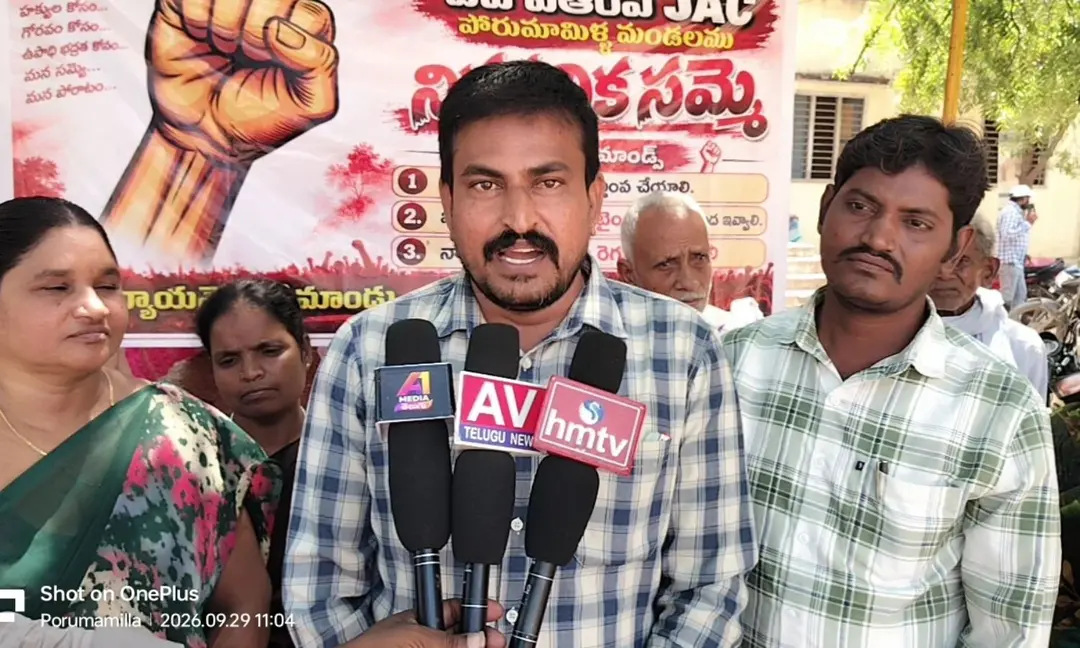
VRAs' non-cooperation strike enters seventh day in Porumamilla
The non-cooperation strike by Village Revenue Assistants (VRAs) has entered its seventh day. As part of the state-wide agitation, VRAs of Porumamilla mandal submitted strike notices to the MRO on Monday and protested outside the MRO office on Tuesday. They demanded equal pay for equal work as implemented in other states, job security, recognition of their services, and promotion as VROs based on qualification and seniority. They warned of intensifying the agitation if a permanent solution is delayed.
Source
Annamayya — వార్తలు · read the original report ↗
Desk check · compared with the source
What the desk checked (5)
- The VRAs' non-cooperation strike has entered its seventh day. — Figure appears in source; attributed to the ongoing agitation as reported, not independently verifiable.
- VRAs submitted strike notices to the Porumamilla MRO on Monday and protested outside the MRO office on Tuesday. — Stated in source with day references but no named official or spokesperson.
- Demands include equal pay for equal work as in other states, job security, recognition and promotion to VRO posts based on qualification and seniority. — Attributed to the protesting VRAs; demands reported as stated by them.
- The agitation is continuing across the state. — Asserted in source without a source or organisation named.
- VRAs warned of intensifying the agitation if demands are delayed. — Attributed to the protesters collectively; no individual quoted by name.
Analysts’ view opinion
A VRA strike reaching its seventh day is no longer a routine service grievance — it is edging into a political problem for the government at the very base of the rural administrative machine. VRAs sit at the last mile of the revenue department and are the face of the state in the village; the longer a non-cooperation strike runs, the more visible the delays in everyday revenue work become to ordinary citizens. The choice of slogans — "equal pay for equal work" and language of bonded labour — shows the agitation converting a pay demand into a moral argument, which is strategically harder for any government to publicly rebut.
- Serving strike notice on the MRO and protesting outside the same office the next day suggests a deliberate, staged escalation rather than a spontaneous flare-up.
- Because this is part of a statewide agitation, mandal-level assurances cannot settle it; any real resolution has to come from the state level.
- Demands for promotion to VRO posts and job security touch both the exchequer and the structure of the revenue department, which is why governments typically move cautiously here.
- Every week of delay widens the space for opposition parties to adopt the employees' cause and question the government's responsiveness.
- The government's options are familiar and both carry a cost: open talks and risk conceding a template to other contract-grade staff, or wait out the agitation and risk being framed as indifferent.
What to watch — Watch whether the government or senior revenue officials call the VRAs to formal talks, or whether the strike spreads across more mandals and picks up open political backing.
The story does not establish any government response, whether talks have been offered, how many VRAs are participating, how much service delivery has actually been disrupted, or whether any political party has backed them.
Deep dive
Research brief · 8 facts · 4 dates · exam-readyThe brief
Context
Village Revenue Assistants (VRAs) are the lowest-rung functionaries of the revenue department at village level in Andhra Pradesh, assisting in land records, surveys and other field-level revenue work. A state-wide non-cooperation strike by VRAs pressing for better pay, job security and promotion avenues has entered its seventh day. In Porumamilla mandal of the Annamayya area, VRAs served strike notices on the Mandal Revenue Officer (MRO) and then staged a protest outside his office, making the agitation a local talking point.
Key facts
- The VRAs' non-cooperation strike (sahaya nirakarana samme) has entered its seventh day, as per the source.
- The agitation is state-wide; Porumamilla mandal VRAs intensified their local protest as part of it.
- On Monday, VRAs of Porumamilla submitted strike notices to the Porumamilla MRO.
- On Tuesday, VRAs protested in large numbers outside the MRO office to press their demands.
- Protest slogans included 'How long this bonded labour?' and 'Equal pay for equal work must be given'.
- Main demands: equal pay for equal work as implemented in other states, recognition of their services, and job security.
- They also demanded promotion of VRAs as VROs (Village Revenue Officers) based on qualification and seniority.
- VRAs warned they will intensify the agitation if the government delays, and will continue the strike until a permanent solution.
Timeline
- Seven days ago (start of strike)VRAs launch state-wide non-cooperation strike demanding immediate resolution of their demands.
- MondayPorumamilla mandal VRAs submit strike notices to the MRO.
- TuesdayVRAs protest in large numbers outside the Porumamilla MRO office, raising slogans on equal pay for equal work.
- OngoingStrike enters seventh day; VRAs warn of escalation if demands remain unaddressed.
Who has a stake
- Village Revenue Assistants (VRAs) — Seek equal pay for equal work, job security, recognition of service and promotion as VROs by qualification and seniority.
- State government (Andhra Pradesh) — Faces a state-wide agitation and demands for a permanent policy decision on VRA pay, status and promotions.
- Mandal Revenue Officer (MRO), Porumamilla — Recipient of the strike notices and the immediate administrative authority facing the protest.
- Revenue department at village level — Village-level revenue work depends heavily on VRAs; non-cooperation disrupts routine functioning.
- Residents of Porumamilla mandal — Village-level revenue services may be affected; the agitation has become a local talking point.
Why it matters
VRAs perform a large share of ground-level revenue work — the first point of contact for villagers in land and certificate-related matters — so a prolonged non-cooperation strike can slow routine administration in rural areas. The dispute also raises the wider question of how states treat their lowest-paid, least-secure field staff, including the principle of equal pay for equal work and a clear promotion ladder.
UPSC angle
Prelims pointers
- VRA stands for Village Revenue Assistant; VRO stands for Village Revenue Officer — village-level revenue department posts.
- MRO (Mandal Revenue Officer) is the mandal-level revenue authority to whom the strike notices were submitted.
- The Porumamilla protest is part of a state-wide VRA agitation, now in its seventh day.
- Key demand: 'equal pay for equal work' on the lines of other states, plus job security and service recognition.
- Second key demand: promotion of VRAs as VROs based on qualification and seniority.
- Sequence: strike notices to MRO on Monday; protest outside MRO office on Tuesday.
Mains framing
The Porumamilla VRA protest illustrates a recurring governance problem: grassroots revenue administration leans on a cadre of village-level assistants who, by their own account, lack adequate wages, job security and a defined promotion path despite performing key departmental duties for years. The immediate cause of the agitation is the demand for equal pay for equal work on the lines of other states, coupled with recognition of service and promotion as VROs on the basis of qualification and seniority; the trigger for escalation is the perception that the government is delaying a decision. The implications are twofold — a non-cooperation strike in its seventh day threatens the continuity of routine village-level revenue services, and the unresolved status of such staff erodes morale and administrative reliability at the very interface between citizen and state. A way forward, grounded in what the protesters themselves seek, would involve a time-bound government response leading to a permanent settlement on pay parity, service regularisation or security, and a transparent seniority-and-qualification-based promotion channel from VRA to VRO, so that agitation is not the default route for redress.
Key terms
- VRA (Village Revenue Assistant)
- Village-level functionary assisting the revenue department in field duties; the cadre on strike in this story.
- VRO (Village Revenue Officer)
- The higher village-level revenue post to which VRAs are demanding promotion based on qualification and seniority.
- MRO (Mandal Revenue Officer)
- Revenue official heading a mandal; the Porumamilla MRO received the VRAs' strike notices.
- Non-cooperation strike
- A protest in which employees refuse to perform official duties while remaining on rolls; here in its seventh day.
- Equal pay for equal work
- The principle that workers doing the same work should get the same pay; the VRAs' central demand, citing other states.
Practice questions
- Discuss the role of village-level revenue functionaries such as VRAs and VROs in rural administration, and the challenges arising from weak pay and job security.
- 'Equal pay for equal work' is often invoked by lower-rung government staff. Examine the issue with reference to the ongoing VRA agitation in Andhra Pradesh.
- How do prolonged non-cooperation strikes by field-level staff affect citizen access to revenue services, and what mechanisms can prevent such deadlocks?
Grounded only in the source report — figures and dates are the source's, not inferred.