
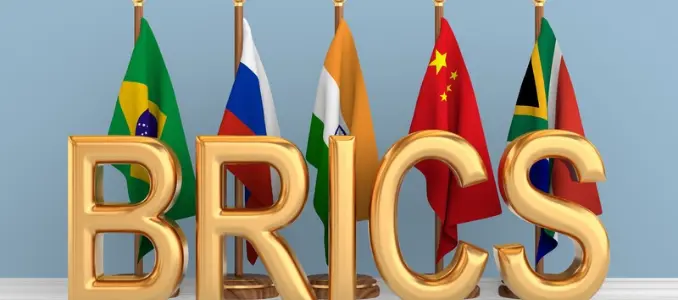
Policy paper examines BRICS summit impact on worker safety
A conceptual policy paper has examined how BRICS cooperation could shape occupational and environmental health and safety across emerging economies. It notes the 2026 BRICS Leaders' Summit was held in New Delhi on September 12-13, with Chinese President Xi Jinping, Russian President Vladimir Putin and Indian Prime Minister Narendra Modi taking part. The paper reviews five dimensions: worker health, environmental protection, safe industrialisation, capacity building and sustainable economic performance, and proposes a BRICS OEHS Cooperation Index.
Source
BRICS / G20 / SCO / Quad · read the original report ↗
Desk check · some claims need care
What the desk checked (5)
- The 2026 BRICS Leaders' Summit was held in New Delhi on September 12-13. — Date and venue appear in the source; no external source or document is cited.
- Xi Jinping, Vladimir Putin and Narendra Modi participated in the summit. — Stated in the source without attribution to any official communique or report.
- The BRICS group took its current name in 2011 and later expanded to include countries from Africa, Asia and the Middle East. — Background claim presented as established fact in the source; no citation given.
- The paper examines five strategic OEHS dimensions and proposes a BRICS OEHS Cooperation Index (BOCI). — Self-described framework by the authors; the case studies are explicitly labelled hypothetical.
- The New Delhi summit agenda includes sustainability, climate action, energy, health, infrastructure and industrial development. — Asserted in the source; no agenda document referenced.
Analysts’ view opinion
This is not summit reporting — it is a conceptual policy paper asking how BRICS cooperation could shape occupational and environmental health and safety (OEHS). The strategic significance lies there: industrial standards, chemical safety and supply-chain rules are no longer merely technical matters, because who writes the standards is part of geopolitical competition. With Xi, Putin and Modi described as attending the same platform, the paper points to the possibility of a parallel standards ecosystem taking shape outside Western-led institutions.
- Standard-setting is a strategic asset: whoever writes industrial safety and emissions rules also shapes market access and investment flows.
- The paper says infrastructure, energy systems and supply chains sit on the BRICS agenda; these look economic but touch defence-relevant manufacturing and critical-minerals dependencies.
- The proposed BRICS OEHS Cooperation Index (BOCI) is only an exploratory idea, yet indices and rankings have historically evolved into instruments of soft power and pressure.
- The counter-case matters: BRICS members differ sharply in regulatory capacity and political interest, and expansion makes consensus harder, so declarations may outrun implementation.
- Western partners are likely to read such efforts against their own supply-chain labour and environmental rules, pulling safety standards into trade negotiations.
What to watch — Watch whether concrete machinery — funding, mutual recognition, data sharing — emerges on industrial safety, chemical regulation and climate resilience, or whether this stays at the level of declaratory language.
The story rests on a conceptual analytical paper and does not establish what, if anything, the summit actually decided on OEHS, or whether the proposed index has any governmental endorsement.
Deep dive
Research brief · 8 facts · 3 dates · exam-readyThe brief
Context
BRICS — originally Brazil, Russia, India, China and South Africa — is a grouping of major emerging economies whose cooperation touches infrastructure investment, industrial development, energy systems, environmental governance, supply chains and worker protection. A conceptual policy paper argues that this diplomacy carries direct consequences for occupational and environmental health and safety (OEHS) in member economies. The paper is framed around the 2026 BRICS Leaders' Summit held in New Delhi on September 12–13, attended by Chinese President Xi Jinping, Russian President Vladimir Putin and Indian Prime Minister Narendra Modi. It proposes a five-dimension framework and a new BRICS OEHS Cooperation Index (BOCI) for comparing members.
Key facts
- The 2026 BRICS Leaders' Summit was held in New Delhi, India, on September 12–13.
- Xi Jinping (China), Vladimir Putin (Russia) and Narendra Modi (India) participated in the New Delhi summit.
- The BRICS group took its current name in 2011; later expansion added countries from Africa, Asia, the Middle East and other regions.
- The paper examines five strategic dimensions: worker health and industrial hygiene; environmental protection and climate resilience; safe industrialisation and infrastructure; occupational health capacity building; and sustainable economic performance.
- It proposes a BRICS OEHS Cooperation Index (BOCI), plus hypothetical case studies, a comparative table and a conceptual causal model.
- The summit agenda includes sustainability, climate action, energy, health, infrastructure and industrial development.
- The summit convened amid geopolitical tension, climate change, supply-chain disruption and rapid industrial transformation.
- The paper is conceptual, drawing on international OEHS literature, and issues recommendations for international OEHS professionals.
Timeline
- 2011The BRICS grouping takes its current name.
- After 2011BRICS expands to include additional countries from Africa, Asia, the Middle East and other regions.
- September 12–13, 2026BRICS Leaders' Summit held in New Delhi with an expanded group of emerging and developing economies.
Who has a stake
- Workers in BRICS economies — Exposure to industrial hygiene, chemical safety and occupational injury risks shaped by how fast industrialisation proceeds and how it is regulated.
- India as summit host — Shaping an agenda covering sustainability, climate action, energy, health, infrastructure and industrial development.
- OEHS professionals — Opportunity to contribute to socioeconomic prosperity while meeting national duties to protect workers and communities.
- Expanded BRICS membership (Africa, Asia, Middle East and other regions) — Access to a broader platform for economic and political cooperation, including standards for safe industrialisation.
- Communities near industrial sites — Environmental protection, chemical safety and climate resilience outcomes of BRICS-linked industrial and infrastructure projects.
- Global supply chains — Disruption and realignment that affect where hazardous production happens and under what safety standards.
Why it matters
BRICS members host a large share of the world's fast-growing industrial base, so the safety and environmental standards they converge on travel through global supply chains. The paper's argument is that summit diplomacy is not separate from shop-floor risk: investment in energy, infrastructure and manufacturing determines who is exposed to chemical, ergonomic and climate hazards. A comparative index such as BOCI would make these differences visible and measurable rather than rhetorical.
UPSC angle
Prelims pointers
- BRICS = Brazil, Russia, India, China, South Africa; the grouping took its current name in 2011.
- 2026 BRICS Leaders' Summit: New Delhi, September 12–13.
- OEHS = occupational and environmental health and safety.
- BOCI = BRICS OEHS Cooperation Index, a comparative index proposed in the paper.
- Five dimensions in the framework: worker health/industrial hygiene, environmental protection and climate resilience, safe industrialisation and infrastructure, occupational health capacity building, sustainable economic performance.
- Summit agenda themes: sustainability, climate action, energy, health, infrastructure, industrial development.
Mains framing
The story frames a governance gap: BRICS has grown from a five-country label adopted in 2011 into an expanded platform spanning Africa, Asia and the Middle East, and its influence over infrastructure investment, energy systems and supply chains now has direct occupational and environmental health consequences that summit communiqués rarely quantify. The causes are structural — rapid industrial transformation, supply-chain disruption, climate stress and geopolitical realignment all shift hazardous production between jurisdictions with uneven industrial hygiene and chemical safety capacity. The implication is that worker protection becomes a byproduct of trade and investment decisions rather than a stated objective. The paper's proposed way forward is analytical before it is regulatory: a five-dimension framework covering worker health, environmental protection and climate resilience, safe industrialisation, occupational health capacity building and sustainable economic performance, operationalised through a BRICS OEHS Cooperation Index plus a comparative table and causal model, so that members can be benchmarked and OEHS professionals can engage proactively. Since the paper is conceptual and its case studies hypothetical, its value lies in agenda-setting — arguing that health and safety belongs in the sustainability, energy and infrastructure baskets already on the summit agenda.
Key terms
- BRICS
- Forum for cooperation among major emerging economies — Brazil, Russia, India, China and South Africa — named as such in 2011 and since expanded.
- OEHS
- Occupational and environmental health and safety: protection of workers and surrounding communities from industrial and environmental hazards.
- BOCI (BRICS OEHS Cooperation Index)
- Index proposed in the paper to compare BRICS members on occupational and environmental health and safety cooperation.
- Industrial hygiene
- The discipline of anticipating and controlling workplace exposures such as chemicals, dust, noise and heat.
- Climate resilience
- Capacity of industries, workers and communities to withstand climate-related stresses; one of the paper's five dimensions.
- Conceptual policy paper
- A framework-building study using literature and hypothetical case studies rather than new field data.
Practice questions
- How can plurilateral groupings such as BRICS influence occupational and environmental health and safety standards across their member economies? Discuss.
- Examine the utility and limitations of composite indices, such as the proposed BRICS OEHS Cooperation Index, in comparing worker-protection performance across countries.
- "Rapid industrialisation and supply-chain realignment shift occupational hazards rather than removing them." Critically evaluate in the context of emerging economies.
Grounded only in the source report — figures and dates are the source's, not inferred.