
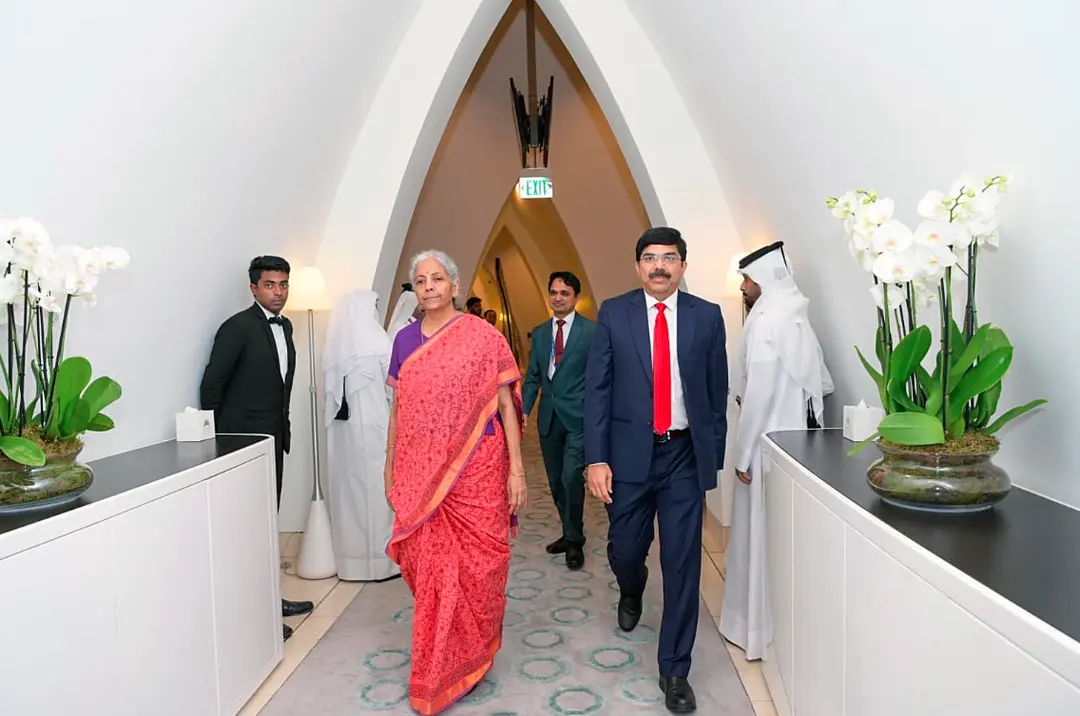
Sitharaman holds bilateral talks with four countries at AIIB meet
Finance Minister Nirmala Sitharaman held bilateral meetings with ministers from Saudi Arabia, Switzerland, Jordan and Nepal on the sidelines of the AIIB annual meeting. On September 28, the first day of her Qatar visit, she met Saudi counterpart Mohammed Al-Jadaan and welcomed the concluded India-Saudi Bilateral Investment Treaty negotiations. She highlighted NIIF and GIFT IFSC to Swiss Ambassador Pietro Lazzeri, discussed flood reconstruction and UPI-NPI linkage with Nepal's Swarnim Wagle, and cited a USD 5 billion trade target with Jordan by 2030.
Source
Finance — Nirmala Sitharaman · read the original report ↗
Desk check · compared with the source
What the desk checked (5)
- Sitharaman held bilateral meetings with ministers from Saudi Arabia, Switzerland, Jordan and Nepal on the sidelines of the AIIB annual meeting. — Stated in source; meetings attributed to finance ministry statement.
- Negotiations on the India-Saudi Arabia Bilateral Investment Treaty concluded successfully. — Directly quoted from the finance ministry statement in the source.
- Swiss FDI growth in India is outpacing global FDI. — Attributed to AIIB Governor from Switzerland Ambassador Pietro Lazzeri; no supporting figures given.
- India is Jordan's fourth largest trading partner, with a target of USD 5 billion bilateral trade by 2030. — Figure appears in source, attributed to Sitharaman; not independently verified.
- Talks with Nepal covered flood reconstruction support and early operationalisation of the UPI-NPI linkage. — Stated in source without direct quotes; consistent internally.
Analysts’ view opinion
These are not ceremonial handshakes — the meetings cluster around three economic pipes: investment-treaty frameworks, payments connectivity and fund channels. The most consequential item is the concluded negotiation on the India–Saudi Bilateral Investment Treaty, because the absence of arbitration-grade protection has been a real reason long-horizon foreign capital has been cautious about Indian infrastructure. On the Swiss side, note the asymmetry: their agreement is not yet finalised, and what India is pitching is not portfolio money but patient infrastructure capital via NIIF.
- A BIT is essentially a risk-premium story — predictable dispute resolution lets sovereign and pension funds accept lower hurdle rates, though no implementation date is stated here.
- With Switzerland the gains cut both ways: infrastructure capital for India, portfolio diversification for Swiss investors — but it stays declaratory until the Bilateral Investment Protection Agreement is signed.
- Pushing GIFT IFSC is a deliberate play to onshore financial-services fees, fund administration and the high-skill jobs that currently sit in rival hubs.
- The UPI–NPI linkage looks small but compresses remittance costs and shifts flows into formal channels — cheaper transactions for Nepal, an export of India's payments rails for Delhi.
- The USD 5 billion Jordan trade target by 2030 is an aspiration; the story gives no current trade base or pathway to judge how demanding it is.
What to watch — Watch for signature and entry-into-force timelines on the Saudi BIT, finalisation of the Swiss investment-protection pact, and whether India's Nepal flood support comes as grant or credit — that structure will decide the real fiscal and growth effects.
The story establishes intent, not money: it gives no investment quantum, no treaty terms, no baseline trade numbers and no size or form of assistance to Nepal.
Deep dive
Research brief · 8 facts · 4 dates · exam-readyThe brief
Context
Finance Minister Nirmala Sitharaman travelled to Qatar for the annual meeting of the Asian Infrastructure Investment Bank (AIIB), a multilateral development bank in which India is a member and whose governors are country representatives. On the sidelines of the meeting she held a series of bilateral meetings with counterparts and representatives from Saudi Arabia, Switzerland, Nepal and Jordan. The talks covered investment treaties, infrastructure funds, digital payments linkage and trade targets. Such sideline diplomacy at multilateral finance meetings is a standard channel for advancing India's investment and trade agenda.
Key facts
- Sitharaman held bilateral meetings with ministers/representatives of Saudi Arabia, Switzerland, Jordan and Nepal on the sidelines of the AIIB annual meeting.
- September 28 was the first day of her Qatar visit, when she met Saudi Finance Minister Mohammed Al-Jadaan.
- Both ministers welcomed the successful conclusion of negotiations on the India-Saudi Arabia Bilateral Investment Treaty (BIT); Saudi Arabia sought early implementation.
- Sitharaman pitched the National Investment and Infrastructure Fund (NIIF) to AIIB Governor from Switzerland, Ambassador Pietro Lazzeri, inviting Swiss investors into NIIF infrastructure funds.
- Lazzeri said Swiss FDI growth in India is outpacing global FDI and sought support for finalising the Bilateral Investment Protection Agreement.
- Lazzeri mentioned an upcoming state visit to India and the 2nd EFTA Prosperity Summit in New Delhi.
- With Nepal's Finance Minister Swarnim Wagle, talks covered flood reconstruction and recovery needs and early operationalisation of the UPI-NPI linkage.
- With Jordan's Minister of Planning and International Cooperation Zeina Zeid Toukan, Sitharaman noted India is Jordan's fourth largest trading partner and a target of USD 5 billion bilateral trade by 2030.
Timeline
- September 28 (first day of Qatar visit)Sitharaman meets Saudi Finance Minister Mohammed Al-Jadaan; both welcome conclusion of India-Saudi BIT negotiations.
- On the sidelines of the AIIB annual meeting (same visit)Meetings with Swiss AIIB Governor Pietro Lazzeri, Nepal's Swarnim Wagle and Jordan's Zeina Zeid Toukan.
- Upcoming (date not stated in the source)State visit to India and the 2nd EFTA Prosperity Summit in New Delhi, as mentioned by Ambassador Lazzeri.
- By 2030Target of raising India-Jordan bilateral trade to USD 5 billion.
Who has a stake
- Union Finance Ministry / Nirmala Sitharaman — Advancing India's investment treaty agenda, attracting foreign capital into infrastructure and GIFT IFSC.
- Saudi Arabia (Minister Mohammed Al-Jadaan) — Early implementation of the BIT and a predictable framework for investments; interest in Indian investments into Saudi Arabia.
- Switzerland (AIIB Governor Ambassador Pietro Lazzeri) — Portfolio diversification in India, finalisation of the Bilateral Investment Protection Agreement, financial sector and sustainable finance cooperation.
- Nepal (Finance Minister Swarnim Wagle) — Indian support for post-flood reconstruction and recovery; operationalising the UPI-NPI payments linkage.
- Jordan (Minister Zeina Zeid Toukan) — Deeper bilateral cooperation and scaling trade with India, already its fourth largest trading partner, to USD 5 billion by 2030.
- NIIF and GIFT IFSC — Positioned as the vehicles/platform for channelling foreign investment and financial services into India.
- AIIB — Its annual meeting serves as the multilateral venue enabling these bilateral engagements.
Why it matters
Bilateral investment treaties and protection agreements shape how much long-term foreign capital flows into Indian infrastructure, so the concluded India-Saudi BIT and the pending India-Switzerland investment protection pact are directly linked to investor confidence. The Nepal discussions show finance diplomacy doubling as disaster-response and digital-payments outreach in the neighbourhood. For India, these meetings signal an effort to convert strategic partnerships into measurable trade and investment outcomes.
UPSC angle
Prelims pointers
- AIIB — Asian Infrastructure Investment Bank; its annual meeting hosted in Qatar was the venue for these bilateral talks.
- India-Saudi Arabia Bilateral Investment Treaty (BIT) negotiations have been successfully concluded.
- NIIF — National Investment and Infrastructure Fund, pitched to Swiss investors for infrastructure exposure.
- GIFT IFSC — India's homegrown International Financial Services Centre offering tax benefits and financial products.
- UPI-NPI linkage — India-Nepal payments linkage whose early operationalisation was discussed.
- India is Jordan's fourth largest trading partner; bilateral trade target of USD 5 billion by 2030.
Mains framing
Sitharaman's sideline diplomacy at the AIIB annual meeting illustrates how India uses multilateral finance platforms to pursue bilateral economic objectives. The conclusion of the India-Saudi Arabia Bilateral Investment Treaty responds to a core investor concern — predictability of the legal framework for cross-border investment — while Switzerland's request for finalisation of the Bilateral Investment Protection Agreement, alongside its observation that Swiss FDI growth in India is outpacing global FDI, shows both the appetite for Indian assets and the treaty gaps that still constrain it. India's counter-offer is institutional: NIIF as a trusted co-investment vehicle for infrastructure and GIFT IFSC as a domestic financial services hub with tax and regulatory advantages. In the neighbourhood, the Nepal meeting blends humanitarian and financial cooperation, pairing flood reconstruction support with the UPI-NPI payments linkage, extending India's digital public infrastructure diplomacy. With Jordan, the USD 5 billion by 2030 trade target gives a measurable benchmark. The way forward lies in swift implementation and ratification of concluded treaties, operationalising payment linkages, and translating investment pitches into actual fund flows rather than statements of intent.
Key terms
- AIIB
- Asian Infrastructure Investment Bank, a multilateral development bank whose annual meeting hosted these bilateral talks; member countries are represented by Governors.
- Bilateral Investment Treaty (BIT)
- A treaty setting the framework and protections for investments between two countries; India and Saudi Arabia have concluded negotiations on one.
- Bilateral Investment Protection Agreement
- The investment protection pact Switzerland sought to finalise with India.
- NIIF
- National Investment and Infrastructure Fund, positioned as a trusted partner for foreign investors seeking Indian infrastructure exposure.
- GIFT IFSC
- India's homegrown international financial services centre offering financial products, tax benefits and a business-friendly environment.
- UPI-NPI linkage
- Linkage of India's UPI with Nepal's NPI for cross-border digital payments, whose early operationalisation was discussed.
Practice questions
- Discuss how Bilateral Investment Treaties influence foreign investment flows into India, with reference to the recently concluded India-Saudi Arabia BIT.
- Examine the role of institutions such as NIIF and GIFT IFSC in channelling foreign capital into India's infrastructure and financial services sectors.
- How does India's digital public infrastructure, including cross-border UPI linkages, serve as an instrument of neighbourhood and economic diplomacy?
Grounded only in the source report — figures and dates are the source's, not inferred.