
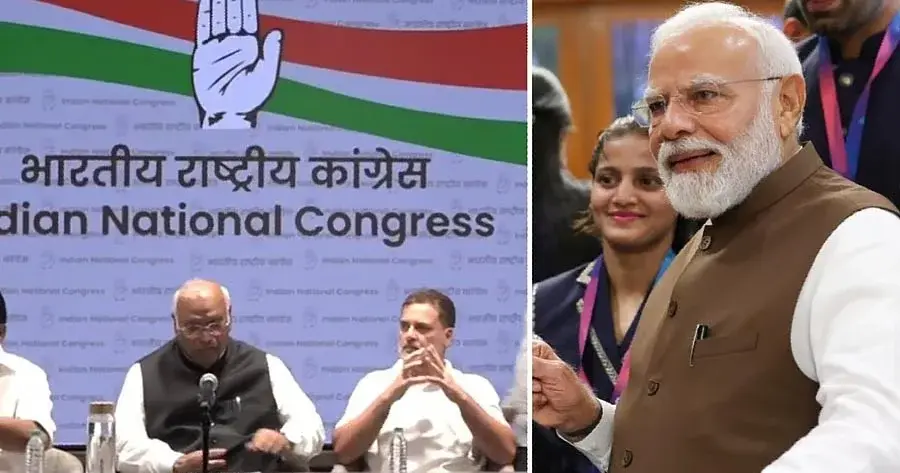
Congress to take SIR issue to streets, seeks CEC removal, Modi resignation
Congress president Mallikarjun Kharge on Tuesday demanded the immediate removal of Chief Election Commissioner Gyanesh Kumar over alleged irregularities in the Special Intensive Revision (SIR) of electoral rolls, and sought Prime Minister Narendra Modi's resignation on moral grounds, alleging he had pressured the CEC. Addressing a CWC meeting, Kharge said the party would take the issue to the streets and Parliament. He listed five transparency demands and alleged two Election Commissioners had called the CEC's actions "arbitrary and unreasonable".
Source
Mallikarjun Kharge (Congress President) · read the original report ↗
Desk check · some claims need care
What the desk checked (5)
- Kharge demanded the immediate removal of CEC Gyanesh Kumar over alleged SIR irregularities. — Attributed to Congress president Kharge at the CWC meeting in the source.
- Kharge sought PM Narendra Modi's resignation on moral grounds, alleging he pressured the CEC. — Allegation attributed to Kharge; no supporting evidence or response cited in source.
- Two Election Commissioners described the CEC's actions as 'arbitrary and unreasonable'. — Claim made by Kharge; commissioners are unnamed and not independently sourced in the text.
- Congress listed five demands on electoral roll transparency. — Five demands are itemised in the source text, consistent with the stated figure.
- Congress will take the SIR protest to the streets and Parliament. — Supported by a direct quote from Kharge in the source.
Analysts’ view opinion
Congress is trying to lift the SIR row out of the technical weeds of electoral-roll administration and turn it into a broad political cause about protecting the right to vote. The maximalist demands — sacking the CEC, the Prime Minister's resignation — are unlikely to be met, but they serve to energise cadres and hand the wider opposition a shared agenda. Kharge's claim that two Election Commissioners called the CEC's actions arbitrary is politically the sharpest element, because it suggests division inside the panel itself. The five transparency demands, being less confrontational, are the easier ground on which other parties can converge.
- The "streets plus Parliament" formulation signals an intent to sustain this beyond one session and use it as a longer campaign plank.
- Removing a CEC is constitutionally difficult, so that demand should be read as messaging rather than an achievable outcome.
- The call for Modi to resign will rally the Congress base but risks looking excessive to swing voters, and the ruling side can frame it as excuse-making for past defeats.
- Most of the five demands are procedural — data disclosure, appeal rights, time-bound inquiry — which is the minimum common ground other opposition parties and civil society can also back.
- Launching it from the CWC platform is deliberate: it marks this as an official party line rather than one leader's remark.
What to watch — Watch for how the Election Commission and the ruling party respond formally, and crucially whether other opposition parties line up behind the same five demands.
These remain Kharge's allegations; the story does not independently establish that the CEC was pressured or that two Commissioners dissented, and it carries no response from the Election Commission or the government.
Deep dive
Research brief · 8 facts · 2 dates · exam-readyThe brief
Context
The Election Commission of India has been carrying out a Special Intensive Revision (SIR) of electoral rolls, a drive to update voter lists. The Congress has alleged irregularities in how the poll panel has conducted the exercise, including deletions of voters' names and inadequate sharing of data with political parties. On Tuesday, at a meeting of the Congress Working Committee, party president Mallikarjun Kharge escalated the attack by demanding the removal of Chief Election Commissioner Gyanesh Kumar and the resignation of Prime Minister Narendra Modi on moral grounds. The source does not state what the Election Commission or the government said in response.
Key facts
- Congress president Mallikarjun Kharge on Tuesday demanded the immediate removal of Chief Election Commissioner Gyanesh Kumar over alleged irregularities in the Special Intensive Revision (SIR) of electoral rolls.
- Kharge sought Prime Minister Narendra Modi's resignation on moral grounds, alleging Modi had "pressured" the CEC.
- The demands were made while addressing a meeting of the Congress Working Committee (CWC).
- Kharge listed five demands aimed at greater transparency in the electoral roll revision process.
- Demand 1: complete data on major changes in electoral rolls be made public; Demand 2: voters whose names were deleted get full information and a chance to appeal.
- Demand 3: political parties be given electoral rolls and essential data in a simple format and in time; Demand 4: serious discrepancies face an independent, time-bound investigation.
- Demand 5: data and decisions on the electoral process be made sufficiently transparent to prevent allegations of information being withheld.
- Kharge claimed two Election Commissioners had described the CEC's actions as "arbitrary and unreasonable", and alleged the CEC acted in a manner favourable to the ruling party.
Timeline
- Tuesday (year/date not stated in the source)At a CWC meeting, Kharge demands CEC Gyanesh Kumar's removal, PM Modi's resignation, and lists five transparency demands on SIR.
- Announced the same dayCongress says it will take the SIR issue "from the streets to Parliament".
Who has a stake
- Congress / Mallikarjun Kharge — Leading the agitation; seeks CEC's removal, PM's resignation and transparency in roll revision, with protests planned on the streets and in Parliament.
- Chief Election Commissioner Gyanesh Kumar — Faces Congress's demand for immediate removal and allegations of acting in a manner favourable to the ruling party.
- Election Commission of India — Its handling of the SIR and its institutional credibility are under challenge; Kharge alleges its functioning raised serious concerns.
- Prime Minister Narendra Modi — Accused by Kharge of pressuring the CEC; Congress demands his resignation on moral grounds.
- The two Election Commissioners (as cited by Kharge) — Reportedly called the CEC's actions "arbitrary and unreasonable", pointing to internal differences within the poll panel.
- Voters whose names were deleted — Seek complete information on deletions and an opportunity to appeal against removal from the rolls.
Why it matters
Accurate electoral rolls are the foundation of a credible election; allegations that deletions and data-sharing during the SIR were opaque go to the heart of voter trust. A principal opposition party demanding the removal of the CEC and the Prime Minister's resignation also turns a technical roll-revision exercise into a wider institutional confrontation over the neutrality of the Election Commission.
UPSC angle
Prelims pointers
- SIR stands for Special Intensive Revision of electoral rolls, conducted by the Election Commission of India.
- Gyanesh Kumar is the Chief Election Commissioner named in the story; Mallikarjun Kharge is the Congress president.
- The Congress Working Committee (CWC) is the party's highest decision-making body, where the demands were announced.
- Congress's five demands include public disclosure of major roll changes, appeal rights for deleted voters, timely data to parties, independent time-bound probes, and overall transparency.
- Kharge alleged two Election Commissioners called the CEC's actions "arbitrary and unreasonable".
Mains framing
The dispute over the Special Intensive Revision of electoral rolls illustrates how procedural questions of electoral administration can escalate into a crisis of institutional trust. Congress's charge is twofold: that the revision process lacked transparency — with inadequate disclosure of major roll changes, insufficient information and appeal opportunity for voters whose names were deleted, and delayed or unusable data for political parties — and that the CEC acted partially, allegedly under pressure from the Prime Minister, with Kharge citing two Election Commissioners describing the CEC's actions as "arbitrary and unreasonable". The implications are significant: if voters cannot verify why they were removed or contest it, the presumption of a level playing field weakens, and unresolved suspicion can spill from institutions into street agitation and parliamentary disruption, as Congress has promised. The way forward suggested in the story itself is procedural rather than punitive — full publication of data on roll changes, notice and appeal rights for affected voters, machine-usable and timely data for all parties, and independent time-bound inquiry where serious anomalies surface. The source does not record the Election Commission's or the government's response, and an assessment of the merits of the allegations would require that side of the record.
Key terms
- Special Intensive Revision (SIR)
- The Election Commission's exercise to intensively revise and update electoral rolls, whose conduct Congress has alleged is marked by irregularities.
- Chief Election Commissioner (CEC)
- Head of the Election Commission of India; the incumbent named in the story is Gyanesh Kumar, whose removal Congress demands.
- Congress Working Committee (CWC)
- The Congress party's top decision-making body; Kharge announced the SIR demands while addressing its meeting.
- Electoral roll
- The official list of registered voters in a constituency; Congress wants data on major changes to it made public.
- Resignation on moral grounds
- A demand that an officeholder quit over propriety rather than legal compulsion — here sought from PM Modi over alleged pressure on the CEC.
Practice questions
- The credibility of electoral rolls is central to free and fair elections. In light of the controversy over the Special Intensive Revision, discuss the transparency safeguards needed in electoral roll revision.
- Examine the constitutional position of the Chief Election Commissioner and the implications of opposition demands for his removal for the independence of the Election Commission of India.
- "Institutional disputes in India increasingly move from formal forums to the street and to Parliament." Critically analyse with reference to the Congress's response to the SIR issue.
Grounded only in the source report — figures and dates are the source's, not inferred.