
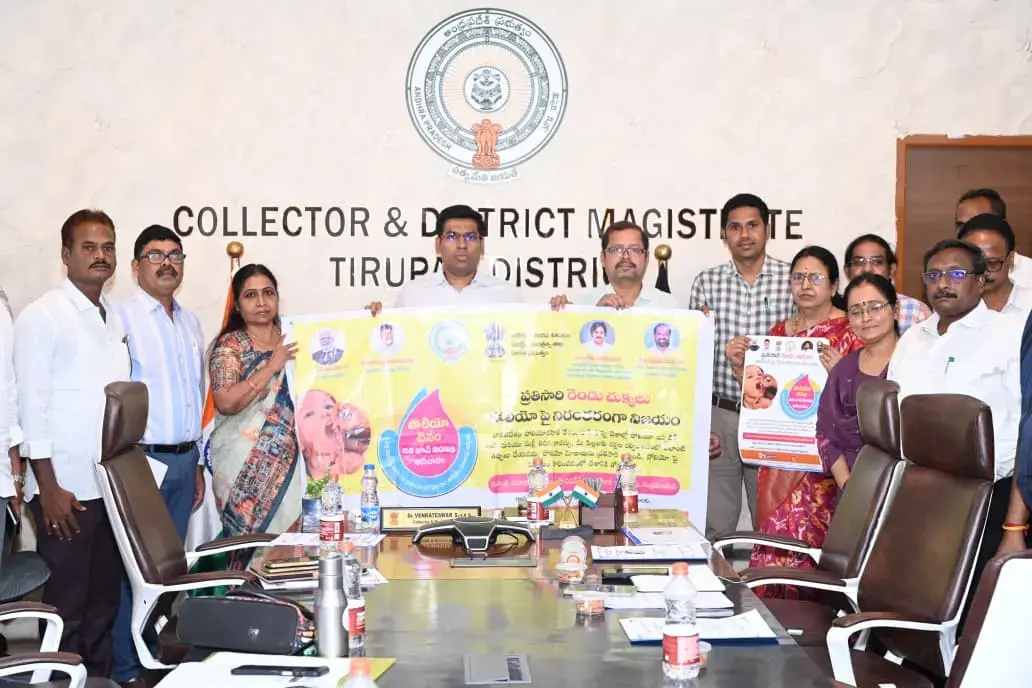
Tirupati Collector reviews Pulse Polio arrangements in district
Tirupati District Collector Dr S. Venkateswar directed officials to make the National Pulse Polio programme, to be held on the 28th, 29th and 30th of this month, a success in the district. Chairing a district task force committee meeting at the collectorate on Tuesday, he reviewed booths, staffing, vaccine stocks and transport. District Medical and Health Officer Dr Balakrishna Naik said 1,937 polio centres, 84 mobile and 57 transit centres have been set up, targeting 2,59,843 children under five.
Source
Tirupati — వార్తలు · read the original report ↗
Desk check · compared with the source
What the desk checked (5)
- National Pulse Polio programme will be held on the 28th, 29th and 30th of this month. — Attributed to District Collector Dr S. Venkateswar; source gives dates without naming the month.
- Tirupati district has set up 1,937 pulse polio centres, 84 mobile centres and 57 transit centres. — Figures attributed to District Medical and Health Officer Dr Balakrishna Naik; appear as stated in source.
- Target of administering polio drops to 2,59,843 children under five in the district. — Figure attributed to the DM&HO; appears in source.
- Mobile staff will visit high-risk sites such as tent settlements, brick kilns and construction sites. — Attributed to the DM&HO; forward-looking statement, not independently checkable.
- Collector reviewed booth setup, staffing, awareness, vaccine stocks, transport and monitoring at the district task force meeting. — Described in source as part of the Tuesday meeting at the collectorate; no independent source given.
Analysts’ view opinion
This is not a new scheme but the district-level execution of a machinery India has run for decades. The real policy question is not the target but the last mile: which of the 2,59,843 under-five children get missed. The design on show is deliberately multi-layered — 1,937 fixed booths plus 84 mobile and 57 transit points, with Anganwadi and school rolls used to identify eligible children — and the Collector-led task force model, pulling in health, education, ICDS, municipal and DRDA departments, has historically been the administrative backbone of polio drives.
- The three-tier structure of fixed booths, mobile teams and transit posts is classic coverage-gap policy design that avoids relying on any single delivery channel.
- In a pilgrimage and tourism district like Tirupati, floating populations are high, so transit points at bus and railway stations are a sensible response to a specific local reality.
- By flagging tents, brick kilns and construction sites as high-risk, the drive is explicitly aimed at migrant worker families — precisely the group routine health systems tend to miss.
- The implementation risks are the familiar ones: cold chain and vaccine stocks, transport, staff deployment and supervision — all listed in the review, though staff numbers and cold chain capacity are not disclosed.
- The "100 percent" ambition signals political will, but the honest metric will be the post-campaign house-to-house mop-up findings and the count of children initially missed.
What to watch — Watch for the actual coverage figures reported after 28–30, the number of missed children found in the mop-up round, and how the mobile teams perform in high-risk settlements.
The story records a review meeting and stated targets only; it establishes nothing about past round coverage, staffing strength, funding or cold chain readiness.
Deep dive
Research brief · 8 facts · 2 dates · exam-readyThe brief
Context
The National Pulse Polio programme, India's mass oral polio vaccination drive for children under five, is being rolled out in Andhra Pradesh's Tirupati district on the 28th, 29th and 30th of this month. Ahead of the drive, District Collector Dr S. Venkateswar chaired a district task force committee meeting at the collectorate on Tuesday to review booths, staffing, awareness activities, vaccine stocks, transport and supervision. District health officials outlined the booth network and target coverage, with special attention to urban areas, tourist spots and high-risk migrant settlements where children are most likely to be missed.
Key facts
- The National Pulse Polio programme will be held in Tirupati district on the 28th, 29th and 30th of this month.
- District Collector Dr S. Venkateswar chaired the district task force committee meeting in the mini conference hall of the collectorate on Tuesday.
- 1,937 pulse polio centres have been set up across Tirupati district, along with 84 mobile centres and 57 transit centres.
- The district target is 2,59,843 children aged under five years.
- Every child aged 0 to 5 years is to be given two drops of polio vaccine, as stated by the Collector.
- Mobile teams will visit high-risk locations such as tents, brick kilns and construction sites to vaccinate all children under five.
- Special mobile vaccination centres are to be set up at bus stations and railway stations in addition to regular polio booths.
- Eligible children are to be identified through anganwadi centres and schools; District Medical and Health Officer Dr Balakrishna Naik briefed the meeting.
Timeline
- Tuesday (this week)Collector Dr S. Venkateswar chairs district task force committee meeting at Tirupati collectorate and reviews pulse polio arrangements; later unveils pulse polio banner and posters with officials.
- 28th, 29th and 30th of this monthNational Pulse Polio programme to be conducted across Tirupati district.
Who has a stake
- Children aged 0-5 years in Tirupati district — 2,59,843 children targeted to receive two polio drops each; protection from paralytic polio.
- District Collector Dr S. Venkateswar — Heads the district task force; accountable for 100 per cent success of the drive and inter-departmental coordination.
- District Medical and Health Officer Dr Balakrishna Naik and health staff — Operating 1,937 booths, 84 mobile and 57 transit centres, vaccine stocks, cold chain and supervision.
- Migrant and floating populations at tents, brick kilns and construction sites — High-risk groups whose children risk being missed; to be covered by mobile teams.
- Education department and ICDS/anganwadi network (DEO K.V.N. Kumar, ICDS PD Vasantabai) — Identifying and mobilising eligible children through schools and anganwadi centres.
- Municipal, DRDA and immunisation officials (Dr Shantakumari, DCHS Anandamurthy) — Urban coverage, transport, awareness campaigns and field supervision during the three-day drive.
Why it matters
Polio spreads fastest among unvaccinated children in mobile and crowded populations, so a single missed pocket can undo years of eradication work. Tirupati, a major pilgrim and tourist destination with brick kilns and construction sites, has a large floating population, which is why the Collector stressed transit and mobile centres. The district's ability to reach all 2,59,843 under-five children is a test of how well health, education, ICDS and municipal machinery coordinate.
UPSC angle
Prelims pointers
- National Pulse Polio programme covers children aged 0-5 years, given two drops of oral polio vaccine.
- Tirupati district arrangements: 1,937 polio centres, 84 mobile centres, 57 transit centres; target 2,59,843 children under five.
- Drive dates in Tirupati district: 28th, 29th and 30th of this month.
- District Task Force Committee, chaired by the District Collector, oversees pulse polio implementation at district level.
- High-risk sites named for mobile vaccination: tents, brick kilns and construction sites; transit points include bus and railway stations.
- Convergence agencies involved: District Medical and Health department, Education department, ICDS/anganwadi centres, municipal bodies and DRDA.
Mains framing
District-level polio immunisation drives illustrate how a national public health goal depends on last-mile administrative convergence. In Tirupati, the Collector's review covered booth creation, staffing, awareness, vaccine stocks, transport and supervision, and identified the core risk: children in urban areas, tourist locations and mobile settlements such as tents, brick kilns and construction sites who may be missed by fixed booths. The response combines a dense fixed network of 1,937 centres with 84 mobile and 57 transit centres at bus and railway stations, plus identification of eligible children through anganwadi centres and schools, against a target of 2,59,843 under-five children. The implications are twofold: coverage gaps among migrant and floating populations are the main vulnerability in maintaining polio-free status, and success rests on departments beyond health, education, ICDS, municipal bodies and rural development, working in coordination under a single district task force. The way forward, as indicated in the source, is focused targeting of high-risk and transit populations, intensive awareness activities, secure vaccine stocks and transport, and close supervision to achieve the stated goal of 100 per cent coverage.
Key terms
- Pulse Polio programme
- National drive in which all children aged 0-5 years are given two drops of polio vaccine on designated days.
- District Task Force Committee
- District-level body, chaired by the Collector, that plans and reviews pulse polio arrangements across departments.
- Transit centre
- Vaccination point at travel hubs such as bus and railway stations to cover children on the move.
- Mobile vaccination centre
- Roving team-based unit that visits high-risk sites like tents, brick kilns and construction sites.
- ICDS / anganwadi centres
- Integrated Child Development Services network used here to identify and mobilise eligible under-five children.
- DMHO (District Medical and Health Officer)
- Senior district health official responsible for booths, staffing and vaccine logistics; here Dr Balakrishna Naik.
Practice questions
- Discuss how district-level administrative convergence determines the success of national immunisation drives, using the Pulse Polio programme as an example.
- Why do migrant and floating populations pose the biggest challenge to sustaining polio-free status in India? Suggest measures based on the Tirupati model of mobile and transit centres.
- Examine the role of the District Collector and district task force committees in delivering public health programmes at the last mile.
Grounded only in the source report — figures and dates are the source's, not inferred.