
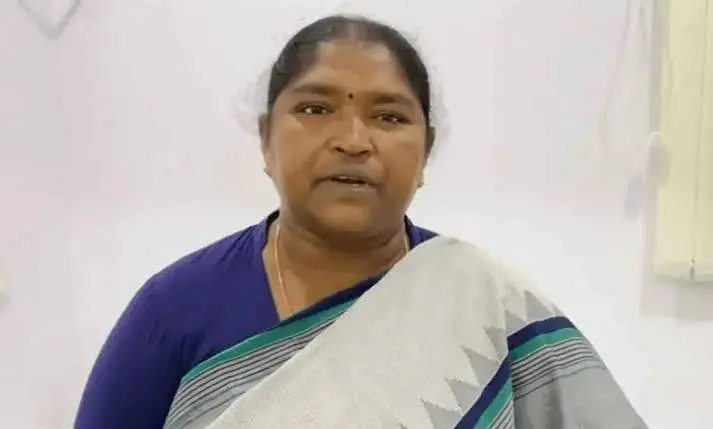
'Tholi Mudda' launched for Anganwadi children's nutrition
The state government has launched the 'Tholi Mudda' programme to provide nutrition essential for the physical, mental and emotional development of children aged three to six years, panchayat raj, rural development and women and child welfare minister Dhanasari Anasuya Seethakka said. She inaugurated it at the Mulugu collectorate on Monday. It is being implemented in six districts, including Mulugu. From October 1, all Anganwadi centres will serve breakfast with an egg, upma one day and khichdi another.
Source
Mulugu — news · read the original report ↗
Desk check · compared with the source
What the desk checked (5)
- The 'Tholi Mudda' programme was inaugurated at the Mulugu collectorate on Monday by minister Dhanasari Anasuya Seethakka. — Attributed to the minister's event; date given only as 'Monday' in the source, no calendar date provided.
- The programme targets children aged three to six years and is being implemented in six selected districts, including Mulugu. — Figures appear in the source, attributed to the minister; the other five districts are not named.
- From October 1, all Anganwadi centres will serve a nutritious breakfast with an egg, upma on one day and khichdi on another. — Attributed to the minister; the year is not specified in the source.
- Children in Mulugu district are already receiving 100 ml of milk, and malnourished children are given Balamrutham and Balamrutham Plus. — Attributed to the minister; no supporting data or coverage numbers given.
- Officials were directed to ensure at least 20 children at each centre and to prepare building proposals under the employment guarantee scheme. — Stated as the minister's directive; no timeline or budget mentioned in the source.
Analysts’ view opinion
'Tholi Mudda' reads as a step in converting Anganwadi centres from food-distribution points into fuller day-care and pre-school hubs. Targeting the three-to-six age group is sound policy design, since this is the most critical window for physical and cognitive growth and these children fall outside the primary-school midday meal net. But for now this is a phased rollout in six districts, and the real test lies in daily execution — supply chains, food quality and the load on frontline staff.
- Moving from milk alone to milk plus egg, breakfast and lunch marks a shift from a single supplementary item to a whole-day nutrition model.
- Choosing locally cookable dishes such as upma and khichdi is a pragmatic cost and supply-chain decision, but without quality and quantity monitoring the menu risks existing only on paper.
- Balamrutham and Balamrutham Plus for malnourished children indicate a two-tier design: universal provision layered with targeted intervention.
- The directive on play-and-activity based pre-school learning and a floor of at least 20 children per centre aims to lift enrolment and attendance, though it adds pressure on already stretched field workers.
- Funding new Anganwadi buildings through the employment guarantee scheme is a familiar convergence approach, reusing existing schemes rather than creating fresh outlays.
What to watch — Watch whether the menu is actually served consistently at every centre from October 1, and what timeline and budget are set for scaling beyond the six districts.
The story does not establish the programme's budget, per-child cost, which six districts were chosen, how many children benefit, the monitoring mechanism, or any timeline for statewide expansion.
Deep dive
Research brief · 8 facts · 2 dates · exam-readyThe brief
Context
Telangana's state government has launched 'Tholi Mudda', a supplementary nutrition programme for Anganwadi children aged three to six years, aimed at supporting their physical, mental and emotional development. Anganwadi centres, run under the women and child welfare department, are the frontline delivery points for child nutrition and pre-primary learning in rural India. Panchayat raj, rural development and women and child welfare minister Dhanasari Anasuya Seethakka inaugurated the programme at the Mulugu collectorate on a Monday, with rollout in six selected districts including Mulugu. The push comes alongside existing interventions such as milk supply and Balamrutham for malnourished children.
Key facts
- 'Tholi Mudda' targets children aged between three and six years at Anganwadi centres.
- The programme was inaugurated by minister Dhanasari Anasuya Seethakka at the Mulugu collectorate on Monday.
- It is being implemented in six selected districts, including Mulugu.
- From October 1, all Anganwadi centres will serve a nutritious breakfast with an egg — upma on one day and khichdi on another.
- Children in Mulugu district are already being given 100 ml of milk daily.
- Children will now receive a complete nutritional diet of milk, eggs, breakfast and lunch.
- Malnourished children are being provided Balamrutham and Balamrutham Plus.
- The minister directed that at least 20 children be ensured at each Anganwadi centre.
Timeline
- Monday (date not stated in the source)Minister Seethakka inaugurates the 'Tholi Mudda' programme at the Mulugu collectorate.
- From October 1All Anganwadi centres to serve nutritious breakfast with an egg — upma one day, khichdi another.
Who has a stake
- Children aged 3-6 years at Anganwadi centres — Direct beneficiaries of breakfast, egg, milk and lunch plus play-based pre-primary education.
- Minister Dhanasari Anasuya Seethakka (panchayat raj, rural development, women and child welfare) — Launched the programme and issued directions on buildings, enrolment and facilities.
- Women and child welfare department officials — Tasked with identifying centres lacking buildings, ensuring 20 children per centre and delivering pre-primary activities.
- Anganwadi centres in six selected districts including Mulugu — Implementation points for the new menu and for basic facilities like drinking water, cupboards and tables.
- Malnourished children — Continue to receive Balamrutham and Balamrutham Plus supplements.
- Employment guarantee scheme machinery — Proposals to be prepared under it to construct buildings for Anganwadi centres without their own premises.
Why it matters
The 3-6 age window is decisive for cognitive and physical growth, and a hot breakfast with an egg addresses the morning hunger gap that supplementary nutrition programmes often miss. By pairing food with play-based pre-primary education, better buildings and basic facilities, the state is treating the Anganwadi as both a nutrition and early-learning centre rather than a feeding point alone.
UPSC angle
Prelims pointers
- 'Tholi Mudda' — Telangana programme for nutrition of Anganwadi children aged 3-6 years, launched in six districts including Mulugu.
- Breakfast with an egg at all Anganwadi centres from October 1; upma one day, khichdi another.
- Mulugu district children already receive 100 ml milk daily; diet now covers milk, eggs, breakfast and lunch.
- Balamrutham and Balamrutham Plus are supplements given to malnourished children.
- Minister in charge: Dhanasari Anasuya Seethakka (panchayat raj, rural development, women and child welfare).
- Anganwadi centres without own buildings to get proposals under the employment guarantee scheme; minimum 20 children per centre directed.
Mains framing
Early childhood undernutrition has long-term effects on learning capacity and productivity, and the Anganwadi system is the state's principal instrument for reaching pre-school children. 'Tholi Mudda' responds to this by adding a hot, protein-rich breakfast with an egg to the existing package of 100 ml milk and lunch for children aged three to six, while continuing targeted supplements — Balamrutham and Balamrutham Plus — for those already malnourished. The programme's design recognises that nutrition alone is insufficient: the minister's directions on play- and activity-based pre-primary education, ensuring at least 20 children per centre, identifying centres without buildings for construction under the employment guarantee scheme, and providing drinking water, cupboards and tables, point to infrastructure and enrolment as the binding constraints on outcomes. The way forward, on the source's own logic, lies in dependable daily supply of eggs and milk, converging construction funds with rural employment works, raising attendance so that food actually reaches children, and eventually extending the model beyond the six pilot districts based on measured results.
Key terms
- Tholi Mudda
- State programme providing nutritious food to Anganwadi children aged 3-6 years for a healthy future.
- Anganwadi centre
- Village-level child care centre delivering supplementary nutrition and pre-primary learning under women and child welfare.
- Balamrutham / Balamrutham Plus
- Nutritional supplements provided to children suffering from malnutrition.
- Employment guarantee scheme
- Scheme under which proposals will be prepared to construct buildings for Anganwadi centres lacking their own premises.
- Pre-primary education through play and activities
- Activity-based early learning that officials were directed to provide alongside nutritious food at Anganwadi centres.
Practice questions
- Discuss how programmes like 'Tholi Mudda' address the nutrition and early-learning needs of children aged 3-6 years at Anganwadi centres.
- Examine the role of infrastructure and enrolment in determining the effectiveness of supplementary nutrition delivered through Anganwadi centres.
- How can convergence between rural employment guarantee works and child welfare infrastructure improve outcomes for pre-school children?
Grounded only in the source report — figures and dates are the source's, not inferred.