
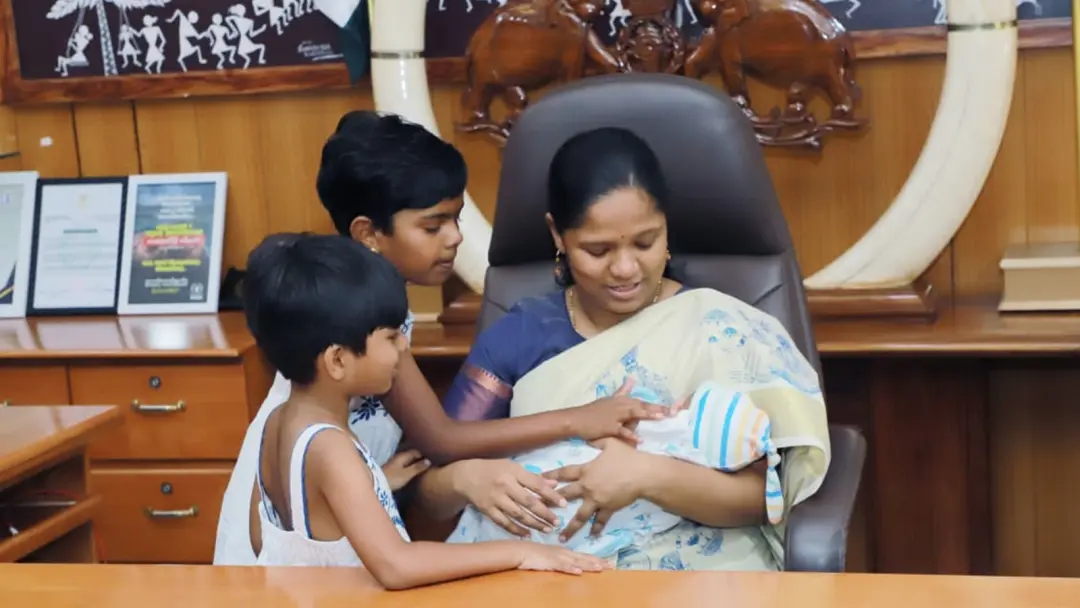
Wayanad Collector resumed duty six days after delivery
Kerala's Wayanad District Collector Meghashree D R attended to official duties on August 24 before checking into a hospital, and gave birth to her third daughter on August 25. She rested five days and began working from the Collector's camp office on September 1. On Wednesday, the 2017-batch IAS officer proceeds on two-month maternity leave after handing charge to successor Chelsasini V. "It is not mandatory that one takes maternity leave. The decision depends on an individual, her health and circumstances," she said.
Source
Indian Express — India · read the original report ↗
Desk check · compared with the source
What the desk checked (4)
- Wayanad Collector Meghashree D R gave birth to her third daughter on August 25 and resumed work from the camp office on September 1. — Attributed to the officer in her own quotes to The Indian Express; dates are internally consistent.
- She will proceed on two-month maternity leave on Wednesday after handing over charge to successor Chelsasini V. — Stated by the reporter without a named official document; consistent within the source.
- Meghashree is a 2017-batch IAS officer who took charge as Wayanad Collector on July 10, 2024. — Figure and date appear in the source; no external verification possible.
- She led rescue and relief operations after the July 30 landslide in Wayanad and is involved in survivor rehabilitation and a new township. — Reported by the publication; no separate official source cited in the text.
Analysts’ view opinion
On the surface this is a personal story, but its administrative and political signalling value is significant. Wayanad is a district under near-constant political scrutiny — landslide relief, rehabilitation, a new township — so a Collector clearing files without a gap reassures everyone that governance did not stall. At the same time it could feed a debate on maternity rights, a risk the officer pre-empted by stressing that the choice was purely personal and that maternity leave is not mandatory for anyone.
- With post-landslide rehabilitation and township work among the most politically scrutinised files in Wayanad, continuity in the Collector's chair reads as a positive administrative signal for the state government.
- Her remark that maternity leave is "not mandatory" will likely be read two ways — as devotion to duty by some, and as risking an unhealthy benchmark for working women by others.
- By framing it as a decision dependent on the individual, her health and circumstances, she limits the space for anyone to convert it into a policy template.
- She is, in the end, taking two months' leave and handing over charge, so this is a case of deferral rather than denial of maternity leave.
- Local political circles will watch whether the pace of rehabilitation work holds through the change of Collector.
What to watch — Watch whether rehabilitation and township work keeps pace under the new Collector, and whether this episode widens into a broader debate on working conditions for women officers.
The story does not establish that any government or political actor pressured her or is leveraging the decision, and it records no official or political reactions.
Deep dive
Research brief · 8 facts · 8 dates · exam-readyThe brief
Context
Meghashree D R, a 2017-batch IAS officer and District Collector of Wayanad in Kerala, gave birth to her third daughter on August 25 and returned to official work from the Collector's camp office on September 1, six days after delivery. She proceeded on a two-month maternity leave only on Wednesday, after handing over charge to her successor Chelsasini V. A native of Chitradurga in Karnataka, she had assumed office in Wayanad on July 10, 2024, and led rescue and relief operations after the landslide of July 30 in the district.
Key facts
- Meghashree D R attended to official duties and functions on August 24 before checking herself into a hospital the same evening.
- She gave birth to her third daughter on August 25.
- She rested for five days and began working from the Collector's camp office from September 1, saying several files demanded the District Collector's sanction.
- She is a 2017-batch IAS officer and a native of Chitradurga in Karnataka.
- She assumed office as Wayanad District Collector on July 10, 2024.
- She led rescue and relief operations after the landslide that struck Wayanad on July 30, and has been involved in survivor rehabilitation and construction of a new township.
- On Wednesday she proceeds on two-month maternity leave after handing over charge to her successor Chelsasini V.
- On September 5, she posted an Instagram video answering rapid-fire questions, saying development, empowerment and conservation should go hand in hand for Wayanad.
Timeline
- July 10, 2024Meghashree D R assumes office as Wayanad District Collector.
- July 30Landslide strikes Wayanad; she leads rescue and relief operations.
- August 24She attends to official duties, then checks into a hospital.
- August 25She gives birth to her third daughter.
- September 1After five days' rest, she resumes work from the Collector's camp office.
- September 5She posts a video on Instagram from the field, answering rapid-fire questions.
- TuesdayShe brings her three daughters, including the newborn, to her farewell ceremony at the District Collectorate.
- WednesdayShe proceeds on two-month maternity leave after handing charge to Chelsasini V.
Who has a stake
- Meghashree D R, Wayanad District Collector — Balancing personal health and motherhood with the demands of district administration; says the decision to keep working was personal.
- Chelsasini V, incoming Collector — Takes over charge of Wayanad district administration during Meghashree's two-month leave.
- Wayanad district administration — Continuity of file clearances and decisions requiring the District Collector's sanction.
- Landslide survivors in Wayanad — Ongoing rehabilitation and construction of the new township led by the Collector's office.
- College students of Wayanad — Beneficiaries of the Collector's 'Good Morning Collector' interaction programme, held online recently.
- Women civil servants and working mothers — The case raises questions about maternity leave entitlements versus individual choice in high-responsibility posts.
Why it matters
A District Collector is the pivot of district administration, and in a district still rehabilitating landslide survivors, the absence of a sanctioning authority can stall files and relief work. Meghashree's choice has been widely praised as a sense of duty, but her own framing — that maternity leave is not mandatory and depends on individual health and circumstances — points to the larger question of how administrative systems support women officers rather than relying on personal sacrifice.
UPSC angle
Prelims pointers
- Meghashree D R: 2017-batch IAS officer, Wayanad District Collector, native of Chitradurga, Karnataka.
- She assumed office as Wayanad Collector on July 10, 2024; the Wayanad landslide struck on July 30.
- She gave birth on August 25 and resumed duty from the Collector's camp office on September 1.
- She proceeded on two-month maternity leave after handing charge to Chelsasini V.
- 'Good Morning Collector' was her regular programme of interaction, recently held online with college students.
- Post-landslide work under her charge included survivor rehabilitation and construction of a new township.
Mains framing
The case of the Wayanad Collector resuming duty six days after childbirth sits at the intersection of administrative continuity and the rights of women in public service. The immediate cause was operational: a district recovering from the July 30 landslide, with rehabilitation and township construction underway, and pending files requiring the District Collector's sanction — a role that cannot easily be left vacant. The officer herself frames it as a personal decision, stressing that maternity leave is not mandatory and depends on individual health and circumstances, which usefully separates personal choice from any expectation placed on women officers. The implication, however, is that the smooth functioning of a district should not hinge on an individual's willingness to forgo rest; institutional arrangements such as timely charge handover — as eventually done to her successor Chelsasini V — delegation of sanctioning powers, and flexible or camp-office working can secure both continuity and welfare. The way forward lies in normalising full use of maternity entitlements while designing succession and delegation protocols in disaster-affected districts, so that duty and dignity are not traded against each other.
Key terms
- District Collector
- The senior-most administrative officer of a district, whose sanction is required on a range of official files and who leads disaster relief efforts.
- Camp office
- An official working space attached to the officer's residence, allowing files and duties to be attended to without going to the main office.
- Maternity leave
- Paid leave available to a woman employee around childbirth; here the officer took two months and noted that availing it is not mandatory.
- Handing over charge
- The formal transfer of an officer's powers and responsibilities to a successor, here from Meghashree D R to Chelsasini V.
- Good Morning Collector
- An interaction programme the Wayanad Collector conducted regularly, recently held online with college students.
- Wayanad landslide
- The disaster that struck the district on July 30, followed by rescue, relief, survivor rehabilitation and construction of a new township.
Practice questions
- Should administrative continuity in disaster-hit districts depend on individual officers forgoing statutory entitlements such as maternity leave? Discuss with reference to the Wayanad case.
- Examine the role of the District Collector in disaster rescue, relief and rehabilitation, using the Wayanad landslide response as an illustration.
- 'Maternity leave is not mandatory; the decision depends on an individual, her health and circumstances.' Critically evaluate this statement in the context of gender and institutional support in the civil services.
Grounded only in the source report — figures and dates are the source's, not inferred.