
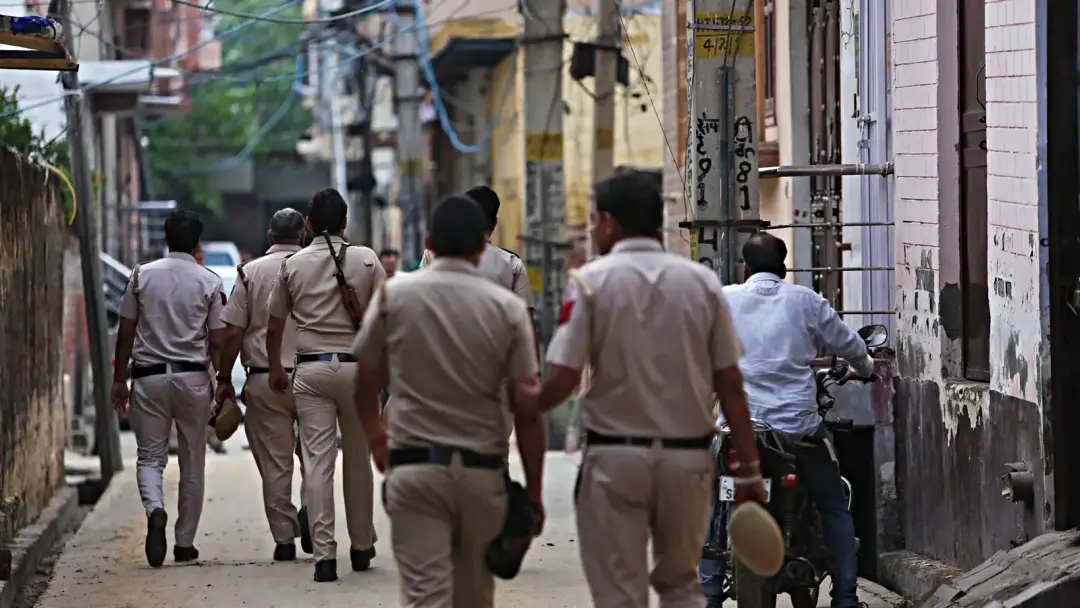
Drug kingpin Virender Baisoya's son arrested at Delhi airport
Rishabh Baisoya, 23, son of drug kingpin Virender Baisoya and wanted by the Delhi Police Special Cell in a drug smuggling case, was arrested on Tuesday soon after landing at Indira Gandhi International Airport from Dubai. A court remanded him in police custody for seven days. The Special Cell alleges he arranged a vehicle in October 2024 to move cocaine from Delhi to Punjab on his father's directions. Lawyer Aditya Dhawan said he was implicated only for being Virender's son.
Source
Indian Express — Cities · read the original report ↗
Desk check · some claims need care
What the desk checked (5)
- Rishabh Baisoya, 23, son of Virender Baisoya, was arrested on arrival at Delhi airport from Dubai on Tuesday and remanded to seven days' police custody. — Attributed to officials in the source; court remand figure appears in source.
- A Red Corner Notice and Look Out Circular against him were revoked on a Delhi court's directions after his lawyer said he wanted to join the probe. — Attributed only to unnamed 'sources' in the source text; weaker sourcing.
- He allegedly handed over his uncle's car to Jatinder Gill alias Jassi in October 2024 to move cocaine to Punjab; 1 kg was seized with a Toyota Fortuner in Amritsar. — Attributed to the Special Cell; contested by lawyer Aditya Dhawan, who cites the chargesheet naming Tushar Goel as the supplier.
- Chargesheet in the Rs 13,000-crore cartel case names 19 accused; seizures of 562 kg, 208 kg and 518 kg of cocaine in Delhi and Gujarat. — Figures appear in the source, attributed to the chargesheet and police.
- Virender Baisoya was arrested in Dubai in June and brought back under NCB's 'Operation Global-Hunt', arrested at Delhi airport on August 14. — Attributed to the source's account of NCB action; no direct official quote given.
Analysts’ view opinion
This is more than an arrest story — it illustrates how a person declared a proclaimed offender navigates a return to India to "join the investigation". The revocation of the Red Corner Notice and Look Out Circular on a Delhi court's directions is what made his travel possible, but the arrest at the airport itself shows such revocation offers no immunity from custody. Meanwhile, his counsel's claim that the co-accused's statement in the chargesheet does not name him raises the central evidentiary question in NDPS prosecutions.
- Even after a proclaimed-offender declaration, revocation of an RCN/LOC on an undertaking to join the probe is a discretionary judicial step, not relief from the case itself.
- A seven-day police custody remand is routine at the investigation stage, and the accused retains rights to counsel, medical examination and to contest any extension.
- Bail is typically hard to obtain early in commercial-quantity cocaine cases because of the stringent conditions built into the NDPS framework.
- The allegation of acting "at his father's behest" cannot rest on the family link alone — the prosecution would have to establish knowledge and a conscious role in handing over the vehicle.
- Saying he stayed away out of fear of false implication is an explanation, not a legal defence, and absconding conduct can weigh against an accused at the bail stage.
What to watch — Watch whether police seek an extension or he is moved to judicial custody after seven days, and what specific material against Rishabh appears in any supplementary chargesheet.
Everything here remains a police allegation; the story does not establish Rishabh's guilt, nor has any court endorsed his lawyer's reading of the chargesheet.
Deep dive
Research brief · 8 facts · 9 dates · exam-readyThe brief
Context
Rishabh Baisoya, 23, son of alleged drug kingpin Virender Baisoya, was arrested by the Delhi Police Special Cell at Indira Gandhi International Airport on Tuesday soon after landing from Dubai, and remanded in police custody for seven days. He is an accused in a Rs 13,000-crore drug cartel case in which the Special Cell has named 19 accused and seized nearly 1,288 kg of cocaine in three operations in Delhi and Gujarat in October 2024. His father Virender was brought back from Dubai under the Narcotics Control Bureau's 'Operation Global-Hunt' and arrested at Delhi airport on August 14. Rishabh's lawyer says he has been implicated only because he is Virender's son.
Key facts
- Rishabh Baisoya, 23, was arrested by the Delhi Police Special Cell on Tuesday soon after landing at Indira Gandhi International Airport from Dubai; a court remanded him to seven days' police custody.
- A Red Corner Notice and a Look Out Circular against Rishabh were revoked on a Delhi court's directions after his lawyer said he wanted to return to India to join the investigation; police say he had been absconding since 2024.
- Special Cell alleges that in October 2024, on his father's directions, Rishabh gave his uncle's Toyota Fortuner to Jatinder Gill alias Jassi to move cocaine from Delhi to Punjab; Jassi was arrested in Amritsar and 1 kg of cocaine seized.
- Lawyer Aditya Dhawan said Rishabh has been pursuing an LLB (Hons) at the University of West London since 2022 and was in India on vacation, planning to return to London in October 2024.
- Dhawan said the chargesheet shows Jatinder Gill did not name Rishabh as the supplier; accused Tushar Goel allegedly disclosed he gave 1 kg of contraband to Gill for supply in Punjab.
- Virender Baisoya was arrested in Dubai in June and brought back under NCB's 'Operation Global-Hunt'; he was arrested at Delhi airport on August 14 and taken to Pune over the seizure of 1,800 kg of mephedrone.
- In the Rs 13,000-crore drug cartel chargesheet, the Special Cell named 19 accused; 14 were arrested, including Tushar Goyal, heir to two publishing houses, and five including Virender and Rishabh were declared proclaimed offenders.
- Three seizures: 562 kg cocaine at Mahipalpur, South Delhi on October 1, 2024; 208 kg at a Ramesh Nagar shop in West Delhi on October 10; 518 kg worth Rs 5,000 crore at Aavkar Drugs, Ankleshwar, Gujarat on October 13.
Timeline
- 2022Rishabh Baisoya begins pursuing an LLB (Hons) at the University of West London, according to his lawyer.
- October 1, 2024562 kg of cocaine seized in Mahipalpur, South Delhi; Tushar and three others arrested.
- October 10, 2024Another 208 kg of cocaine seized from a shop in Ramesh Nagar, West Delhi.
- October 13, 2024Special Cell and Gujarat Police recover 518 kg of cocaine worth Rs 5,000 crore at Aavkar Drugs in Ankleshwar, Gujarat.
- October 2024Rishabh allegedly hands over his uncle's Toyota Fortuner to Jatinder Gill alias Jassi to transport cocaine from Delhi to Punjab; Jassi later arrested in Amritsar with 1 kg cocaine.
- June (year as stated in source)Virender Baisoya arrested in Dubai.
- August 14Virender arrested at Delhi airport by NCB after landing from Dubai; taken to Pune for questioning by NCB's Mumbai unit.
- Earlier this monthDelhi Police secure Virender's custody in the Rs 13,000-crore drug cartel case.
- Tuesday (this week)Rishabh detained at IGI Airport, taken into Special Cell custody, produced in court and remanded for seven days.
Who has a stake
- Delhi Police Special Cell — Investigating agency in the Rs 13,000-crore cartel case; must prove Rishabh's role beyond his family link, having named 19 accused in the chargesheet.
- Rishabh Baisoya (23) — Accused, declared proclaimed offender, now in seven-day police custody; claims false implication and disrupted law studies in London.
- Virender Baisoya — Alleged kingpin; in custody in the Delhi cartel case and questioned by NCB over the 1,800 kg mephedrone seizure.
- Narcotics Control Bureau (NCB) — Ran 'Operation Global-Hunt' to bring Virender back from Dubai; its Mumbai unit probes the Pune-Delhi mephedrone case.
- Aditya Dhawan, defence lawyer — Argues chargesheet does not link Rishabh to the contraband and that he avoided investigation fearing false arrest.
- Gujarat Police / Ankleshwar firm Aavkar Drugs — Joint raid partner; the pharma unit allegedly used to refine and process cocaine shipped as pharmaceutical chemicals.
- Other accused (Tushar Goyal, Jatinder Gill alias Jassi) — Arrested co-accused whose disclosures shape the case against the Baisoyas.
Why it matters
The case exposes how a transnational cocaine pipeline allegedly ran from South America via Dubai into India, using pharmaceutical factories and a fake company, Pharma Solutions Services, to move drugs as medical consignments. It also shows the machinery of international enforcement — Red Corner Notices, Look Out Circulars and NCB's 'Operation Global-Hunt' — being used to bring absconders home. At the same time, the defence claim of guilt by association raises questions about evidentiary standards when family members of alleged kingpins are named as accused.
UPSC angle
Prelims pointers
- Red Corner Notice (RCN) and Look Out Circular (LOC) against Rishabh Baisoya were revoked on the directions of a Delhi court.
- NCB's 'Operation Global-Hunt' was used to bring Virender Baisoya back to India after his arrest in Dubai in June.
- Delhi Police Special Cell chargesheet in the Rs 13,000-crore drug cartel case names 19 accused; 14 arrested, 5 declared proclaimed offenders.
- October 2024 cocaine seizures: 562 kg (Mahipalpur), 208 kg (Ramesh Nagar), 518 kg (Aavkar Drugs, Ankleshwar) worth Rs 5,000 crore.
- NCB's Mumbai unit probed the seizure of 1,800 kg of mephedrone from Pune and Delhi in a 2024 case.
- Alleged route: cocaine entered India from South America via Dubai, refined at a Gujarat pharma unit, moved as medicine packages of a fake firm, Pharma Solutions Services, to Delhi-NCR.
Mains framing
The Baisoya case illustrates the industrialisation of narcotics trafficking in India: according to police, cocaine sourced from South America entered the country at multiple points via Dubai, was routed as pharmaceutical chemical consignments to a firm in Ankleshwar for refining, and then dispatched as medicine packages of an alleged shell company, Pharma Solutions Services, to Delhi-NCR — a model that exploits legitimate pharma logistics and paper trails. The scale, over 1,288 kg of cocaine seized in three October 2024 operations and a case valued at Rs 13,000 crore, plus a separate 1,800 kg mephedrone seizure, points to weaknesses in supply-chain scrutiny of chemical and medical consignments and in port and road cargo checks. Enforcement responses have been transnational: Interpol Red Corner Notices, Look Out Circulars, and NCB's 'Operation Global-Hunt' to secure Virender Baisoya's return from Dubai, with the Special Cell then obtaining custody. The counter-narrative from the defence — that Rishabh, a London law student, was named only as the kingpin's son and that neither the alleged carrier's statement nor the chargesheet links him to the contraband — highlights the need for rigorous, disclosure-independent evidence, prompt trial and judicial supervision of coercive measures such as proclaimed-offender declarations, so that networked crime is dismantled without diluting due process.
Key terms
- Red Corner Notice (RCN)
- An international notice sought to locate and provisionally arrest a wanted person abroad; the one against Rishabh was revoked by a Delhi court's direction.
- Look Out Circular (LOC)
- An alert to immigration authorities to stop or track a person's movement across Indian borders; Rishabh's was revoked before his return.
- Proclaimed offender
- An accused declared by a court as absconding from proceedings; five of the 19 accused, including Virender and Rishabh, were so declared.
- Operation Global-Hunt
- Narcotics Control Bureau operation under which Virender Baisoya was brought back to India after his arrest in Dubai.
- Delhi Police Special Cell
- Specialised unit investigating the Rs 13,000-crore cocaine cartel case and which arrested Rishabh at the airport.
- Mephedrone
- A synthetic stimulant drug; 1,800 kg of it was seized from Pune and Delhi in a 2024 case probed by NCB's Mumbai unit.
Practice questions
- Discuss how transnational drug cartels exploit legitimate pharmaceutical supply chains, using the Delhi-Gujarat cocaine case as an illustration. What regulatory gaps does it reveal?
- Examine the role of instruments such as Red Corner Notices, Look Out Circulars and inter-agency operations like NCB's 'Operation Global-Hunt' in tackling fugitive economic and narcotics offenders.
- 'Guilt by association cannot substitute for evidence.' In light of the defence arguments in the Baisoya case, discuss the balance between aggressive narcotics enforcement and due process safeguards.
Grounded only in the source report — figures and dates are the source's, not inferred.