
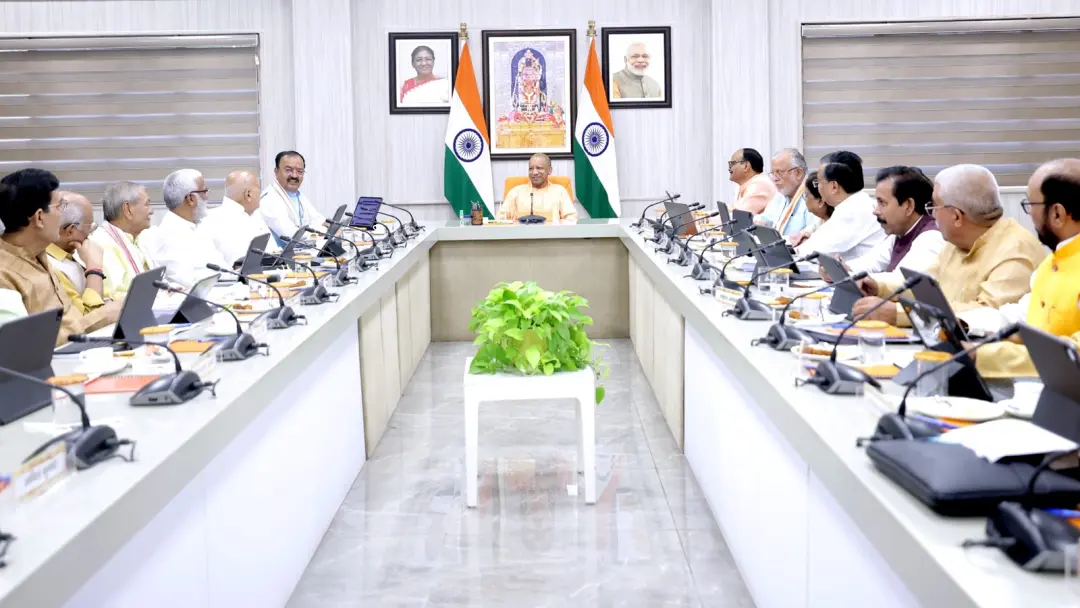
UP Cabinet clears 65-acre transfer for NSG regional centre in Ayodhya
The Uttar Pradesh Cabinet on Tuesday approved the free transfer of land to the Union Home Ministry for a National Security Guard regional centre in Ayodhya. The meeting, chaired by Chief Minister Yogi Adityanath, cleared the transfer of 26 hectares (65 acres) of barren land in Milkipur tehsil, valued at about Rs 16.9 crore. Finance Minister Suresh Khanna said the centre will strengthen Ram Temple premises security. Unused land reverts to the Revenue Department after three years.
Source
Indian Express — Cities · read the original report ↗
Desk check · compared with the source
What the desk checked (5)
- UP Cabinet approved free transfer of 26 hectares (65 acres) of barren land in Milkipur tehsil, Ayodhya, to the Union Home Ministry for an NSG Regional Centre. — Attributed to the Cabinet meeting chaired by CM Yogi Adityanath; figures appear in source.
- Market value of the land is around Rs 16.9 crore. — Figure appears in source, stated passively without a named source.
- The centre aims to strengthen security of Ayodhya Dham-Ram Temple and rapid response capability. — Attributed to a government official and the state government.
- Land will revert to the UP Revenue Department if unused for the stated purpose within three years or if the requirement ends. — Attributed to Finance and Parliamentary Affairs Minister Suresh Khanna.
- Revenue Department government order provisions were relaxed as an exception for this allotment. — Attributed to Minister Suresh Khanna; specific order not identified in source.
Analysts’ view opinion
On the surface this is a security decision, but politically it is a move that cements Ayodhya as a permanent site of national priority. After the Ram Temple's construction and consecration, the BJP government is now converting its narrative of Ayodhya as a cultural, religious and strategic centre into administrative and security infrastructure. The free land transfer and the relaxation of revenue rules are, in effect, a public demonstration of Centre–state alignment.
- The state supplying land while the Union Home Ministry builds the NSG centre gives the BJP a concrete illustration of its 'double engine' governance pitch.
- The choice of Milkipur tehsil in Ayodhya district is politically notable given the constituency's recent electoral prominence, though the stated rationale is purely security-based.
- Handing over land valued at about Rs 16.9 crore free of cost, with revenue-order provisions relaxed, could invite opposition questions about special exemptions — but the national security framing is politically hard to contest.
- The clause returning the land to the Revenue Department if unused within three years reads like a pre-emptive administrative shield against criticism.
- With pilgrim volumes and international attention rising in Ayodhya, any security lapse would carry a heavy political cost, giving the decision a practical logic beyond symbolism.
What to watch — Watch for opposition reaction to the free allotment, the construction timeline, and whether the three-year reversion condition is enforced in practice.
The story does not establish the underlying threat assessment, the Centre's formal approval stage, the project cost, or the strength of the force to be deployed, and it records no opposition response.
Deep dive
Research brief · 8 facts · 3 dates · exam-readyThe brief
Context
The Uttar Pradesh Cabinet has cleared the free transfer of state land to the Union Ministry of Home Affairs to set up a Regional Centre (hub) of the National Security Guard in Ayodhya. The NSG is India's federal counter-terror and rapid-response force, and regional hubs allow faster deployment away from its main base. The move follows the construction and consecration of the Ram Temple, after which Ayodhya has seen large inflows of devotees, VIP guests and foreign tourists, raising the area's security sensitivity. The land has been given free of cost, with conditions restricting its use and providing for reversion to the state Revenue Department.
Key facts
- The UP Cabinet, chaired by Chief Minister Yogi Adityanath, approved on Tuesday the free transfer of land to the Union Ministry of Home Affairs for an NSG Regional Centre in Ayodhya.
- The transfer covers 26 hectares (65 acres) of barren land in Milkipur tehsil of Ayodhya district.
- The market value of the transferred land is stated to be around Rs 16.9 crore.
- Finance and Parliamentary Affairs Minister Suresh Khanna said the NSG Regional Hub will strengthen security arrangements of the Ram Temple premises.
- The land can be used only for the NSG Regional Centre; use for any other purpose is completely prohibited.
- If the land is not used for the stated purpose within three years, or if the requirement ceases, it automatically reverts to the UP Revenue Department.
- Provisions of the Revenue Department's Government Order on land allotment were relaxed as an exception, citing Ayodhya's special security sensitivity and national security.
- The centre is intended to help deal with potential security challenges in Ayodhya and strengthen rapid response capability in emergencies.
Timeline
- After construction of the Ram Temple and its consecration ceremonyAyodhya emerges as a major cultural, religious and strategic centre, with rising visitor numbers and security sensitivity, per Minister Suresh Khanna
- Tuesday (date not stated in the source)UP Cabinet chaired by CM Yogi Adityanath approves free transfer of 26 hectares in Milkipur tehsil to the MHA for the NSG Regional Centre
- Within three years of allotmentIf land is unused for the proposed purpose, it automatically reverts to the UP Revenue Department
Who has a stake
- Union Ministry of Home Affairs — Recipient of the 65-acre land; will establish and run the NSG Regional Centre in Ayodhya
- National Security Guard (NSG) — Gains a permanent regional hub in Ayodhya for rapid response to security challenges
- Uttar Pradesh Cabinet / CM Yogi Adityanath — Approved the free transfer and the relaxation of revenue rules for the allotment
- UP Revenue Department — Owner of the barren land; its Government Order provisions were relaxed, and land reverts to it if unused within three years
- Ram Temple premises, devotees and tourists in Ayodhya — Security of the temple complex and of large numbers of Indian and foreign visitors
- Milkipur tehsil, Ayodhya — Location where 26 hectares of barren land is being transferred for the security installation
Why it matters
A permanent NSG presence signals that Ayodhya is now treated as a high-value, security-sensitive national site rather than only a pilgrimage town, cutting response time in any emergency. The decision also shows the state using a rules relaxation and a free land transfer worth about Rs 16.9 crore to support a central security asset, with safeguards such as single-purpose use and automatic reversion after three years.
UPSC angle
Prelims pointers
- NSG is a central force under the Union Ministry of Home Affairs; a Regional Centre/Hub is being set up in Ayodhya.
- Land transferred: 26 hectares (65 acres) of barren land in Milkipur tehsil, Ayodhya, valued at about Rs 16.9 crore.
- The transfer is free of cost and was approved by the UP Cabinet chaired by CM Yogi Adityanath.
- Conditions: exclusive use for the NSG centre; automatic reversion to UP Revenue Department if unused in three years.
- Announcement made by UP Finance and Parliamentary Affairs Minister Suresh Khanna.
- Revenue Department Government Order provisions on land allotment were relaxed as a special exception.
Mains framing
The Ayodhya NSG hub decision illustrates how the security architecture of India adapts to sites that acquire mass religious, cultural and symbolic significance. The stated trigger is the post-consecration surge of devotees, dignitaries and foreign tourists to Ayodhya Dham, which the state government says has sharply raised the area's security sensitivity and made permanent NSG deployment necessary rather than reliance on ad hoc reinforcement from distant bases. The implications are twofold: operationally, a regional hub compresses reaction time for counter-terror and emergency response; institutionally, it deepens Centre-State cooperative federalism in internal security, with the state transferring 26 hectares worth about Rs 16.9 crore free of cost to the MHA. The relaxation of Revenue Department allotment norms raises the general question of how special-case exemptions are justified and bounded; here the government has built in safeguards - use restricted solely to the NSG centre, a prohibition on any other use, and automatic reversion of the land to the Revenue Department if it is not used within three years or if the requirement lapses. The way forward lies in transparent implementation within the three-year window, integration of the hub with state police and local intelligence, and ensuring that land-use conditionalities are actually enforced.
Key terms
- National Security Guard (NSG)
- Central force under the Union Home Ministry deployed for counter-terror and rapid response tasks; to get a regional centre in Ayodhya.
- NSG Regional Centre / Hub
- A permanent forward base allowing quicker NSG deployment in a region instead of moving forces from the main base.
- Ministry of Home Affairs (MHA)
- Union ministry receiving the Ayodhya land and responsible for establishing the NSG centre.
- Milkipur tehsil
- Revenue subdivision of Ayodhya district where the 26 hectares of barren land is located.
- Reversion clause
- Condition under which the allotted land automatically returns to the UP Revenue Department if unused within three years or no longer needed.
- Ayodhya Dham–Ram Temple
- The temple complex whose security arrangements the new NSG centre is meant to strengthen, per the state government.
Practice questions
- Discuss the rationale for locating permanent NSG regional hubs at sites of mass religious congregation, using the Ayodhya decision as an example.
- Examine the role of Centre-State cooperation in internal security, with reference to state land transfers for central security installations.
- Critically evaluate the practice of relaxing revenue land-allotment norms for national security projects. What safeguards should accompany such exceptions?
Grounded only in the source report — figures and dates are the source's, not inferred.