
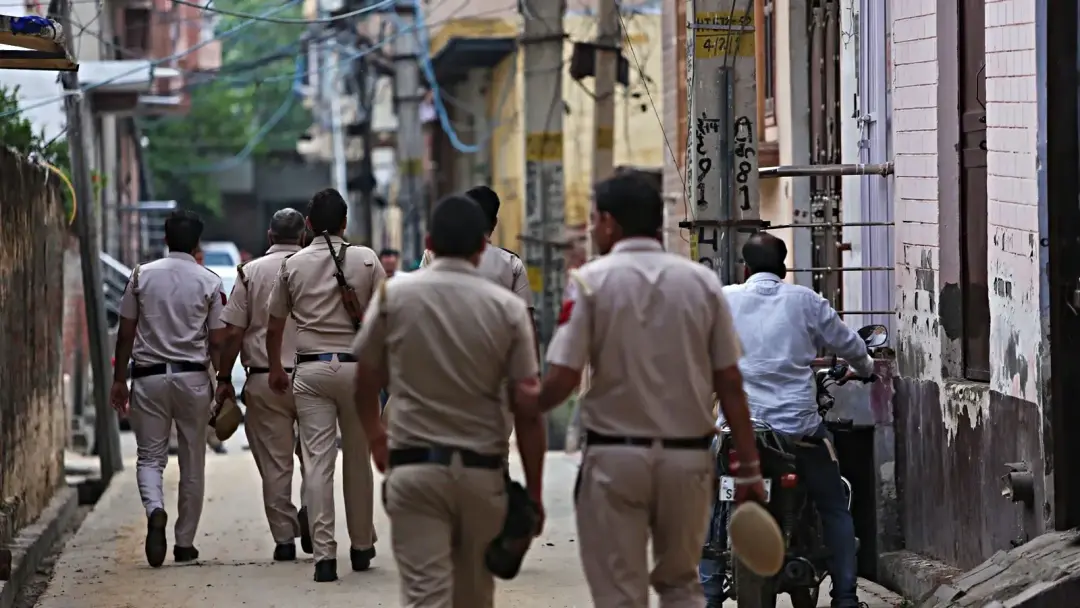
Missing couple found dead in Bijnor, bodies a kilometre apart
Police in Bijnor, Uttar Pradesh, recovered the bodies of a missing couple from a field in Kotwali City area on Tuesday morning, found a kilometre apart. The deceased were identified as Chottu and his wife Sushma of Jalalpur, missing since Monday. Sushma's semi-naked body, with neck injury marks, was found on the Ganga bank; Chottu was found hanging from a tree, tied with wire, wearing his wife's salwar. Preliminary inquiry suggests he strangled her before ending his life. SP Krishan Kumar said postmortem is underway.
Source
Indian Express — Cities · read the original report ↗
Desk check · some claims need care
What the desk checked (5)
- Bodies of a missing couple, Chottu and Sushma of Jalalpur, were recovered on Tuesday from a field in Kotwali City area, Bijnor, about a kilometre apart. — Attributed to Bijnor police in the source; figures and names appear as given.
- The woman's semi-naked body with neck injury marks was found on the Ganga bank about 50 metres from their field; the husband's body was found hanging from a tree, tied with a wire, wearing his wife's salwar. — Attributed to police; source states the salwar detail explicitly as a police statement.
- Preliminary inquiry suggests Chottu strangled his wife before ending his own life; motive not yet ascertained. — Preliminary police assessment, unconfirmed and pending postmortem — must be reported as alleged.
- SP Bijnor Krishan Kumar said bodies were sent for postmortem and an investigation is ongoing. — Directly attributed to a named senior police officer.
- Search launched after the son's complaint was called off due to rain on Monday night; forensics team and dog squad examined the scene. — Attributed to police; no independent corroboration in source.
Analysts’ view opinion
What exists so far is a police working hypothesis, not a legal finding — for a "murder followed by suicide" reading to hold up, the postmortem, forensic results and scene analysis must independently support that sequence. The fact that the two bodies were found a kilometre apart, the injury marks on Sushma's neck and the condition in which Chottu's body was found make scene examination and independent evidence decisive. Where the sole suspect is himself dead, the purpose of the investigation is not punishment but placing the truth on record.
- A "preliminary inquiry suggests" formulation is investigative suspicion, not proof; in Indian practice the postmortem report is the foundational document for cause of death.
- If the suspect is deceased, the matter would ordinarily not reach trial, so factual closure rests almost entirely on forensics and the inquest process.
- In unnatural deaths, inquest proceedings plus forensic and dog-squad findings are mandatory procedural steps, and the shape of the case can still change once they are complete.
- The distance between the bodies and the state of clothing are the kinds of details that argue for keeping third-party involvement formally open until ruled out.
- Established principle favours restraint in publicising details about the condition of bodies, given the dignity of the deceased and the family's privacy.
What to watch — Watch what the postmortem and forensic reports conclude, and under which sections police register or close the case.
The story does not establish cause of death, the sequence of events or any motive — only that police currently suspect this version.
Deep dive
Research brief · 8 facts · 4 dates · exam-readyThe brief
Context
In Bijnor district of Uttar Pradesh, a married couple from Jalalpur village went missing after leaving for their farm field on a Monday morning. Their son filed a missing person's report at the local police station after a search of the nearby forest failed. On Tuesday morning, police recovered both bodies from a field in the Kotwali City police area, lying about a kilometre apart, in what police are treating as a case of murder followed by suicide pending postmortem findings.
Key facts
- Bijnor police recovered the bodies of a missing couple on Tuesday morning from a field in the Kotwali City area; the two bodies were found a kilometre apart.
- The deceased were identified as Chottu and his wife Sushma, residents of Jalalpur.
- The couple had been missing since Monday, and a missing person's report was filed at the police station on their son's complaint.
- Sushma's semi-naked body, bearing injury marks on the neck, was found on the banks of the Ganga river, about 50 metres from their field.
- Chottu's body was found hanging from a tree, tied with a wire, about a kilometre away; he was wearing his wife's salwar, police said.
- Preliminary police inquiry suggests Chottu allegedly strangled his wife before ending his own life; the motive is yet to be ascertained.
- Superintendent of Police, Bijnor, Krishan Kumar said the bodies were sent for postmortem examination and an investigation was ongoing.
- A forensics team and a dog squad were called in to examine the scene.
Timeline
- Monday morningThe couple, Chottu and Sushma, went to their field in Bijnor and did not return home by the afternoon.
- Monday (afternoon onwards)Their son searched the forest without success, then informed the police; a search began with local residents and forest officials.
- Monday nightThe search operation had to be called off due to rain.
- Tuesday morningPolice recovered both bodies — Sushma's on the Ganga bank, Chottu's hanging from a tree a kilometre away; forensics team and dog squad called in.
Who has a stake
- Family of the deceased, especially the couple's son — He filed the missing person's report and searched for his parents; he now awaits the outcome of the postmortem and investigation.
- Bijnor police, Kotwali City station — Responsible for the search, recovery of bodies, forensic examination and establishing the sequence of events and motive.
- Superintendent of Police, Bijnor, Krishan Kumar — Senior officer accountable for the investigation; confirmed postmortem and ongoing probe.
- Forensics team and dog squad — Tasked with examining the scene to corroborate or challenge the preliminary murder-suicide inference.
- Forest officials and local residents — Assisted the police search on Monday before it was suspended due to rain.
Why it matters
The case shows how a domestic crime in a rural setting is reconstructed from circumstantial evidence — the distance between bodies, neck injuries, and forensic and dog-squad examination — before a postmortem confirms cause of death. It also illustrates the practical limits of rural search operations, where a night of rain forced police, forest officials and villagers to suspend the hunt. With the motive still unascertained, the story is a reminder that preliminary police inferences are provisional until forensic and postmortem findings are in.
UPSC angle
Prelims pointers
- Bijnor is a district in Uttar Pradesh; the incident falls under its Kotwali City police area.
- Superintendent of Police (SP) is the district police chief; Bijnor's SP in the story is Krishan Kumar.
- Sushma's body was found on the banks of the Ganga, about 50 metres from the couple's field.
- A missing person's report was registered at the police station on the son's complaint.
- Investigative aids deployed: forensics team and dog squad; bodies sent for postmortem examination.
Mains framing
The Bijnor case is a textbook illustration of how Indian police convert a missing-person complaint into a homicide investigation. The sequence — a report filed by a family member, a community-assisted search involving forest officials, suspension of the search due to rain, and recovery of bodies the next morning — highlights both the responsiveness and the resource constraints of rural policing. The investigative method matters: injury marks on the neck, the semi-naked state of the woman's body, the wire-tied hanging a kilometre away and the unusual detail of the husband wearing his wife's salwar led police to a preliminary inference of strangulation followed by suicide, but the source records that the motive is yet to be ascertained. The correct way forward, as the police themselves indicate, is deference to scientific evidence — postmortem examination, forensic scene analysis and dog-squad tracking — rather than early closure on a narrative. For public policy, such cases underline the need for trained forensic capacity at district level, prompt action on missing-person reports, and all-weather search capability, while for reporting they underline the duty to distinguish preliminary police inference from established fact.
Key terms
- Kotwali City
- The urban police station jurisdiction in Bijnor district where the field and the bodies were found.
- Missing person's report
- A complaint filed at a police station about someone untraced; here filed by the couple's son, triggering the search.
- Postmortem examination
- Medical autopsy to establish cause and manner of death; the bodies of both deceased were sent for it.
- Forensics team
- Specialist unit called to the scene to collect and analyse physical evidence.
- Dog squad
- Police unit using trained sniffer dogs to track movement and detect evidence at a crime scene.
- Superintendent of Police (SP)
- The officer heading a district police force; in this story, Krishan Kumar of Bijnor.
Practice questions
- Trace the sequence of events in the Bijnor case from the couple going missing on Monday to the recovery of their bodies on Tuesday, and identify the evidence on which police based their preliminary inference.
- Discuss the role of scientific investigation — postmortem, forensic teams and dog squads — in establishing cause of death, with reference to the Bijnor case where the motive remains unascertained.
- What do rural search operations such as the one in Bijnor, called off due to rain, reveal about the capacity constraints of district-level policing in India? Suggest measures to strengthen them.
Grounded only in the source report — figures and dates are the source's, not inferred.