
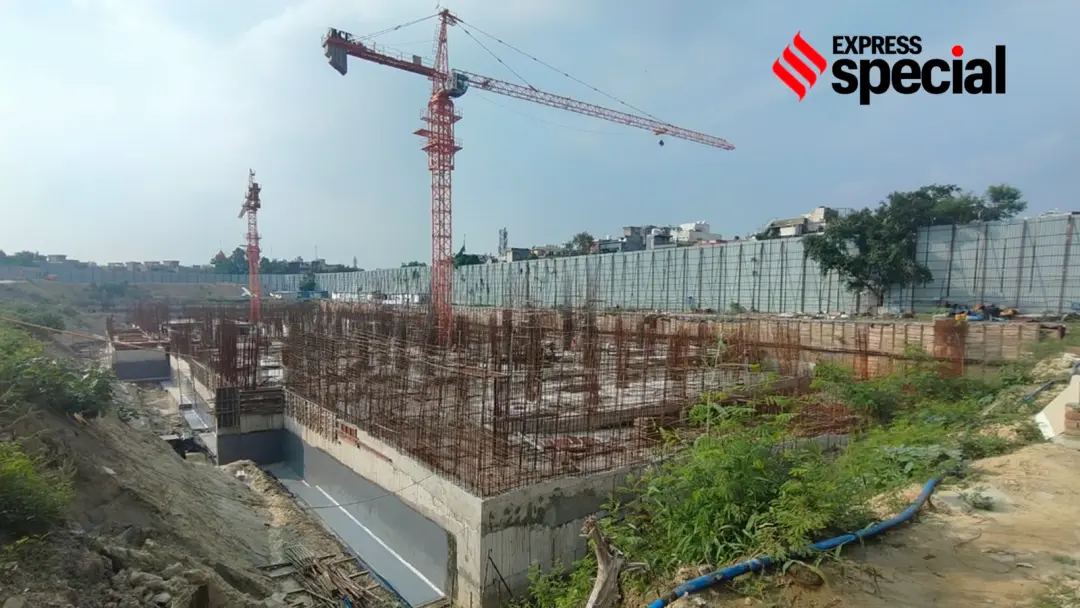
Delhi University hostel projects stalled or delayed, records show
Delhi University hostel projects remain stalled or slow-moving, records of Executive Council meetings and project documents show, after five students died in a building collapse in Satya Niketan. Two 1,000-bed hostels promised by Vice Chancellor Yogesh Singh in 2022, and at least four other projects, are pending. A Rs 318-crore, 1,456-seat project is now expected only by 2028. Singh cited multiple clearances for delays. Over 2.6 lakh students study at DU.
Source
Indian Express — Cities · read the original report ↗
Desk check · compared with the source
What the desk checked (5)
- VC Yogesh Singh promised in May 2022 that two 1,000-bed PG hostels would come up at the Dhaka complex within two years. — Attributed in source to his May 2022 press conference; not independently verified.
- Five students were killed in a building collapse in Satya Niketan on September 6. — Stated in source in the context of the Delhi High Court's September 7 remarks; no separate attribution given.
- The 1,456-seat Dhaka complex hostel, costing Rs 318 crore, was awarded to NBCC in September 2023 with March 2025 completion, and is now expected by 2028. — Figures and dates sourced to project documents and a senior NBCC official; source's references to construction beginning in 'April 2026' and 'April this year' are internally inconsistent.
- DU has 3,422 PG hostel seats and colleges 3,788, with proposed additions taking capacity to 12,754 against over 2.6 lakh students. — Attributed to official figures and the administration.
- CM Rekha Gupta said the Delhi government will build hostels for 10,000 students. — Direct quote attributed to the Chief Minister.
Analysts’ view opinion
This reads less as a funding failure and more as a governance and coordination failure. Announcements, bhoomi poojans and revised cost estimates have accumulated, but the actual bed count at a university of over 2.6 lakh students has not moved — officials themselves say the Rs 318-crore project was 31 months behind even before construction started. The VC's point about multi-agency clearances in Delhi is genuine, yet the record of hostels being discussed in just one of 24 Executive Council meetings raises a fair question about administrative priority, and the fact that the machinery moved visibly only after five deaths is a textbook case of reactive policymaking.
- Sanction is not the same as spending: Rs 64.68 crore released but only Rs 1.7 crore utilised by April points to absorption and execution capacity, not money, as the binding constraint.
- Funding is fragmented across the Union Education Ministry, an HEFA loan, the Women and Child Development Ministry and DU's own development fund — a single stalled channel can freeze an entire project.
- The need for clearances from fire services, DDA, MCD, metro, NHAI and environment authorities is a real Delhi-specific hurdle, but it is a known and therefore plannable one.
- There is also a prioritisation question: while student hostels crawled, an Executive Hostel/Guest House proposal for FMS saw its estimate revised from Rs 12.41 crore to Rs 20.05 crore.
- The South Campus projects together add only about 150 seats, and the focus on postgraduate housing leaves large numbers of students dependent on private PG accommodation.
What to watch — Watch whether the VC's promise of more accommodation by the next academic year and the Delhi government's 10,000-seat announcement translate into released funds, tenders and dated timelines — and note that pollution-season construction curbs from November could slow progress further.
The story documents delays and the reasons officials offer for them; it does not establish where exactly each clearance stalled, who is accountable, or that the hostel shortage caused the Satya Niketan collapse.
Deep dive
Research brief · 8 facts · 10 dates · exam-readyThe brief
Context
Delhi University's chronic shortage of student housing came into sharp focus after five students died in a building collapse in Satya Niketan, an area popular for paying guest (PG) accommodation near DU's South Campus. On September 7, a day after the collapse, the Delhi High Court criticised the "absolutely inadequate number of hostels" in DU, saying students were forced into "very dangerous" PG accommodation. Records of DU's Executive Council and Building Committee meetings, project documents and planning approvals show that two 1,000-bed hostels promised by Vice Chancellor Yogesh Singh in May 2022, and at least four other housing projects announced during his tenure, are stalled or moving very slowly. More than 2.6 lakh students study at DU, many from outside Delhi.
Key facts
- In May 2022, VC Yogesh Singh announced two 1,000-bed postgraduate hostels (one each for men and women) at DU's Dhaka complex, to be built within two years; over four years later excavation is nearly all that has happened at one site.
- The Rs 318-crore, 1,456-seat Hostel cum Residential Block at Dhaka complex was awarded to NBCC (India) Ltd in September 2023 with a March 2025 deadline; an NBCC official says it will take at least until 2028.
- Officials said the 1,456-seat project was delayed by 31 months even before construction began; bhoomi poojan happened only in September 2025, six months after the completion deadline had passed.
- The 1,050-seat Girls' Hostel/Studio Apartment Complex (Rs 233.35 crore) has an HEFA loan of Rs 161 crore, with DU bearing Rs 72.35 crore; of Rs 64.68 crore released, only Rs 1.7 crore had been utilised until April this year.
- For the Nirbhaya Residential Accommodation (1,000 women students, two blocks of 500 beds each), then WCD Minister Smriti Irani sanctioned Rs 272 crore in March 2024; funds are yet to be disbursed.
- In South Campus, the New Hostel Building cost was revised from Rs 17.96 crore (July 2025) to Rs 22.81 crore (April 2026), and the Executive Hostel/Guest House from Rs 12.41 crore to Rs 20.05 crore; no funds released for either.
- DU has 3,422 postgraduate hostel seats plus 3,788 college seats; 1,622 university-level and 3,922 college-level seats are proposed, taking combined capacity to 12,754 for over 2.6 lakh students.
- Only one of the 24 Executive Council meetings held during VC Singh's tenure records a discussion on student housing projects.
Timeline
- October 2021Yogesh Singh takes charge as DU Vice Chancellor; DU's Finance Committee approves a proposal for accommodation for 700 EWS women students.
- May 2022Singh announces at a press conference that two 1,000-bed PG hostels will come up at the Dhaka complex within two years.
- September 2023Work for the Rs 318-crore, 1,456-seat Hostel cum Residential Block awarded to NBCC, with completion targeted for March 2025.
- March 2024Nirbhaya Residential Accommodation announced; WCD Minister Smriti Irani sanctions Rs 272 crore.
- February 2025Mithuraaj Dhusiya joins DU's Executive Council; he later says hostels were not seriously discussed before the Satya Niketan incident.
- March 2025Scheduled completion deadline for the 1,456-seat Dhaka complex project passes.
- July 2025South Campus New Hostel Building (Rs 17.96 crore), Geetanjali Hostel expansion (Rs 11.23 crore) and Executive Hostel/Guest House (Rs 12.41 crore) proposals approved.
- August 2025Building Committee approves conceptual proposal for vertical extension of Saramati and Aravali men's hostels, with no tree felling.
- September 2025Bhoomi poojan held for the 1,456-seat Dhaka complex project.
- April 2026Continuous on-ground work begins at the Dhaka complex site; costs of two South Campus projects revised upward.
Who has a stake
- DU students (over 2.6 lakh, many from outside Delhi) — Face a severe hostel shortage and are pushed into unsafe PG accommodation; five died in the Satya Niketan collapse.
- Vice Chancellor Prof Yogesh Singh — Promised two 1,000-bed hostels in 2022; begins a second five-year term next month and cites multi-agency clearances for delays.
- DU Executive Council and Building Committee — Governance bodies whose records show minimal discussion of housing; approve and revise project proposals and costs.
- NBCC (India) Ltd and CPWD — Executing agencies for the Dhaka complex and South Campus projects; responsible for timelines and building plans.
- Union Ministry of Education and HEFA — Fund the Institution of Eminence project and the Rs 161-crore loan for the girls' hostel complex.
- Ministry of Women and Child Development — Sole funding agency for the Nirbhaya Residential Accommodation; disbursal of the sanctioned Rs 272 crore is pending.
- Delhi government / CM Rekha Gupta — Announced hostels for 10,000 students across Delhi colleges and universities after the collapse.
- Delhi High Court — Flagged the inadequacy of DU hostels as a threat to students' life and security.
Why it matters
DU's official hostel capacity of about 7,210 seats serves more than 2.6 lakh students, a large share of them from outside Delhi, which pushes thousands into unregulated PG accommodation whose safety the Delhi High Court has called a threat to life. The Satya Niketan collapse shows that construction delays in public higher education are not merely administrative lapses but have direct consequences for student safety. The record of stalled funds, revised costs and multi-agency clearances also illustrates how capital projects in higher education stall even when money is sanctioned.
UPSC angle
Prelims pointers
- HEFA (Higher Education Financing Agency) is a joint venture of the Ministry of Education and Canara Bank for market-based financing of capital assets in higher education.
- The Rs 318-crore, 1,456-seat DU Dhaka complex hostel is funded mainly by the Union Ministry of Education under DU's Institution of Eminence programme.
- Nirbhaya Residential Accommodation: Rs 272 crore sanctioned in March 2024 by the Ministry of Women and Child Development for 1,000 women students.
- DU's three university-run South Campus hostels: Geetanjali (PG Women), Saramati (PG Men) and Aravali (PG Men).
- DU hostel seats: 3,422 (university PG) + 3,788 (colleges); proposed additions take combined capacity to 12,754.
- Clearance agencies cited for delay include Delhi Fire Service, DUAC, NHAI, AAI, Delhi Jal Board, DMRC, DDA and MCD.
Mains framing
The stalling of Delhi University's hostel projects illustrates how implementation failure, rather than absence of policy or funds, drives India's student housing crisis. Causes visible in the record are multiple: a fragmented clearance regime requiring sign-offs from bodies such as the Delhi Fire Service, DUAC, NHAI, AAI, Delhi Jal Board, DMRC, DDA and MCD; weak internal oversight, with only one of 24 Executive Council meetings in the VC's tenure discussing housing; poor fund absorption, as with only Rs 1.7 crore of Rs 64.68 crore released being utilised for the girls' hostel complex; pending inter-ministerial disbursal, as in the Nirbhaya project; and cost escalation from revised estimates in South Campus projects. The implications are direct: with about 7,210 existing seats against over 2.6 lakh students, demand shifts to unregulated PG accommodation, which the Delhi High Court linked to threats to students' life and security after the Satya Niketan collapse in which five died. A way forward, grounded in the story, would involve time-bound single-window clearance coordination among Delhi's agencies, regular Executive Council monitoring of housing projects with published milestones, faster release and utilisation of sanctioned central funds, and complementary state action such as the Delhi government's announced hostels for 10,000 students, alongside safety regulation of PG housing.
Key terms
- HEFA
- Higher Education Financing Agency, a Ministry of Education-Canara Bank joint venture that lends for capital assets in higher education institutions.
- Institution of Eminence (IoE)
- Central programme under which DU's Rs 318-crore Dhaka complex hostel is funded mainly by the Union Ministry of Education.
- NBCC (India) Ltd
- Central public sector construction company acting as executing agency and project management consultant for the Dhaka complex hostel.
- CPWD
- Central Public Works Department, the executing agency for the DU girls' hostel complex and South Campus hostel projects.
- Executive Council (EC)
- DU's top executive decision-making body; its minutes record only one discussion on student housing in the current VC's tenure.
- PG accommodation
- Paying guest housing, privately run lodging for students; the Delhi High Court called such housing around DU "very dangerous".
Practice questions
- Delhi University has about 7,210 hostel seats for over 2.6 lakh students. Examine how regulatory and financial bottlenecks delay public higher education infrastructure, using the DU hostel projects as a case study.
- "Unregulated paying guest accommodation has become a substitute for public student housing." Discuss the safety, equity and regulatory dimensions of this shift in India's university towns.
- Evaluate the role of institutional governance bodies such as a university's Executive Council in monitoring capital projects. What reforms would improve accountability for delayed construction?
Grounded only in the source report — figures and dates are the source's, not inferred.