
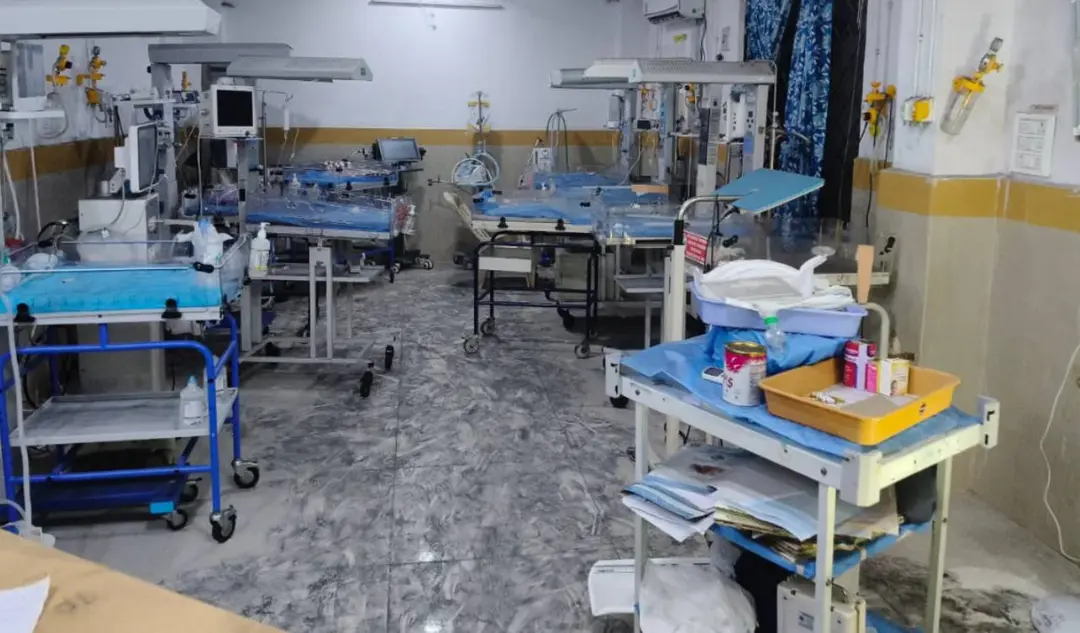
Two newborns die after AC explosion at RIMS Adilabad
Two newborns died and two others fell ill after inhaling toxic gases from an explosion of air-conditioning units caused by an electrical short circuit at the Special Newborn Care Unit of RIMS-Adilabad late on Monday night. Officials said a five-day-old baby of Saleem from Ichoda died on the spot of asphyxiation and another infant died during treatment. Two unconscious infants were shifted to private hospitals. Around 30 infants were in incubators. Collector Rajarshi Shah, SP Akhil Mahajan and RIMS director Jaisingh inspected the hospital.
Source
Telangana Today · read the original report ↗
Desk check · compared with the source
What the desk checked (5)
- Two newborns died and two others fell ill after inhaling toxic gases from an AC explosion at the SNCU of RIMS-Adilabad on Monday night. — Central claim of the source; figures appear consistently in headline and body.
- The explosion was caused by an electrical short circuit. — Stated in source as the cause; attributed generally, no technical report cited.
- A five-day-old baby of Saleem from Ichoda died on the spot due to asphyxiation; another infant died during treatment. — Attributed to officials, who are not named.
- Around 30 infants were in incubators at the SNCU at the time. — Figure appears in source without specific attribution.
- Collector Rajarshi Shah, SP Akhil Mahajan and RIMS director Jaisingh visited the hospital. — Named officials cited in source; statements paraphrased, no direct quotes.
Analysts’ view opinion
This is less a freak accident than a governance failure at the most fragile point of the public health system — a neonatal unit where the patients cannot be evacuated quickly and cannot tolerate even seconds of smoke. A Special Newborn Care Unit is by design a high-dependency, electrically dense space with roughly 30 incubators running continuously, which makes routine electrical audits, fire-safety certification and AC maintenance schedules core clinical safety functions, not facilities housekeeping. That the immediate response relied on night-duty staff manually shifting babies to nearby wards suggests the protective layers that should have failed first — protection devices, alarms, a safe evacuation design — did not do their job.
- The victims were newborns on life support equipment, the group least able to survive any interruption or exposure, which is exactly why SNCUs are meant to carry the strictest electrical and fire-safety norms in a hospital.
- A short circuit escalating into an explosion and heavy toxic smoke points to questions about load management, wiring age, earthing and preventive maintenance of the AC units rather than a single unforeseeable fault.
- The story shows staff improvising — shifting infants and cutting power — which indicates human response worked, but does not establish that a drilled evacuation protocol or smoke-containment design existed.
- District-level inspections by the Collector, SP and RIMS director are the standard post-incident script in India's public hospitals; the accountability question is whether findings translate into funded retrofits across all such units, not just this one.
- Government medical college hospitals in tier-2 districts typically carry deferred maintenance backlogs, so the policy fix is recurring O&M budgets and third-party safety audits rather than one-off orders to 'prevent recurrence'.
What to watch — Watch whether the state orders a time-bound safety and electrical audit of neonatal and ICU units across all government hospitals with published compliance deadlines, and whether an independent inquiry fixes responsibility beyond the immediate technical cause.
The story does not establish when the unit was last inspected or maintained, what safety systems were in place, who was responsible, or the final official cause — only that officials attribute the blast to a short circuit.
Deep dive
Research brief · 8 facts · 5 dates · exam-readyThe brief
Context
Two newborns died and two others were hospitalised after air-conditioning units exploded due to an electrical short circuit at the Special Newborn Care Unit (SNCU) of the Rajiv Gandhi Institute of Medical Sciences (RIMS), Adilabad, late on Monday night. Thick smoke and toxic gases filled the unit, where around 30 infants were being treated in incubators. Night-duty staff shifted the remaining infants to nearby wards and electricity to the unit was switched off. District administration and hospital heads inspected the facility and ordered preventive steps.
Key facts
- Two newborns died and two others fell ill after inhaling toxic gases from an AC explosion at the SNCU of RIMS-Adilabad on Monday night.
- The explosion of air-conditioning machines was caused by an electrical short-circuit, according to officials.
- A five-day-old baby of Saleem from Ichoda died on the spot due to asphyxiation; another infant succumbed during treatment.
- Two infants lost consciousness after inhaling toxic gases and were shifted to different private hospitals in the town.
- Around 30 infants were being treated in incubators at the SNCU when the incident occurred.
- Night-duty staffers shifted the other infants to nearby wards and electricity to the unit was turned off.
- Collector Rajarshi Shah inspected the institution and instructed officials to provide better medical services to the infants.
- SP Akhil Mahajan and RIMS director Jaisingh also visited the hospital to find out the causes of the accident.
Timeline
- Monday night (late)Air-conditioning machines explode at the SNCU of RIMS-Adilabad following an electrical short circuit; smoke and toxic gases spread.
- Immediately after the blastA five-day-old infant dies on the spot of asphyxiation; staff shift other infants to nearby wards and cut off power to the unit.
- SubsequentlyA second infant dies during treatment; two unconscious infants are moved to private hospitals in the town.
- On receiving informationCollector Rajarshi Shah, SP Akhil Mahajan and RIMS director Jaisingh inspect the hospital and inquire into the mishap.
- 22 September 2026, 11:30 AMReport updated; further details awaited.
Who has a stake
- Families of the newborns, including Saleem of Ichoda — Lost a five-day-old child to asphyxiation; two other families face infants treated for toxic gas inhalation.
- RIMS-Adilabad and its director Jaisingh — Accountability for electrical safety and fire preparedness in a critical-care newborn unit.
- SNCU night-duty staff — Carried out the emergency evacuation of infants from incubators to nearby wards.
- District Collector Rajarshi Shah — Ordered better medical services for the infants and preventive steps against recurrence.
- SP Akhil Mahajan and police — Examining the causes of the accident.
- Around 30 infants in incubators at the SNCU — Exposed to smoke and toxic gases; dependent on uninterrupted power and life support.
Why it matters
Newborns in incubators are among the most vulnerable patients in any hospital and cannot be evacuated quickly, so a short circuit in a neonatal unit can turn fatal within minutes. The deaths at RIMS-Adilabad point to gaps in electrical maintenance, fire safety and evacuation readiness in public tertiary-care hospitals. The inquiry's findings will shape whether preventive safety audits follow, as the Collector directed.
UPSC angle
Prelims pointers
- SNCU stands for Special Newborn Care Unit, a facility for sick newborns requiring intensive care.
- RIMS-Adilabad is the Rajiv Gandhi Institute of Medical Sciences, Adilabad (Telangana).
- Cause of the incident as stated by officials: explosion of air-conditioning machines due to an electrical short circuit.
- Immediate cause of the first death: asphyxiation of a five-day-old infant.
- Around 30 infants were in incubators in the SNCU at the time of the mishap.
- Officials who inspected: Collector Rajarshi Shah, SP Akhil Mahajan, RIMS director Jaisingh.
Mains framing
The RIMS-Adilabad tragedy illustrates how non-clinical infrastructure failures — electrical short circuits, ageing air-conditioning equipment, smoke and toxic gas accumulation — can kill patients inside the very units built to save them. Neonatal intensive care compounds the risk: infants in incubators depend on continuous power and cannot be moved swiftly, so a fire or gas event forces staff to choose between cutting power and evacuating, as happened when electricity to the SNCU was switched off and babies were shifted to nearby wards. That two infants died and two lost consciousness, with about 30 in incubators at the time, suggests the need for routine electrical load and fire-safety audits, smoke detection and extraction systems, trained evacuation drills for neonatal staff, and redundant power arrangements in critical-care areas of government hospitals. The Collector's instruction to improve medical services for the affected infants and prevent recurrence, along with the police and RIMS director's inquiry into causes, marks a first step; the way forward lies in translating such inquiries into enforceable safety standards and periodic third-party certification rather than post-incident inspections alone. Beyond safety engineering, accountability for maintenance contracts and timely replacement of faulty equipment must be fixed.
Key terms
- SNCU (Special Newborn Care Unit)
- A hospital unit for intensive care of sick and premature newborns, typically using incubators.
- RIMS-Adilabad
- Rajiv Gandhi Institute of Medical Sciences, the government tertiary-care hospital in Adilabad where the incident occurred.
- Asphyxiation
- Death or severe injury caused by deprivation of oxygen, here from toxic gases and smoke; cited as the cause of the first infant's death.
- Electrical short circuit
- An abnormal low-resistance connection in a circuit that causes overheating and, as here, an explosion of AC machines.
- Incubator
- A powered enclosure maintaining temperature and oxygen for newborns; around 30 infants were in incubators during the mishap.
Practice questions
- Fire and electrical safety failures in public hospitals repeatedly harm the most vulnerable patients. Examine the systemic gaps revealed by the RIMS-Adilabad SNCU incident and suggest preventive measures.
- What are Special Newborn Care Units and why does an evacuation during a fire or gas emergency pose unique challenges in neonatal intensive care?
- Discuss how accountability for maintenance of non-clinical infrastructure in government hospitals can be strengthened, drawing on the inquiries ordered after the Adilabad mishap.
Grounded only in the source report — figures and dates are the source's, not inferred.