
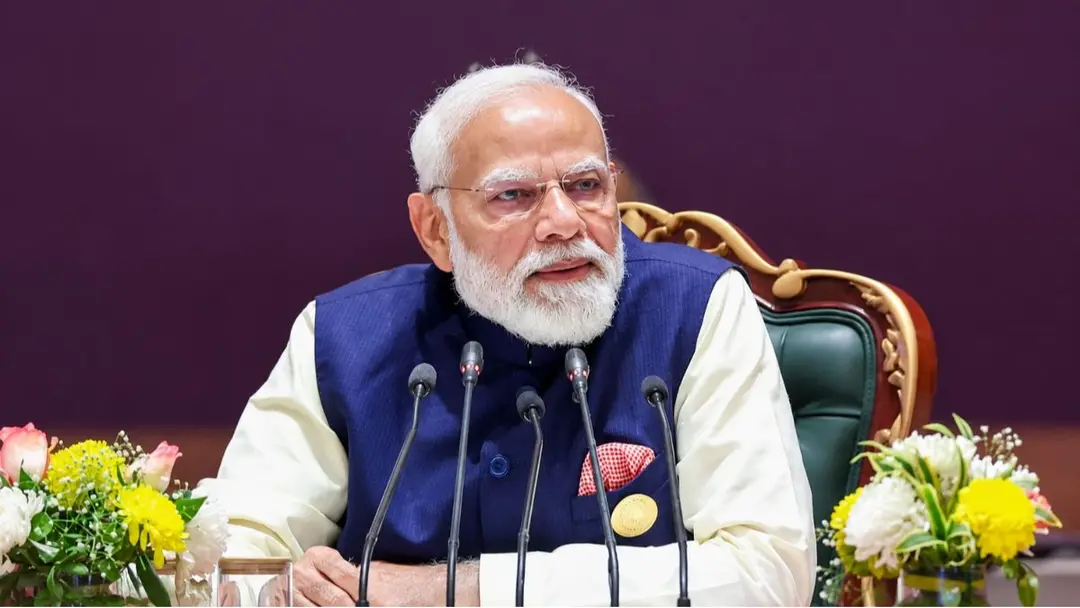
Modi to review ministers' performance at two-day Chintan Shivir
Prime Minister Narendra Modi is organising a two-day "Chintan Shivir" for Union Cabinet ministers on September 23 and 24, 2026, at Seva Teerth in New Delhi. Coming midway through the NDA government's third term, the retreat aims to review governance, improve coordination and shape future policies. Ahead of it, Modi formed multiple eight-member ministerial groups on self-improvement, communication and administration. Sources said ministers have been asked to present self-analysed report cards on their ministries' progress and operational outcomes.
Source
Narendra Modi · read the original report ↗
Desk check · some claims need care
What the desk checked (4)
- A two-day 'Chintan Shivir' for Union Cabinet ministers will be held on September 23 and 24, 2026, at Seva Teerth in New Delhi. — Stated directly by the source with no official attribution; dates and venue appear in the source text.
- The retreat aims to review governance, improve coordination and shape future policies, coming midway through the NDA government's third term. — Presented as the outlet's characterisation of the event's purpose; no named official cited.
- PM Modi formed multiple eight-member ministerial groups on self-improvement, communication and administration. — Unattributed claim in the source; figure of eight members appears in the source text.
- Ministers have been asked to present self-analysed report cards on their ministries' progress. — Attributed only to unnamed 'sources' — treat as unconfirmed.
Analysts’ view opinion
Coming midway through the NDA government's third term, this 'Chintan Shivir' is not merely an administrative review — it is also a political instrument that tightens the Prime Minister's grip on his cabinet. Asking ministers to submit self-analysed report cards centralises performance accountability and could lay the groundwork for future portfolio rejigs or a reshuffle. The explicit focus on communication also signals a government that believes its messaging, not just its delivery, needs sharpening.
- Mid-term retreats of this kind typically serve to reset priorities for the remaining stretch and to hold performance standards in place.
- The self-report format raises pressure on individual ministers while pointing to further concentration of decision-making around the Prime Minister's office.
- Splitting ministers into eight-member groups is likely aimed at improving inter-ministerial coordination and collective ownership of outcomes.
- Placing communication on the agenda suggests the government sees the projection of policy as politically as consequential as its implementation.
- Opposition parties could frame the exercise as an admission that governance needs fixing, while the government will present it as evidence of discipline and accountability.
What to watch — Watch whether the retreat is followed by changes in portfolios, fresh policy announcements, or early signals of a cabinet reshuffle.
The story does not establish what consequences, if any, will follow from the performance assessments, or how any individual minister is rated — and the report-card detail is attributed only to sources.
Deep dive
Research brief · 8 facts · 3 dates · exam-readyThe brief
Context
Prime Minister Narendra Modi is holding a two-day "Chintan Shivir" (reflection retreat) for Union Cabinet ministers on September 23 and 24, 2026, at Seva Teerth in New Delhi. Such retreats are used by the leadership to take stock of governance, tighten inter-ministerial coordination and set policy direction. The exercise comes midway through the NDA government's third term, when mid-course correction and messaging become politically important. Ahead of it, ministers have been grouped into eight-member teams and asked to bring self-assessed report cards on their ministries.
Key facts
- The Chintan Shivir for Union Cabinet ministers is scheduled for two days, September 23 and 24, 2026.
- The venue is Seva Teerth in New Delhi.
- The retreat is being organised by Prime Minister Narendra Modi himself.
- It comes midway through the NDA government's third term.
- Stated aims: review governance, improve coordination and shape future policies.
- Ahead of the event, PM Modi formed multiple eight-member ministerial groups.
- The ministerial groups are to deliberate on self-improvement, communication and administration.
- Sources said ministers have been asked to present self-analysed report cards on their ministries' progress and operational outcomes.
Timeline
- Ahead of the retreat (exact date not stated in the source)PM Modi forms multiple eight-member ministerial groups on self-improvement, communication and administration.
- September 22, 2026Report published that ministers have been asked to bring self-analysed report cards on their ministries.
- September 23-24, 2026Two-day Chintan Shivir for Union Cabinet ministers at Seva Teerth, New Delhi.
Who has a stake
- Prime Minister Narendra Modi — Organiser of the retreat; seeks to review ministerial performance, tighten coordination and set the policy agenda for the rest of the term.
- Union Cabinet ministers — Required to present self-analysed report cards on their ministries' progress and operational outcomes.
- Union ministries and their bureaucracies — Their delivery record and operational outcomes come under review, which may shape priorities and administrative practice.
- NDA government — Mid-term stock-taking of its third term, with implications for governance performance and public communication.
- Citizens — Outcomes of the review could affect service delivery and future policy direction; specific decisions not stated in the source.
Why it matters
A prime-ministerial retreat that asks ministers to submit self-assessed report cards signals a shift from routine Cabinet business to explicit performance review at the political executive's highest level. Coming midway through the NDA's third term, it is the point at which a government decides what to fix, drop or push harder in its remaining years. The grouping of ministers around self-improvement, communication and administration also indicates that messaging and delivery, not just policy design, are being treated as governance priorities.
UPSC angle
Prelims pointers
- Chintan Shivir for Union Cabinet ministers: September 23-24, 2026, at Seva Teerth, New Delhi.
- The retreat is organised by PM Narendra Modi midway through the NDA government's third term.
- Multiple eight-member ministerial groups were formed on three themes: self-improvement, communication, administration.
- Ministers asked to present self-analysed report cards on ministries' progress and operational outcomes.
- Stated objectives of the retreat: review governance, improve coordination, shape future policies.
Mains framing
The Chintan Shivir represents an attempt to build an internal performance-review culture within the political executive, complementing the constitutional principle of collective responsibility of the Council of Ministers. Its drivers are visible in the source itself: the need to review governance midway through a term, to improve inter-ministerial coordination in an era of cross-cutting programmes, and to strengthen communication of government work. Asking ministers to submit self-analysed report cards on progress and operational outcomes shifts the focus from announcements to delivery, while eight-member thematic groups on self-improvement, communication and administration create a peer-deliberation mechanism rather than a purely top-down audit. The limitation of self-assessment is inherent — it risks self-serving evaluation unless anchored in verifiable output and outcome indicators. A credible way forward, consistent with what the source describes, would be to tie such retreats to measurable ministry-level outcome data, ensure follow-up on the coordination gaps identified, and convert group deliberations into concrete administrative reform commitments; specific decisions taken at the retreat are not stated in the source.
Key terms
- Chintan Shivir
- Literally a 'reflection camp' — a retreat where leaders or ministers deliberate collectively on review, coordination and future direction.
- Seva Teerth
- The New Delhi venue where the two-day ministerial Chintan Shivir is being held on September 23-24, 2026.
- Union Cabinet
- The core body of senior Union ministers headed by the Prime Minister that takes the government's principal policy decisions.
- NDA
- National Democratic Alliance, the ruling coalition, now midway through its third term at the Centre.
- Self-analysed report card
- A minister's own assessment of the ministry's progress and operational outcomes, to be presented at the retreat.
Practice questions
- Retreats such as the Chintan Shivir seek to improve coordination within the Union Council of Ministers. Examine how inter-ministerial coordination affects policy delivery in India and what institutional mechanisms can strengthen it.
- Self-assessment by ministries can improve ownership but risks weak objectivity. Critically discuss how performance review of the political executive can be made credible and outcome-based.
- Discuss the significance of mid-term governance reviews in a parliamentary system, with reference to the principle of collective responsibility of the Council of Ministers.
Grounded only in the source report — figures and dates are the source's, not inferred.