
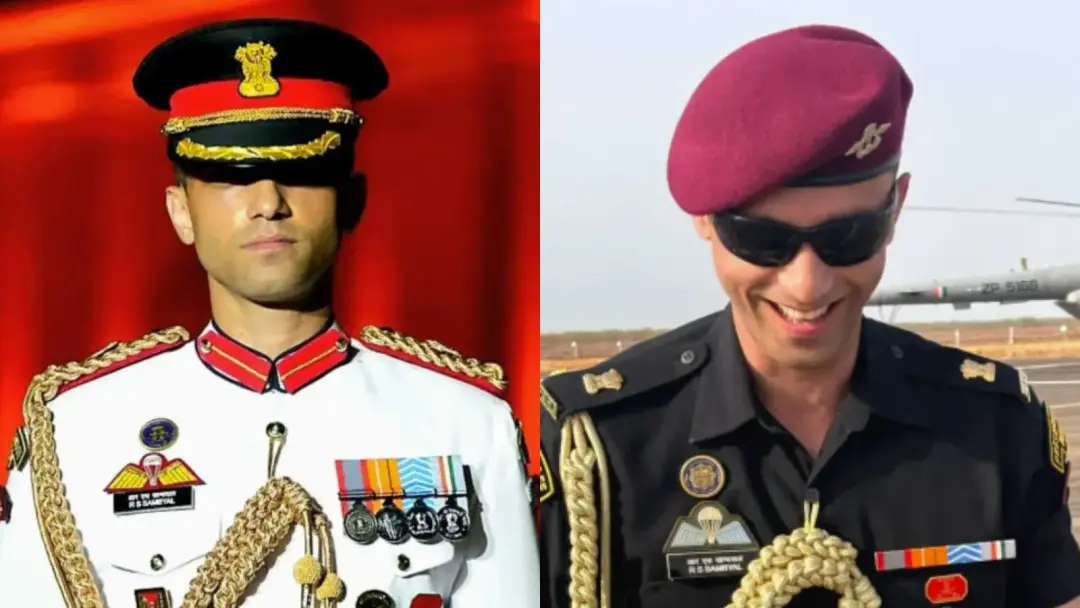
Retired Major says no-marriage rule applies to President's ADCs
Major Rishabh Singh Sambyal (retired), who served as aide-de-camp to President Droupadi Murmu, said in a conversation with podcaster Raj Shamani that ADCs are barred from marrying and must stay away from family, calling it the biggest sacrifice. He retired after 12 years in the Army, about three of them with the President. The President has five ADCs — three from the Army, one each from the Navy and Air Force. The rule is a voluntary requirement known at appointment, it is learnt.
Source
Indian Express — India · read the original report ↗
Desk check · compared with the source
What the desk checked (5)
- Major Rishabh Singh Sambyal (retired) says ADCs to the President cannot marry and must stay away from family. — Attributed directly to the officer in a podcast conversation with Raj Shamani; quoted in source.
- The 'no marriage' rule is a voluntary requirement known at the time of appointment, intended to keep the officer available 24/7. — Sourced in the article only as 'it is learnt'; no named official attribution.
- The President has five ADCs — three from the Army and one each from the Navy and Air Force. — Figure appears twice in the source; no external verification possible.
- Lieutenant Commander Yashaswi Solankee became the first woman ADC in 75 years last year, and Major Navya Shekhawat the first woman Army officer this year. — Stated as fact in the source, consistent with earlier Indian Express reporting cited within the article.
- Sambyal retired after 12 years in the Army, about three of them with President Murmu. — Figures appear in source, attributed to the officer's own account.
Analysts’ view opinion
This began as a personal podcast conversation, but its political significance lies in opening a debate about institutional culture at Rashtrapati Bhavan. The story states the 'no marriage' clause for ADCs is a voluntary requirement known to the officer at the time of appointment — which gives the establishment a ready defence that this is protocol, not punishment. At the same time, since the first women ADCs were appointed during President Murmu's tenure, critics and civil society could reasonably ask how well such a clause sits with a message of women's empowerment and inclusivity.
- This is not yet a direct policy controversy for Rashtrapati Bhavan — the story notes the clause is voluntary and that some selected officers have opted out, which strengthens the official defence.
- On the other side, restricting personal life to guarantee round-the-clock availability is the kind of norm that invites scrutiny in a modern work-life debate.
- The appointment of women ADCs for the first time in 75 years during Murmu's tenure is a positive-messaging asset for the office and the government; this debate could dilute some of that shine.
- The story's point that the rule applies to all genders pre-empts allegations of gender discrimination.
- Because the presidency is constitutionally above party politics, this is more likely to stay an institutional-reform conversation than a partisan clash.
What to watch — Watch for whether Rashtrapati Bhavan or the defence establishment issues any formal clarification, or whether calls to review the clause build in Parliament or public debate.
The story does not establish whether the clause is a written official order, who framed it or since when it has applied, and it carries no official response from the government or the President's office.
Deep dive
Research brief · 8 facts · 4 dates · exam-readyThe brief
Context
An aide-de-camp (ADC) is a serving military officer attached to the President of India as a personal aide, managing her engagements and acting as the link between the First Citizen, the government and the armed forces. Major Rishabh Singh Sambyal (retired), who served about three years as ADC to President Droupadi Murmu, spoke on podcaster Raj Shamani's show about the personal cost of the job, saying ADCs cannot marry and must stay away from family. The President has five ADCs — three from the Army, one each from the Navy and the Air Force. The source notes the 'no marriage' rule is a voluntary requirement an officer knows of at the time of appointment, intended to keep the officer available round the clock.
Key facts
- Major Rishabh Singh Sambyal (retired), now 30, announced retirement from the Indian Army last month after 12 years of service, about three of which were as ADC to President Droupadi Murmu.
- He said: "I am not married. So there is a clause for the ADCs that they can't get married… they have to stay away from the family, and I think this is the biggest sacrifice."
- The President of India has a total of five ADCs — three from the Army and one each from the Navy and the Air Force.
- The 'no marriage' rule is a voluntary requirement an officer is aware of at the time of appointment; some selected officers have opted out, it is learnt.
- The rule's stated rationale is to ensure the officer serving the First Citizen can focus 24/7 and be available round the clock; it applies to all genders.
- Sambyal trained at the Indian Military Academy, joined the Jat Regiment, then served with 4 Para Special Forces before becoming ADC.
- ADC duty hours run from 9 am to 9 am the next day, when peers take over; ADCs live in a duty room next to the President.
- On official tours the President has at least three engagements daily, with every movement from car to event planned by ADCs.
Timeline
- Last yearLieutenant Commander Yashaswi Solankee of the Indian Navy became the first woman officer appointed ADC to the President in 75 years.
- Earlier this yearMajor Navya Shekhawat became the first woman Army officer appointed ADC to the President.
- Last monthMajor Rishabh Singh Sambyal announced his retirement from the Indian Army after 12 years of service.
- CurrentlyPresident Murmu has five ADCs — two women and three men.
Who has a stake
- President Droupadi Murmu — Depends on ADCs for round-the-clock scheduling, ceremonial support and secure, disruption-free engagements; the source says the idea of women ADCs came from her.
- ADCs to the President (five officers) — Face the personal cost of the no-marriage requirement, separation from family, loneliness and 24-hour duty cycles.
- Indian Army, Navy and Air Force — Supply the five officers — three Army, one Navy, one Air Force — for the coveted appointment through a selection process with filters.
- Major Rishabh Singh Sambyal (retired) — Served about three years as ADC; publicly described the marriage clause and social isolation as the biggest sacrifice.
- Women officers such as Lt Cdr Yashaswi Solankee and Maj Navya Shekhawat — Represent the opening of the ADC post to women, tied to the President's stated emphasis on gender parity and inclusivity.
- Military Secretary to the President (Maj Gen V Parida) — Implements appointments; quoted saying the women-ADC idea was the President's thought, now implemented.
Why it matters
The account puts on record a little-discussed service condition at Rashtrapati Bhavan — a voluntary no-marriage clause — and the personal trade-offs behind a post many officers aspire to. It also spotlights the recent opening of the ADC role to women officers, with President Murmu now having two women among her five ADCs, linking protocol appointments to the wider debate on gender parity in the armed forces.
UPSC angle
Prelims pointers
- The President of India has five ADCs: three from the Army, one from the Navy and one from the Air Force.
- Lt Cdr Yashaswi Solankee (Navy) was the first woman ADC to the President, appointed last year, the first in 75 years.
- Maj Navya Shekhawat became the first woman Army officer appointed ADC to the President earlier this year.
- ADC duty runs 9 am to 9 am the next day; ADCs stay in a duty room adjacent to the President.
- Maj Gen V Parida is the Military Secretary to the President, as quoted in the source.
- Maj Rishabh Singh Sambyal served in the Jat Regiment and 4 Para Special Forces before becoming ADC.
Mains framing
The ADC to the President is a ceremonial-cum-functional post where an officer becomes the operational bridge between the First Citizen, the government and the armed forces — planning engagements, accompanying the President at ceremonies and pre-empting disruptions at public events. The source indicates that this 24/7 availability is secured through a voluntary 'no marriage' requirement made known at the time of appointment, with the rationale of undivided focus; officers who cannot accept it have opted out. Major Sambyal's testimony brings out the human cost: absence from family, inability to \"go out as a normal human being\", chronic loneliness, and a trained disposition of distrust because young officers in such positions are vulnerable to manipulation or inducement — risks the selection process seeks to filter. At the same time, the institution is changing: on President Murmu's own initiative, as stated by the Military Secretary, women officers have entered the role, with two women among five ADCs today. The way forward, as suggested by the facts in the source rather than any announced policy, lies in balancing the operational need for round-the-clock availability with humane service conditions and transparency about such clauses at the point of selection, while sustaining the inclusivity now visible in the appointments.
Key terms
- Aide-de-camp (ADC)
- A serving military officer attached to the President as personal aide, planning appointments, attending ceremonies and liaising with government and military branches.
- First Citizen of India
- Term used for the President of India, whom the ADCs serve.
- No-marriage clause
- A voluntary requirement, known at appointment, barring ADCs to the President from marrying so they remain available round the clock.
- 4 Para Special Forces
- Special Forces unit of the Indian Army's Parachute Regiment, where Maj Sambyal served before becoming ADC.
- Military Secretary to the President
- Senior Army officer at Rashtrapati Bhavan handling military-related appointments and matters; Maj Gen V Parida is quoted in this role.
- Indian Military Academy (IMA)
- Army officer training institution, Dehradun, where Maj Sambyal trained before joining the Jat Regiment.
Practice questions
- What is the role of an aide-de-camp to the President of India, and how do the service conditions described in this story reflect the demands of the post?
- Discuss the implications of a voluntary 'no marriage' requirement for officers appointed as ADCs to the President. Should such conditions be balanced against personal rights and humane service conditions?
- The appointment of the first woman Navy and Army ADCs to the President is presented as a step towards gender parity. Examine the significance of such symbolic appointments in the armed forces.
Grounded only in the source report — figures and dates are the source's, not inferred.