
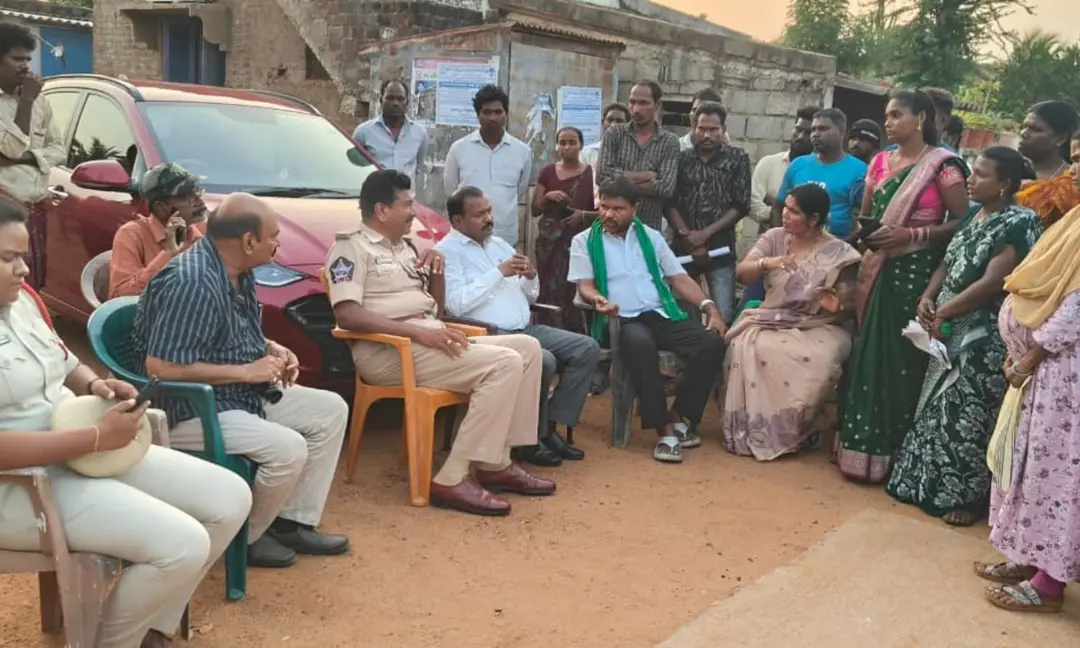
DSP conducts inquiry into microfinance harassment in Jaladanki
The Yanadi Welfare Association complained about harassment by microfinance institutions in Jaladanki mandal of Nellore district. Acting on the Collector's orders, Kavali DSP Ramana Kumar, ITDA Project Officer Srinivasa Rao and other officials held an inquiry with affected Yanadi tribal residents at Nehru Nagar Colony in Jaladanki mandal. Affected Yanadi women described the harassment by the institutions to the officials. The officials promised to bring the matter to the district SP's notice and take appropriate action.
Source
Kavali — స్థానికం · read the original report ↗
Desk check · some claims need care
What the desk checked (5)
- Kavali DSP Ramana Kumar, ITDA Project Officer Srinivasa Rao and other officials held an inquiry at Nehru Nagar Colony in Jaladanki mandal. — Attributed to the officials named in the source; figure and names appear in source text.
- The inquiry followed a complaint by the Yanadi Welfare Association and orders from the district Collector. — Stated in source as the basis for the inquiry; the Collector is not quoted directly.
- Affected Yanadi tribal women described harassment by microfinance institutions to the officials. — Reported in source; no individual complainant named or quoted.
- Officials promised to bring the matter to the district SP's notice and take appropriate action. — Attributed to officials present; no verbatim quote given.
- Microfinance-type bodies collect interest in violation of rules and past harassment has led to deaths. — General background assertion in the source with no source, data or case reference given.
Analysts’ view opinion
So far this is an administrative, fact-finding step rather than a criminal proceeding: acting on the Collector's direction, the DSP and the ITDA project officer heard affected residents on the ground. Moving quickly on a complaint and involving the tribal welfare machinery is procedurally sound, because the complainants are tribal Yanadis — which means the general law on coercive lending may not be the only framework in play. But an inquiry is not an FIR; the step that converts grievance into legal process is still ahead.
- If allegations of interest charged in breach of norms and coercive recovery are substantiated, they could attract both lending/money-lending regulatory violations and penal provisions such as intimidation or criminal intimidation.
- Because the complainants are tribal Yanadis — though the story does not cite that statute — officials will have to consider whether special protective legislation for SC/ST communities is engaged.
- Procedurally, the key next threshold is registration of an FIR: settled principle holds that police must register a case where information discloses a cognizable offence.
- The matter is not purely criminal — licensing conditions, interest caps and recovery practices also open civil and regulatory avenues before financial supervisors.
- The firms named in the complaint and their response do not appear in the story; fairness requires that they be heard in the inquiry before conclusions are drawn.
What to watch — Watch whether the escalation to the district SP actually results in an FIR, under which sections it is registered, and whether any protective or relief measures follow for the affected families.
The allegations remain at the complaint stage — the story does not establish that any FIR has been filed, how many people are affected, which institutions are involved, or under what laws action will be taken.
Deep dive
Research brief · 8 facts · 4 dates · exam-readyThe brief
Context
Microfinance institutions lend small sums to poor borrowers, but complaints persist that some collect interest in violation of rules and use coercive recovery methods. The source notes past instances where impoverished borrowers, unable to withstand such harassment, ended their lives. In Jaladanki mandal of Nellore district, the Yanadi Welfare Association complained of such harassment against Yanadi tribal families, prompting the District Collector to order an inquiry led by the Kavali DSP.
Key facts
- The inquiry was reported on 26 May 2026 (published 3:03 PM IST) from Kavali.
- The complaint was lodged by the Yanadi Welfare Association (Yanadula Sankshema Sangham) over harassment by microfinance institutions in Jaladanki mandal.
- The inquiry was held on the orders of the District Collector.
- Kavali DSP Ramana Kumar, ITDA Project Officer Srinivasa Rao and other officials conducted the inquiry.
- The inquiry was held at Nehru Nagar Colony in Jaladanki mandal with affected Yanadi tribal residents.
- Affected Yanadi women personally explained the harassment by microfinance institutions to the officials.
- Officials assured that the matter would be brought to the notice of the district SP and appropriate action taken.
- The source states that microfinance-type institutions exploit poverty, give small loans and collect interest in violation of rules.
Timeline
- Before the inquiry (date not stated in the source)Yanadi Welfare Association complains about harassment by microfinance institutions in Jaladanki mandal.
- Before the inquiry (date not stated in the source)District Collector orders an inquiry into the complaint.
- 26 May 2026 (as published)Kavali DSP Ramana Kumar, ITDA PO Srinivasa Rao and other officials hold the inquiry at Nehru Nagar Colony, Jaladanki mandal.
- 26 May 2026Affected Yanadi women describe the harassment; officials promise to inform the district SP and take suitable action.
Who has a stake
- Yanadi tribal residents of Nehru Nagar Colony, Jaladanki mandal — They are the affected borrowers facing harassment over small loans and high interest; their safety and relief depend on the inquiry.
- Yanadi Welfare Association — Complainant body representing the community; its petition triggered the Collector-ordered inquiry.
- Kavali DSP Ramana Kumar — Led the field inquiry and must report findings to the district SP for action.
- ITDA Project Officer Srinivasa Rao — Responsible for tribal welfare administration; participated in the inquiry with affected tribal families.
- District Collector, Nellore — Ordered the inquiry; accountable for administrative response to microfinance harassment in the district.
- District Superintendent of Police — The matter is to be placed before the SP for appropriate police action.
- Microfinance institutions operating in Jaladanki mandal — Face allegations of charging interest in violation of rules and harassing poor borrowers.
Why it matters
Coercive microfinance recovery has, in the past, pushed poor borrowers to suicide, as the source itself recalls, making early administrative intervention a preventive measure rather than a routine grievance. That the complainants are Yanadis, one of the most marginalised tribal communities, shows how debt distress compounds existing vulnerability. The case tests whether revenue, tribal welfare and police machinery can act together before harassment turns fatal.
UPSC angle
Prelims pointers
- Jaladanki mandal and Kavali are in Nellore district, Andhra Pradesh.
- Yanadi is a Scheduled Tribe community; the Yanadi Welfare Association filed the complaint in this case.
- ITDA (Integrated Tribal Development Agency) Project Officer took part in the inquiry alongside the Kavali DSP.
- District Collector ordered the inquiry; findings are to be placed before the district Superintendent of Police.
- Allegation: microfinance institutions gave small loans and collected interest in violation of rules, harassing the poor.
- Story dated 26 May 2026; inquiry held at Nehru Nagar Colony, Jaladanki mandal.
Mains framing
The Jaladanki inquiry illustrates how microcredit, designed as a poverty-alleviation tool, can turn predatory when lenders exploit borrowers' desperation, charge interest contrary to rules and resort to coercive recovery; the source recalls that many poor borrowers in the past have died by suicide unable to bear such harassment. The victims here are Yanadi tribal families, whose low literacy, insecure livelihoods and absence of formal credit access leave them dependent on such lenders and unable to contest illegal charges. The administrative response is notable for being collaborative and preventive: a community association's complaint moved the Collector to order a joint inquiry by the Kavali DSP and the ITDA Project Officer, combining policing with tribal welfare oversight, with findings to go to the district SP. The way forward, on the source's own logic, lies in acting on such complaints promptly so that incidents are not repeated, verifying whether interest collection breaches prescribed norms, and ensuring vulnerable tribal borrowers have a standing grievance channel rather than relying on one-off inquiries.
Key terms
- Microfinance institution
- A lender that extends small loans to low-income borrowers; here accused of collecting interest against rules and harassing the poor.
- Yanadi
- A tribal (Scheduled Tribe) community in coastal Andhra Pradesh; the affected borrowers in Jaladanki belong to it.
- ITDA
- Integrated Tribal Development Agency, the field agency for tribal development whose Project Officer joined the inquiry.
- DSP
- Deputy Superintendent of Police, a sub-divisional police officer; Kavali DSP Ramana Kumar led the inquiry.
- Yanadula Sankshema Sangham
- Yanadi Welfare Association, the community body that complained about microfinance harassment in Jaladanki mandal.
Practice questions
- Microfinance was conceived as a tool of financial inclusion but has repeatedly been linked to coercive recovery and borrower distress. Examine, with reference to recent instances, how regulation and local administration can prevent such harassment.
- Discuss why Scheduled Tribe communities such as the Yanadis remain particularly vulnerable to informal and microfinance debt, and suggest institutional safeguards.
- How effective is a joint inquiry model involving police, revenue and tribal welfare agencies in addressing debt-related harassment? Illustrate with the Jaladanki case.
Grounded only in the source report — figures and dates are the source's, not inferred.