
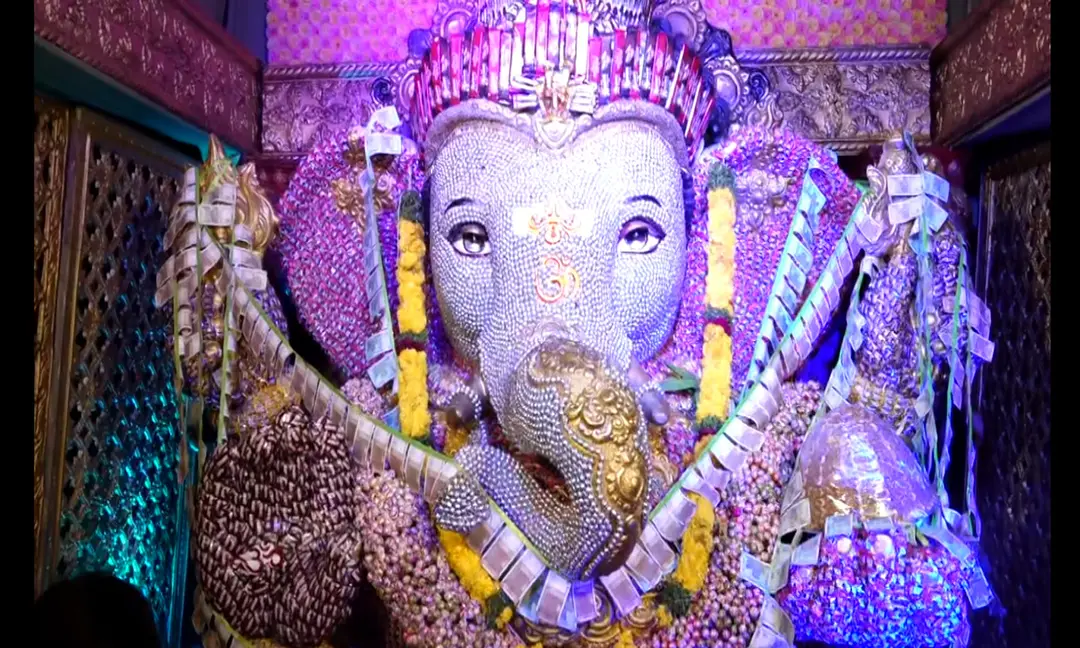
Ganesh idols taken for immersion in Adilabad under tight security
A Shobha Yatra of Ganesh idols was taken out in Adilabad on Friday for immersion amid tight police security. After a special puja at Saraswati Shishu Mandir under Hindu Istava Samiti supervision, the procession moved from Vinayaka Chowk to the Penganga river, with 250 idols taken to the river. Police deployed 600 personnel, including DSPs, CIs and SIs, along with 600 CCTV cameras and drones. Police said nearly 2,000 idols were installed in the district and 1,500 immersed.
Source
Adilabad — news · read the original report ↗
Desk check · compared with the source
What the desk checked (4)
- 250 Ganesh idols were taken from Adilabad to the Penganga river for immersion. — Figure appears in source; no attribution given for the count.
- Police deployed 600 personnel and used 600 CCTV cameras and drones. — Attributed to police deployment details in source; identical 600 figure for both staff and cameras appears as written.
- Nearly 2,000 idols were installed across Adilabad district and 1,500 immersed. — Explicitly attributed to police in the source.
- 7,858 students from 15 institutions joined a mass 'Vande Mataram' singing for a Guinness record attempt. — Figure appears in source, but the sentence is truncated mid-word, leaving institution type unclear.
Analysts’ view opinion
The immersion Shobha Yatra in Adilabad was not only a religious event — it also functioned as a stage for local political power. An MP, an MLA, the collector, the SP and the municipal chairperson taking part in the same puja, with an RSS pracharak as chief guest, put elected representatives, the administration and the Sangh Parivar platform within a single frame. The same day's mass singing of 'Vande Mataram', attended by a senior BJP leader among others, points to a coordinated push of a cultural-nationalist agenda at the local level.
- A deployment of 600 personnel, 600 CCTV cameras and drones turns law-and-order management into a political test for the administration in a district like Adilabad; an incident-free procession works in the district machinery's favour.
- An MP and MLA sharing a platform and using festival occasions for outreach is routine in Indian politics — what stands out here is that the outreach sat inside an event framework associated with the RSS.
- The Guinness record attempt under 'Namami Bharatham' marking 150 years of Vande Mataram, with 7,858 students taking part, reflects a longer-term strategy of mobilising youth and schools around nationalist symbols.
- In tribal-heavy Adilabad, if such cultural programming consolidates a broader Hindu vote, opposition parties could find it harder to build a local counter-narrative.
- Officials such as the collector and SP attending religious functions is conventional practice in India, but appearing alongside political leaders always leaves room for questions about neutrality.
What to watch — Watch whether the remaining roughly 500 immersions pass off peacefully, whether 'Namami Bharatham'-style events expand across the district, and how opposition parties respond.
The story establishes no incident or disturbance, and offers no evidence of any shift in party support; it says nothing about the political calculations behind the leaders' presence or about opposition reaction.
Deep dive
Research brief · 8 facts · 4 dates · exam-readyThe brief
Context
Adilabad district in Telangana held its annual Ganesh idol immersion procession (Shobha Yatra) on Friday, culminating the Ganesh Chaturthi/Navaratri festivities. Such processions, which pass through mixed neighbourhoods and end at water bodies, are routinely treated as law-and-order sensitive events, prompting heavy police deployment and electronic surveillance. In Adilabad the idols were taken from Vinayaka Chowk to the Penganga river for immersion, organised under the supervision of the Hindu Istava Samiti. A separate civic event the same day saw a mass singing of 'Vande Mataram' marking 150 years of the national song.
Key facts
- A Shobha Yatra of Ganesh idols was taken out in Adilabad on Friday for immersion under tight police security.
- The procession began at Vinayaka Chowk and proceeded to the Penganga river for immersion.
- 250 Ganesh idols were taken from Adilabad town to the river.
- Police deployed 600 personnel, including DSPs, CIs and SIs, for the procession.
- 600 CCTV cameras and drones were used for surveillance; the yatra was monitored from the command control room.
- Idols were taken out after a special puja at Saraswati Shishu Mandir under the supervision of Hindu Istava Samiti.
- Police said nearly 2,000 Ganesh idols were installed across Adilabad district during Navaratri and 1,500 had been immersed.
- At a separate 'Namami Bharatham' event at Saraswati Vidya Mandir High School, 7,858 students took part in a mass singing of 'Vande Mataram' for a Guinness Book record, marking 150 years of the national song.
Timeline
- During Navaratri (before the procession)Nearly 2,000 Ganesh idols installed across Adilabad district; 1,500 immersed.
- Friday (day of the event)Special puja at Saraswati Shishu Mandir under Hindu Istava Samiti supervision, attended by MP, MLA, collector and SP.
- Friday, after the pujaShobha Yatra began at Vinayaka Chowk and moved to the Penganga river; 250 idols immersed under watch of 600 police, 600 CCTV cameras and drones.
- Friday (same day)Mass singing of 'Vande Mataram' by 7,858 students at Saraswati Vidya Mandir High School under Namami Bharatham for a Guinness record.
Who has a stake
- Adilabad district police (SP Akhil Mahajan, DSPs, CIs, SIs) — Responsible for incident-free immersion; deployed 600 personnel and ran surveillance from the command control room.
- Hindu Istava Samiti — Organiser that supervised the special puja and the Shobha Yatra of idols.
- District administration (Collector Rajarshi Shah) — Coordinating civic arrangements and immersion logistics at the Penganga river.
- Elected representatives: MP Godam Nagesh, MLA Payal Shankar, municipal chairman Anusha Bandari, market committee chairman Srikanth Reddy — Participated in the puja; public accountability for peaceful conduct of the festival.
- RSS and BJP leaders (Meesari Prakash as chief guest; senior BJP leader Suhasini Reddy) — Ideological and organisational presence at the puja and the Vande Mataram event.
- Students of 15 schools — Participants (7,858) in the mass Vande Mataram singing under Namami Bharatham.
Why it matters
Immersion processions concentrate large crowds along fixed routes and at river banks, making policing, crowd control and surveillance a test of district administration capacity. The scale in Adilabad — nearly 2,000 idols installed and 1,500 immersed, with 600 police, 600 CCTV cameras and drones — shows how technology-backed policing is now standard for festival management. The parallel Vande Mataram mass-singing event marking 150 years of the national song links local festivity to a national commemorative exercise.
UPSC angle
Prelims pointers
- Penganga river is the immersion site for Ganesh idols from Adilabad town.
- The Adilabad Shobha Yatra started from Vinayaka Chowk after a puja at Saraswati Shishu Mandir.
- Adilabad MP: Godam Nagesh; MLA: Payal Shankar; Collector: Rajarshi Shah; SP: Akhil Mahajan.
- Police deployment: 600 personnel, 600 CCTV cameras and drones, monitored from a command control room.
- Namami Bharatham event marked 150 years of the national song 'Vande Mataram'; 7,858 students from 15 schools participated.
- District figures: nearly 2,000 idols installed during Navaratri, 1,500 immersed.
Mains framing
Large religious processions such as the Ganesh immersion Shobha Yatra sit at the intersection of the right to religious practice, public order and environmental management of water bodies. In Adilabad, the state's response was primarily preventive policing and surveillance: 600 personnel including DSPs, CIs and SIs, 600 CCTV cameras, drones and centralised monitoring from a command control room for a procession carrying 250 idols to the Penganga river, out of nearly 2,000 idols installed district-wide and 1,500 already immersed. The presence of the MP, MLA, collector, SP, municipal chairman and organisational leaders at the puja illustrates how festival administration in India blends civic coordination with political participation. The way forward suggested by the source is limited to what it records — organiser-administration coordination through bodies like the Hindu Istava Samiti, route and crowd management, and technology-enabled monitoring; questions of immersion site management and post-immersion cleanup are not stated in the source. Aspirants should note that legitimacy of such deployments rests on proportionality and on transparent coordination with organisers, rather than on force alone.
Key terms
- Shobha Yatra
- A ceremonial religious procession; here, the procession taking Ganesh idols for immersion.
- Hindu Istava Samiti
- The organising committee that supervised the special puja and the Adilabad immersion procession.
- Command control room
- Centralised police facility from which the procession was monitored using CCTV and drone feeds.
- Namami Bharatham
- The programme under which the mass 'Vande Mataram' singing event was held at Saraswati Vidya Mandir High School.
- Penganga river
- The river near Adilabad where the 250 Ganesh idols from the town were immersed.
- Vande Mataram
- India's national song; the event marked its completion of 150 years.
Practice questions
- Discuss how district administrations balance the right to hold religious processions with the maintenance of public order, using the Adilabad Ganesh immersion arrangements as an illustration.
- Surveillance technologies such as CCTV networks and drones are increasingly central to festival policing in India. Examine their benefits and the concerns they raise.
- What administrative and environmental challenges arise in managing mass idol immersion in rivers, and how can local bodies address them?
Grounded only in the source report — figures and dates are the source's, not inferred.