
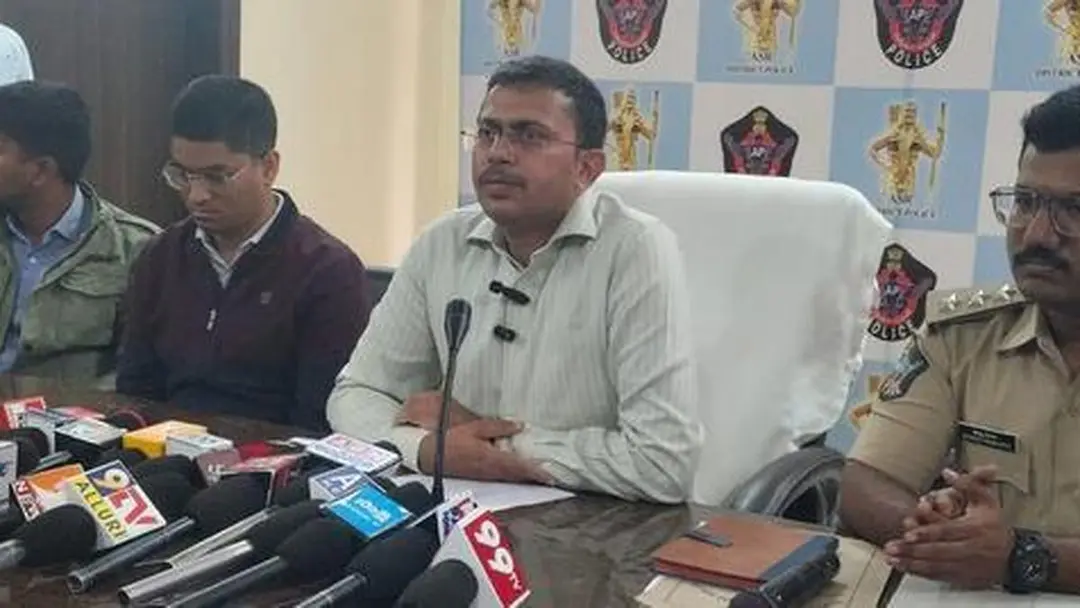
AOB SZC leadership dismantled, ganja cases fall: ASR SP
Superintendent of Police Amit Bardar said on Monday that operations through 2024 and 2025 had dismantled the leadership of the Andhra Odisha Border Special Zonal Committee in Alluri Sitharama Raju district. Addressing the annual press conference at Paderu, he said seven exchange-of-fire cases in 2025 left 18 Maoists neutralised, with nine arrests and 49 surrenders. Ganja cases fell from 316 in 2024 to 135 in 2025, with 14,484 kg seized and 358 arrests. Overall crime declined 34%.
Source
Alluri Sitharama Raju — news · read the original report ↗
Desk check · compared with the source
What the desk checked (5)
- Seven Exchange of Fire cases in 2025, 18 Maoists neutralised, nine arrests and 49 surrenders. — Attributed to SP Amit Bardar at the annual press conference; figures appear in source.
- Ganja cases fell to 135 in 2025 (14,484 kg seized, 35 kg hash oil, 358 arrests) from 316 in 2024 (23,366 kg, 1,016 arrests). — Figures stated by the SP in the source; no independent verification possible.
- Overall crime declined 34% in 2025 compared with 2024. — Attributed to the SP; underlying calculation not detailed in source.
- 138 villages verified and 83 suspected locations checked showed no ganja cultivation. — Direct quote from the SP in the source.
- 248 accidents in 2025, 177 fatal with 197 deaths, against 252 accidents and 177 deaths in 2024. — Figures appear in source as police data; internally consistent.
Analysts’ view opinion
This is a police force presenting its own annual performance ledger — legally, almost every figure in it still has to survive judicial testing. The claim of 18 deaths in seven exchange-of-fire incidents is the most sensitive element: under standards laid down by the Supreme Court, every death in police firing attracts mandatory processes such as independent investigation, magisterial or independent-agency inquiry, and reporting to the human rights commission. The word "neutralised" is not a legal finding — guilt is determined in court, and arrests and surrenders each carry their own distinct legal consequences.
- The story does not state whether FIRs, independent investigations or magisterial inquiries into the encounter deaths have been registered or completed.
- Describing the 18 as "Maoists" is a police characterisation; identification and criminal liability remain matters for the courts to establish.
- A fall in ganja case numbers can read as success, but the real legal test in NDPS matters is the conviction rate, the integrity of seizure proceedings and compliance with sampling protocols.
- The 49 surrenders engage a separate legal track — rehabilitation entitlements and the handling or withdrawal of pending cases — and the story does not explain how those were applied.
- A 34% drop in "overall crime" is a drop in registered crime, which must be distinguished from an actual fall in offending, especially given the settled principle that FIR registration is obligatory in cognisable cases.
What to watch — Watch for independent inquiry outcomes in the seven exchange-of-fire cases, any proceedings before human rights bodies, and the conviction rates that eventually emerge in the NDPS and extremism cases.
The story reports only the police account; it does not establish the lawfulness of any encounter, the status of any inquiry, the rehabilitation terms for those who surrendered, or any court verdict.
Deep dive
Research brief · 8 facts · 5 dates · exam-readyThe brief
Context
Alluri Sitharama Raju (ASR) district in Andhra Pradesh lies along the Andhra-Odisha Border (AOB), long a stronghold of the CPI (Maoist)'s Andhra Odisha Border Special Zonal Committee (AOB SZC) and also a corridor for illicit ganja cultivation and transport. At the ASR district police's annual press conference at Paderu on December 29, 2025, Superintendent of Police Amit Bardar said sustained security operations through 2024 and 2025 had dismantled the AOB SZC leadership, marking a "critical turning point" for extremism in the district. He paired this with data showing a steep fall in narcotics cases and overall crime, credited to enforcement plus community policing and alternative livelihood support for tribal families.
Key facts
- SP Amit Bardar said on December 29, 2025 that operations through 2024 and 2025 systematically dismantled the AOB SZC leadership in ASR district.
- Seven Exchange of Fire (EOF) cases were registered in 2025, in which 18 Maoists were neutralised; there were nine arrests and 49 surrenders.
- Ganja cases fell from 316 in 2024 to 135 in 2025.
- In 2025, 14,484 kg of ganja and 35 kg of hash oil were seized and 358 persons arrested; in 2024, 23,366 kg was recovered and 1,016 persons arrested.
- 138 villages with previously identified cultivation (spotted via drones and human intelligence) were verified and found to have no ganja cultivation; checks at about 83 suspected locations also found none.
- 325 targeted families were given alternative livelihood support including crops, business loans and income generation assistance.
- Community welfare initiatives 'Saral', 'Nirman' and 'Prerana' benefited around 1,800 youth.
- Overall crime declined 34% in 2025 over 2024; murders fell to 20 (from 27 in 2024 and 29 in 2023), rape cases to 22 (from 25), while HBs rose to 16 from 14.
Timeline
- 2023ASR district reported 29 murders.
- 2024316 ganja cases with 23,366 kg seized and 1,016 arrests; 27 murders; 14 HBs; 25 rape cases; 252 road accidents, 162 fatal, 177 deaths.
- 2024 and 2025High-level security operations systematically dismantle the AOB SZC leadership in ASR district.
- 2025Seven EOF cases with 18 Maoists neutralised, nine arrests, 49 surrenders; 135 ganja cases, 14,484 kg seized, 358 arrests; 248 accidents, 177 fatal, 197 deaths.
- December 29, 2025SP Amit Bardar addresses the annual press conference at Paderu SP Office and releases the district crime data.
Who has a stake
- ASR district police / SP Amit Bardar — Credited with dismantling AOB SZC leadership, curbing ganja trade and a 34% crime decline; accountable for sustaining law and order.
- AOB Special Zonal Committee (CPI-Maoist formation) — Leadership dismantled; 18 cadres neutralised, nine arrested and 49 surrendered in 2025.
- Tribal youth and communities in ASR district — Targeted by community policing to wean them away from extremism and ganja transport; about 1,800 youth benefited.
- 325 targeted families — Received alternative livelihood support - crops, business loans and income generation assistance - in place of ganja cultivation.
- Residents and road users of ASR district — Fatal accidents rose to 177 in 2025 from 162 in 2024, with deaths up from 177 to 197, even as overall crime fell.
Why it matters
The AOB has been one of the last active theatres of left-wing extremism in the Andhra-Odisha region, and the claimed dismantling of its Special Zonal Committee leadership signals a shift in the security landscape of the agency areas. The parallel collapse in ganja cases and the drone-verified absence of cultivation in 138 villages suggest enforcement combined with livelihood substitution can dent an illicit economy that has funded and fed extremism. But rising fatal road accidents show that overall crime decline does not automatically translate into wider public safety.
UPSC angle
Prelims pointers
- AOB SZC = Andhra Odisha Border Special Zonal Committee, a Maoist organisational formation; ASR = Alluri Sitharama Raju district, Andhra Pradesh, headquartered police-wise at Paderu.
- 2025 ASR data: 7 Exchange of Fire cases, 18 Maoists neutralised, 9 arrests, 49 surrenders.
- Ganja cases in ASR fell from 316 (2024) to 135 (2025); seizures 23,366 kg to 14,484 kg; 35 kg hash oil recovered in 2025.
- Drones and human intelligence were used to verify 138 villages and about 83 suspected locations for ganja cultivation.
- ASR police community welfare initiatives named in the source: 'Saral', 'Nirman' and 'Prerana' - about 1,800 youth benefited.
- Overall crime in ASR district declined 34% in 2025 compared with 2024; murders 20 (2025), 27 (2024), 29 (2023).
Mains framing
The ASR district data illustrates the twin-track approach now used against left-wing extremism in India's tribal belts: kinetic operations against armed cadre alongside welfare and livelihood substitution to dry up the social base. On the security side, seven exchange-of-fire cases in 2025 neutralised 18 Maoists, with nine arrests and 49 surrenders, which the SP says dismantled the AOB SZC leadership. On the development side, 'Saral', 'Nirman' and 'Prerana' reached about 1,800 youth and 325 families received crops, business loans and income-generation support, addressing the ganja economy that both sustains poverty and intersects with extremist networks; technology (drones) and human intelligence enabled verification that 138 previously cultivating villages and 83 suspect sites were clean, and cases halved from 316 to 135. The implication is that enforcement gains are fragile unless the alternative livelihoods endure at scale far beyond 325 families, and unless surrendered cadres are rehabilitated. A way forward grounded in the source would combine continued intelligence-led prevention, visible policing and beat systems with sustained livelihood support and attention to neglected areas such as road safety, where fatal accidents and deaths rose in 2025.
Key terms
- AOB SZC
- Andhra Odisha Border Special Zonal Committee, the Maoist formation operating along the Andhra-Odisha border, whose leadership the SP says has been dismantled.
- Exchange of Fire (EOF) case
- A case registered following an armed encounter between security forces and extremists; seven were registered in ASR district in 2025.
- Neutralised
- Term used by police for extremists killed in operations; 18 Maoists were neutralised in ASR district in 2025.
- Saral, Nirman, Prerana
- ASR district police community welfare and policing initiatives that benefited around 1,800 youth.
- Hash oil
- A concentrated cannabis extract; 35 kg was recovered in ASR district in 2025 alongside 14,484 kg of ganja.
- Community policing
- Police-led engagement and welfare work aimed here at weaning tribal youth away from extremism and ganja transportation.
Practice questions
- Critically examine the 'security plus development' model of countering left-wing extremism, using the 2025 record of Alluri Sitharama Raju district as an illustration.
- The sharp fall in ganja cases in ASR district has been attributed to enforcement, technology and alternative livelihoods. Discuss how sustainable such declines are in tribal economies.
- How can the use of drones and human intelligence in verifying illicit cultivation be balanced with privacy and community trust in scheduled areas?
Grounded only in the source report — figures and dates are the source's, not inferred.