
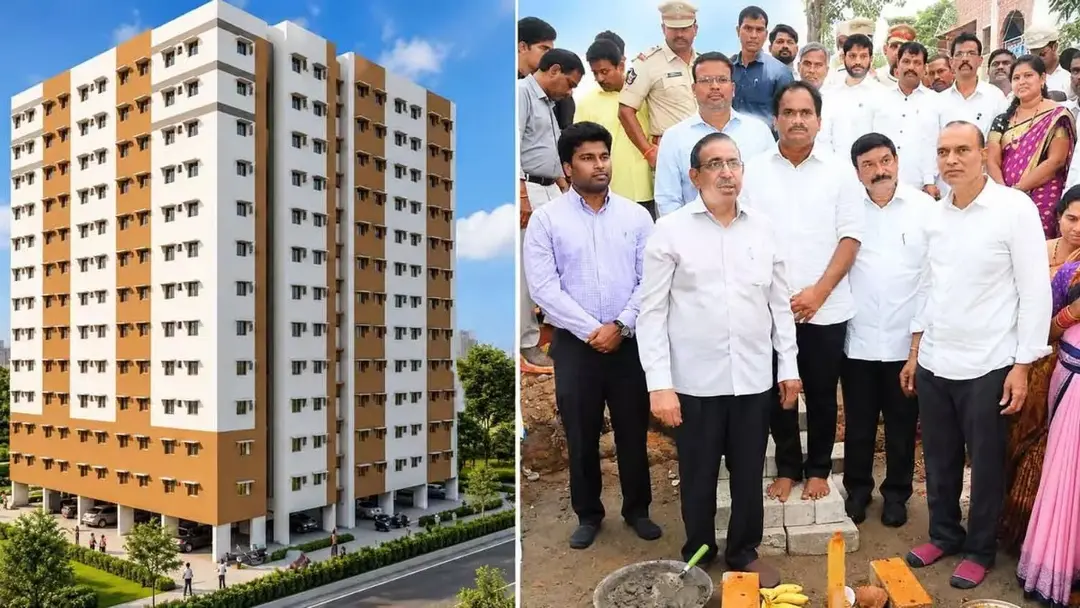
Visakhapatnam slum families to get 12-storey apartment flats
The Andhra Pradesh government is building a stilt plus 12-storey apartment block for 177 families living in tin sheds for five decades at Velampeta Lakshminagar, near Poorna Market in Visakhapatnam. Each family gets a 410 sq ft 1BHK flat, paying only Rs 3.5 lakh through EMIs of under Rs 1,000 a month. The project costs Rs 28.44 crore, with each unit valued at Rs 16.07 lakh. The Centre gives Rs 1.5 lakh and the state Rs 1 lakh as subsidy. Completion is targeted in nine months.
Source
ఆంధ్రప్రదేశ్ వార్తలు — Andhra Pradesh · read the original report ↗
Desk check · some claims need care
What the desk checked (5)
- A stilt plus 12-storey building for 177 slum families is being built at Velampeta Lakshminagar, Visakhapatnam. — Figure appears in source; no named official cited.
- Beneficiaries pay Rs 3.5 lakh for a 410 sq ft 1BHK flat via EMIs under Rs 1,000 a month. — Stated in source without attribution.
- Project cost Rs 28.44 crore; unit value Rs 16.07 lakh. — Specific figures in source; costing source unidentified.
- Centre gives Rs 1.5 lakh under PM Awas Yojana, state Rs 1 lakh, developer bears the rest. — Scheme claim internally consistent with unit cost but unattributed.
- Nine-month completion target; developer incentivised with TDR at 1:4 and fee waivers. — Timeline and incentives in source; no sanction order referenced.
Analysts’ view opinion
This is more than a housing scheme — the government is politically testing an in-situ model that rehouses the urban poor on prime city land rather than pushing them to the periphery. Choosing Visakhapatnam is no accident; read it as a bid for both civic-administrative credit and a slice of the urban poor vote. With both the Centre and the state putting in subsidies, a credit-claiming contest is near certain, while the developer incentives — TDR and waived fees — hand the opposition a ready line of attack.
- The 177 families who spent five decades in tin sheds are a small number, but as the state's first project of its kind it becomes a showcase that will shape the government's image on urban poverty.
- A beneficiary paying only Rs 3.5 lakh for a unit valued at Rs 16.07 lakh, with EMIs under Rs 1,000 a month, is exactly the kind of figure that travels well in campaign messaging.
- Because the Centre contributes Rs 1.5 lakh under PM Awas Yojana and the state Rs 1 lakh, competing claims over who delivered this are almost inevitable.
- The 1:4 TDR to the developer, relaxed parking norms and waived permission fees open the door to transparency questions about the design-build-finance-transfer route.
- The nine-month deadline cuts both ways: on-time delivery strengthens the 'slum-free state' pitch, while slippage becomes opposition ammunition.
What to watch — Watch whether the nine-month timeline holds, who shares the stage at handover from the Centre and the state, and how quickly the model is extended to other slums.
The story establishes the project's announcement and design details only — it says nothing about how beneficiaries or the developer were selected, how residents or opposition parties have reacted, or actual construction progress.
Deep dive
Research brief · 8 facts · 3 dates · exam-readyThe brief
Context
At Velampeta Lakshminagar near Poorna Market in Visakhapatnam, 177 families have lived for five decades in tin-sheet sheds on a 59-cent plot. The Andhra Pradesh government is now redeveloping the site in situ with a stilt plus 12-storey high-rise apartment block, giving each family a 1BHK flat. The project is run on a Design, Build, Finance, Transfer model with Pradhan Mantri Awas Yojana and state subsidies, and is described as the first project of its kind in the state. Officials see it as a template for making Andhra Pradesh slum-free if it succeeds.
Key facts
- 177 families living for five decades in tin sheds on 59 cents of land at Velampeta Lakshminagar, near Poorna Market, Visakhapatnam, will be rehoused.
- Each family gets a 410 sq ft 1BHK flat (one bedroom, hall, kitchen).
- Beneficiaries pay only Rs 3.5 lakh, through EMIs of under Rs 1,000 a month.
- Total project cost is Rs 28.44 crore; each unit is valued at Rs 16.07 lakh.
- Subsidy: Rs 1.5 lakh from the Centre under Pradhan Mantri Awas Yojana and Rs 1 lakh from the state; the developer bears the remaining cost.
- Stilt plus 12 floors on 2,691 sq yards: 15 flats on each of the first 11 floors and 12 flats on the top floor.
- Shear wall technology is being used for faster construction; the target is completion in nine months.
- Developer incentives: Transferable Development Rights (TDR) at a 1:4 ratio, relaxed parking norms and waiver of permission fees.
Timeline
- Past five decadesThe 177 families lived in tin-sheet sheds on 59 cents of land at Velampeta Lakshminagar.
- As reported (September 20, 2026)Construction of the stilt plus 12-storey high-rise apartment for the families is under way.
- Nine months from startTargeted completion of the works, after which families move into the flats.
Who has a stake
- 177 slum families at Velampeta Lakshminagar — Move from tin sheds to pucca 410 sq ft 1BHK flats for a payment of Rs 3.5 lakh in sub-Rs 1,000 monthly EMIs.
- Andhra Pradesh government — Provides Rs 1 lakh per unit subsidy, waives permission fees, relaxes parking norms; wants to replicate the model to make the state slum-free.
- Union government / Pradhan Mantri Awas Yojana — Contributes Rs 1.5 lakh per unit as central subsidy.
- Private developer — Bears the balance project cost under the Design, Build, Finance, Transfer model and is compensated with TDR in a 1:4 ratio.
- Other slum settlements in Andhra Pradesh — Success of this first-of-its-kind project could see the same redevelopment model extended to them.
Why it matters
Vertical in-situ redevelopment lets families stay on the same central urban land they have occupied for 50 years while freeing space and gaining lifts, continuous water supply and parking. By making a developer finance most of the Rs 16.07 lakh per-unit cost in exchange for TDR, the state cuts its own fiscal outlay for slum housing. As the first such project in Andhra Pradesh, its outcome will decide whether the model is scaled up statewide.
UPSC angle
Prelims pointers
- Pradhan Mantri Awas Yojana subsidy in this project: Rs 1.5 lakh per unit; state subsidy Rs 1 lakh per unit.
- Project model: Design, Build, Finance, Transfer (DBFT), with developer incentive of TDR in 1:4 ratio.
- Site: Velampeta Lakshminagar near Poorna Market, Visakhapatnam; 2,691 sq yards; earlier 59 cents of tin sheds.
- Flat size 410 sq ft (1BHK); beneficiary contribution Rs 3.5 lakh via EMIs under Rs 1,000 a month.
- Building configuration: stilt + 12 floors; 15 flats each on first 11 floors, 12 on the top floor; total 177 units.
- Construction technique: shear wall technology, chosen for speed; nine-month completion target.
Mains framing
Urban slums in Indian cities persist because poor families occupy small, centrally located plots with insecure tenure and minimal services, as at Velampeta Lakshminagar where 177 families lived five decades in tin sheds on 59 cents. The Visakhapatnam project illustrates an in-situ vertical redevelopment approach: the same land is used for a stilt plus 12-storey block of 410 sq ft 1BHK flats, with the Rs 16.07 lakh unit cost split between a Rs 1.5 lakh PMAY central subsidy, Rs 1 lakh state subsidy, a Rs 3.5 lakh beneficiary contribution payable in sub-Rs 1,000 EMIs, and the developer meeting the balance under a Design, Build, Finance, Transfer arrangement. Regulatory sweeteners such as TDR at 1:4, relaxed parking norms and waived permission fees are the state's instruments for crowding in private capital, while shear wall technology is used to compress the schedule to nine months. Implications include secure tenure, lifts, continuous water supply and dignity for beneficiaries, but also questions of affordability of EMIs, maintenance of a high-rise, and the fiscal value forgone through TDR. The way forward, as the source indicates, is to test this first-of-its-kind project and, if successful, replicate the model in other slums towards a slum-free state.
Key terms
- Pradhan Mantri Awas Yojana
- Central housing scheme under which Rs 1.5 lakh per unit subsidy is given in this project.
- Design, Build, Finance, Transfer (DBFT)
- Delivery model where the developer designs, builds and finances the project and then transfers it.
- Transferable Development Rights (TDR)
- Development rights given to the developer as incentive, here in a 1:4 ratio.
- Shear wall technology
- Construction method using load-bearing walls, used here to speed up the multi-storey build.
- Stilt plus 12 floors
- Building design with an open ground-level stilt (used for parking) and 12 residential floors above.
- 1BHK flat
- Unit with one bedroom, hall and kitchen; here 410 sq ft per family.
Practice questions
- Examine how in-situ vertical redevelopment of slums, as attempted in Visakhapatnam, differs from peripheral resettlement, and assess its advantages and risks.
- Discuss the role of incentives such as Transferable Development Rights and fee waivers in mobilising private capital for affordable housing. What safeguards are needed?
- Evaluate the Visakhapatnam Velampeta project as a replicable model for a slum-free state, using the cost-sharing pattern described.
Grounded only in the source report — figures and dates are the source's, not inferred.