
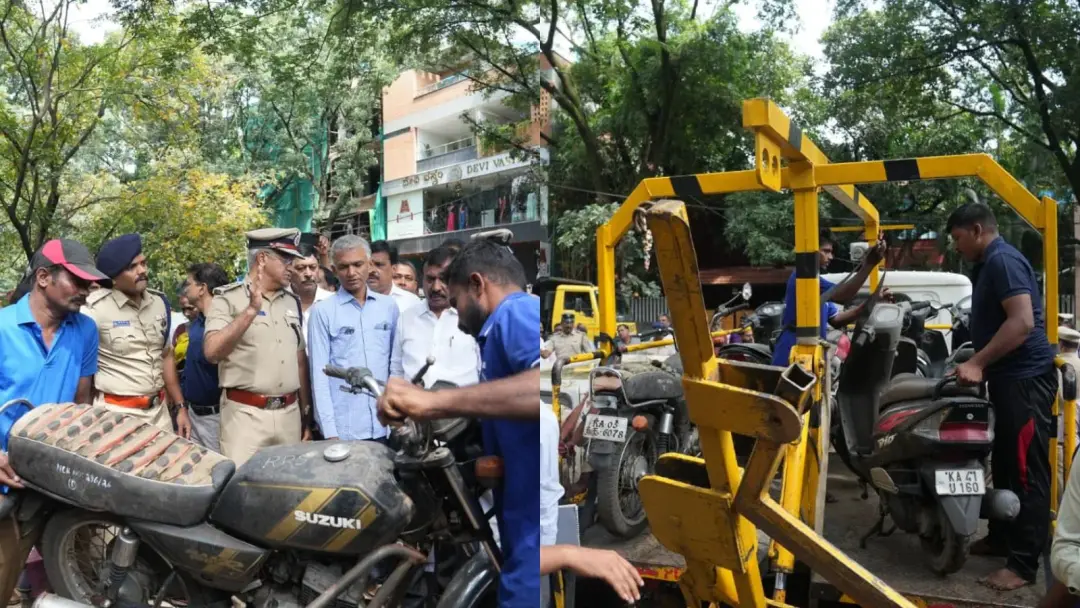
Bengaluru begins relocating 11,341 seized vehicles from footpaths
Bengaluru police, with the Greater Bengaluru Authority, began relocating 11,341 seized vehicles on Wednesday under the ‘Safe Footpath Campaign’, after complaints that areas near police stations had become makeshift scrapyards blocking footpaths. The two-, three- and four-wheelers will be stored on 26 acres allotted by the Revenue Department at seven locations outside the city. Owners can claim vehicles with a court order. Minister Krishna Byre Gowda said some had stood for over 15 years due to pending trials; notices were issued for 2,274 abandoned vehicles, of which 718 were towed for auction.
Source
Indian Express — Cities · read the original report ↗
Desk check · compared with the source
What the desk checked (5)
- 11,341 seized vehicles are being relocated from near police stations to seven off-site locations — Figure appears in source, attributed to officials; consistent with headline's rounded 11,000.
- The Revenue Department allotted 26 acres across seven locations outside Bengaluru — Attributed to the source's account of the Revenue Department; no document cited.
- Some vehicles had been parked outside police stations for over 15 years due to pending court trials — Directly attributed to Minister Krishna Byre Gowda.
- Notices were issued for 2,274 abandoned vehicles; 718 were towed and will be auctioned — Quoted figures attributed to Gowda; internally consistent.
- The court refused a request to set up a fast-track court to clear the vehicles — Minister's statement as quoted; no court order or independent confirmation in source.
Analysts’ view opinion
On the surface this is an administrative clean-up; politically it is a low-cost, high-visibility win. Encroached footpaths and heaps of rusting vehicles outside police stations are problems city voters see every day, which means the fix is equally visible. By fronting the announcement and describing how he pulled police, revenue and the GBA together, Urban Development Minister Krishna Byre Gowda has steered the credit towards his department.
- Moving vehicles that had sat for over 15 years frames the problem as an inherited, cross-government failure — while the credit for finally shifting it accrues to the current minister.
- Saying the request for a fast-track court was refused, and that revenue land offered the way out, sends the message that the bottleneck was systemic rather than political.
- With the Greater Bengaluru Authority still a new structure, visible deliverables like this are likely to be cited as proof that the reorganisation works.
- Because the 26 acres are outside the city, owners tied up in court cases must travel further to reclaim vehicles — a ready-made line of local grievance and opposition criticism.
- If the auction of the 718 leftover vehicles and the notice process are not seen as transparent, a pedestrian-friendly win could turn into a property-rights dispute.
What to watch — Watch whether the batch-wise relocation is actually completed and whether the cleared footpaths stay clear — that is where the political dividend will be won or lost.
The story establishes only that the relocation has begun; it does not set out a completion timeline, costs, any opposition response, or how much inconvenience owners will actually face.
Deep dive
Research brief · 8 facts · 5 dates · exam-readyThe brief
Context
For years, vehicles seized by Bengaluru police in accident and criminal cases have been parked around police stations awaiting court disposal, turning footpaths and station surroundings into makeshift scrapyards. After public complaints raised in meetings with officials, the Bengaluru police and the Greater Bengaluru Authority (GBA) launched a 'Safe Footpath Campaign'. Under it, relocation of 11,341 seized vehicles to off-site storage yards outside the city began on Wednesday, with land provided by the Revenue Department.
Key facts
- Officials identified 11,341 seized vehicles — two-wheelers, three-wheelers and four-wheelers — parked near police stations for batch-wise relocation.
- Relocation began on Wednesday under the 'Safe Footpath Campaign' by Bengaluru police in coordination with the Greater Bengaluru Authority (GBA).
- The Revenue Department allotted 26 acres of land at seven locations outside Bengaluru to store the relocated vehicles.
- Owners whose vehicles are tied to ongoing legal cases can claim them from the off-site yards by presenting a court order.
- Bengaluru Urban Development Minister Krishna Byre Gowda said many vehicles had stood in front of police stations for over 15 years due to ongoing court trials in accident and criminal cases.
- Police approached the court seeking a fast-track court to clear the vehicles, but the court refused; land from the Revenue Department became the alternative solution.
- Notices were issued for 2,274 abandoned vehicles across the city; owners reclaimed most, but 718 were left behind.
- The 718 towed vehicles are set to be auctioned for disposal.
Timeline
- Over the past 15 years (as stated)Several seized vehicles remained parked in front of Bengaluru police stations awaiting conclusion of court trials.
- Before the campaign (date not stated in the source)Public complaints in meetings with officials about police station surroundings turning into makeshift scrapyards and blocking footpaths.
- Before the campaign (date not stated in the source)Police requested the court to set up a fast-track court to clear seized vehicles; the court refused. Revenue Department then allotted land.
- Before the campaign (date not stated in the source)Notices issued for 2,274 abandoned vehicles; 718 unclaimed vehicles towed for auction.
- WednesdayRelocation of 11,341 seized vehicles to seven off-site storage locations begins; Minister Krishna Byre Gowda explains the plan.
Who has a stake
- Bengaluru police — Custodians of seized vehicles; must clear station surroundings while preserving vehicles as case property until courts decide.
- Greater Bengaluru Authority (GBA) — Coordinating agency for the 'Safe Footpath Campaign' and reclaiming footpaths for pedestrians.
- Karnataka Revenue Department — Allotted 26 acres at seven locations outside Bengaluru for off-site vehicle storage.
- Vehicle owners in ongoing cases — Must now travel to off-site yards and produce a court order to reclaim their vehicles.
- Pedestrians and residents — Stand to regain footpaths blocked by seized and abandoned vehicles near police stations.
- Courts — Pending trials keep vehicles in custody; the court declined the police request for a fast-track court for vehicle disposal.
- Bengaluru Urban Development Minister Krishna Byre Gowda — Political sponsor of the solution; coordinated between police and Revenue Department.
Why it matters
Footpaths occupied by case-property vehicles push pedestrians onto busy roads, and the 15-year pile-up shows how judicial delay converts a legal process into an urban-space problem. The relocation to 26 acres outside the city is a workaround rather than a fix, since the underlying trials remain pending. It also sets a template other Indian cities with similar station-side scrapyards could follow.
UPSC angle
Prelims pointers
- 'Safe Footpath Campaign': Bengaluru police–Greater Bengaluru Authority (GBA) drive to clear footpaths of seized vehicles.
- 11,341 seized vehicles (two-, three- and four-wheelers) identified for batch-wise relocation from near police stations.
- Karnataka Revenue Department allotted 26 acres across seven locations outside Bengaluru for storage.
- Owners in pending cases can reclaim vehicles only by producing a court order.
- Notices issued for 2,274 abandoned vehicles; 718 unclaimed ones towed and to be auctioned.
- Bengaluru Urban Development Minister: Krishna Byre Gowda; police request for a fast-track court to clear vehicles was refused.
Mains framing
Bengaluru's relocation of 11,341 seized vehicles illustrates how delays in the criminal justice system spill over into urban governance. Vehicles held as case property in accident and criminal trials accumulated for over 15 years outside police stations, converting public footpaths into makeshift scrapyards and eroding pedestrian space in an already congested city. With the court declining a fast-track mechanism for disposal of such vehicles, the executive response was spatial: the Revenue Department allotted 26 acres at seven sites outside the city, and the GBA-police 'Safe Footpath Campaign' began shifting vehicles batch-wise, with owners allowed to reclaim them on producing a court order. The parallel drive on abandoned vehicles — 2,274 notices, 718 towed for auction — shows a workable route for ownerless vehicles. However, relocation only moves the problem: unless timely judicial disposal of case-property vehicles, clear custody and auction protocols, and periodic clearance of station premises are institutionalised, the yards outside the city could themselves become permanent scrapyards. The way forward lies in linking footpath protection to faster case-property disposal, digital inventories of seized vehicles and accountability for maintaining pedestrian rights of way.
Key terms
- Safe Footpath Campaign
- Bengaluru police–GBA initiative to clear footpaths and police-station surroundings of parked seized vehicles.
- Greater Bengaluru Authority (GBA)
- City-level authority coordinating with the police on the relocation of seized vehicles in Bengaluru.
- Seized vehicles / case property
- Vehicles held by police in connection with accident or criminal cases, releasable only on a court order.
- Fast-track court (as sought here)
- A dedicated court the police requested to speed up clearance of long-pending seized vehicles; the request was refused.
- Abandoned vehicles drive
- Process of issuing notices to owners of derelict vehicles and towing unclaimed ones for auction — 2,274 notices, 718 towed.
Practice questions
- Long-pending seized vehicles outside police stations are as much a judicial delay problem as an urban management problem. Discuss with reference to Bengaluru's 'Safe Footpath Campaign'.
- Examine the challenges in protecting pedestrian rights of way in large Indian cities. What institutional mechanisms could ensure footpaths are not encroached upon by state agencies themselves?
- Relocating seized vehicles to off-site yards is a stopgap, not a solution. Suggest measures for timely disposal of case-property vehicles.
Grounded only in the source report — figures and dates are the source's, not inferred.