
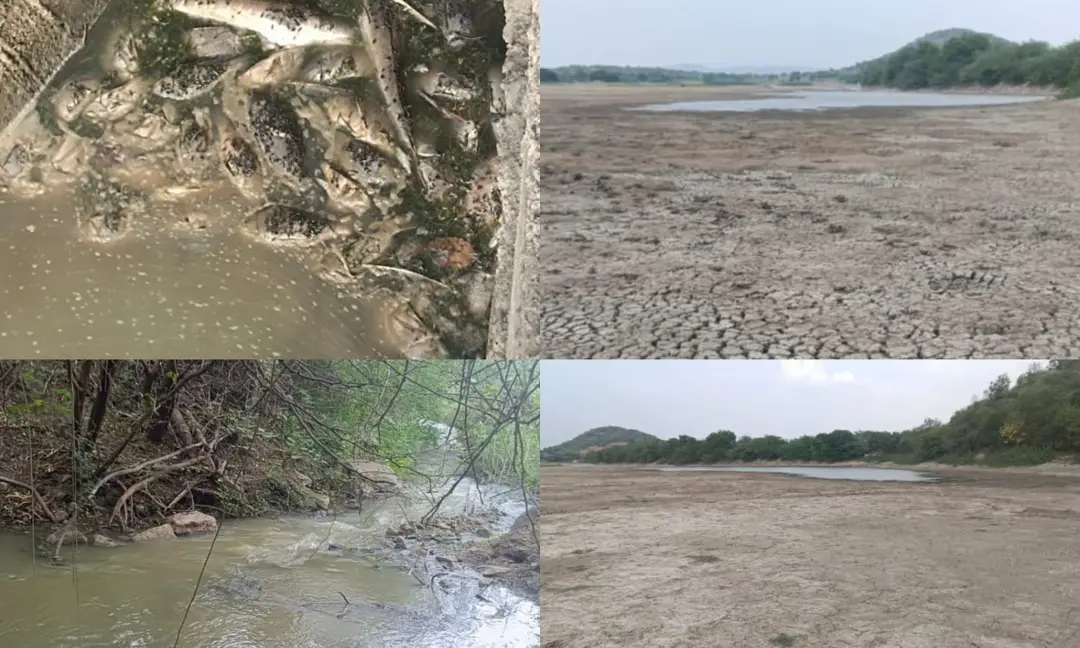
Farmers allege lake water released for fishing at Mandalagudem
Residents of Mandalagudem in Raghunathpally mandal of Telangana's Jangaon district have alleged that the village lake's sluice has been opened for the past month to release water for catching fish. They said water was let out twice earlier for the same purpose, and that the sluice was reopened within two or three days even after being blocked with mud sacks. With no rains and depleted groundwater, crops are drying up and fish are dying in the lake, they said, urging officials to stop the water wastage and take legal action against those responsible.
Source
Jangaon — crime & civic · read the original report ↗
Desk check · some claims need care
What the desk checked (5)
- Lake water at Mandalagudem has been released through the sluice for the past month to catch fish — Attributed to local residents; no official confirmation or named source in the source text.
- Water was released twice earlier for fishing, causing heavy losses to farmers — Allegation by locals; no documentation or official figure given in source.
- Sluice was blocked with mud sacks but was reopened after two or three days — Stated in source without attribution to a named person or authority.
- Crops are drying up due to lack of water and depleted groundwater from poor rainfall — Presented as local account; no rainfall or crop-loss data provided.
- Fish are dying in the lake due to lack of water — Alleged by locals; unverified, no official assessment cited.
Analysts’ view opinion
This looks like a village dispute, but at its core it is a common-pool resource problem: a shared asset — tank water — is allegedly being drawn down for the short-term gain of a few, while the cost falls on every farmer in the command area. With rainfall scarce and groundwater reportedly depleted, water released over a month, as alleged, imposes a double burden: crop loss now, and higher pumping costs later. Notably, villagers say fish are dying too — which would make this a net-loss transaction even on the fisheries side.
- Because tank water carries no price, whoever uses it does not bear its full cost; the loss is transferred to crop farmers — a textbook externality.
- In a season of failed rains and falling groundwater, the shadow price of stored water is unusually high, so draining it to harvest fish is likely an inefficient use of a scarce input.
- Crop failure destroys more than one harvest's revenue: seed, fertiliser and labour already spent become sunk costs, raising debt stress and migration pressure.
- If fish are indeed dying for want of water, the fisheries gain is temporary and the tank's longer-term productivity is being eroded.
- The claim that the sluice is reopened within days of being sandbagged suggests weak enforcement — where monitoring is thin, incentives beat rules.
What to watch — Watch whether officials move to a permanent lock or monitoring on the sluice, with clear release norms and conditions attached to fishing rights — or whether storage keeps falling ahead of the main cropping season.
These are residents' allegations: the story does not establish who is releasing the water, whether they hold legal fishing rights, how much water was lost, or the verified extent of crop damage, and no response from the other side is recorded.
Deep dive
Research brief · 8 facts · 4 dates · exam-readyThe brief
Context
Mandalagudem, a village in Raghunathpally mandal of Jangaon district in Telangana, depends on its village lake (cheruvu) for irrigation and for fish. Residents allege that the lake's sluice (thoomu) has been kept open for about a month to drain water so that fish can be caught. With no rains and groundwater already dried up, farmers say standing crops are withering and even the fish in the shrinking lake are dying. They have asked officials to stop the wastage of water and take legal action against those responsible.
Key facts
- Locals of Mandalagudem village, Raghunathpally mandal, Jangaon district (Telangana) allege the lake sluice has been opened and water released for the past one month.
- Villagers say water was drained and fish caught in the same manner twice earlier.
- Even after mud sacks were placed at the sluice to stop the flow, the sluice was reopened within two or three days, according to residents.
- Farmers say crop fields are getting no water and crops are drying up.
- Residents attribute the crisis to absence of rains and dried-up groundwater, worsened by removal of the lake's remaining water.
- Locals allege fish in the lake are dying because of the lack of water.
- Villagers and farmers have demanded that officials curb the water wastage and initiate legal action against those responsible.
- The report is dated 19 June 2026 (published 10:53 AM IST).
Timeline
- Earlier (dates not stated in the source)Water was released from the lake twice before and fish were caught, causing losses to farmers, as per residents.
- About one month before the reportThe sluice was opened again and lake water has been flowing out continuously.
- During this periodMud sacks were placed at the sluice to block the water, but the sluice was reopened two or three days later.
- 19 June 2026Report published carrying villagers' allegations and their demand for official action.
Who has a stake
- Farmers of Mandalagudem — Loss of irrigation water from the lake; standing crops drying up amid no rains and depleted groundwater.
- Villagers/residents — Depletion of a shared water body they depend on; seeking enforcement against alleged water wastage.
- Those allegedly opening the sluice to catch fish — Face demands for legal action; identity or affiliation not stated in the source.
- District and mandal officials (Jangaon district, Raghunathpally mandal) — Expected to stop the water release, protect the tank and act against the responsible parties.
- Fish stock in the lake — Fish are reportedly dying as the water level falls, hurting any livelihood dependent on the tank fishery.
Why it matters
Village tanks are the backbone of irrigation and groundwater recharge in large parts of Telangana, and their water is a common resource with competing claims — irrigation versus inland fisheries. When a sluice can be opened repeatedly despite being blocked, it points to weak local control over a common property resource in a year of failed rains. The outcome decides whether standing crops survive and whether tank management rules are enforced.
UPSC angle
Prelims pointers
- Mandalagudem village lies in Raghunathpally mandal of Jangaon district, Telangana.
- 'Thoomu' (sluice) is the outlet structure through which tank water is released for irrigation.
- Allegation in the source: lake water released for a month to catch fish, causing crops to dry up.
- Villagers' remedies sought: stop water wastage and take legal action against those responsible.
- Twin stress cited: no rains and depleted groundwater, making tank storage the only source.
- Report date: 19 June 2026.
Mains framing
The Mandalagudem episode is a textbook conflict over a common property resource: the same village tank serves irrigation and inland fisheries, and in a rain-deficit year the two uses become irreconcilable. Residents allege that the sluice was opened for a month — and twice before — purely to drain water for catching fish, leaving fields unirrigated even as groundwater has dried up; the fact that mud sacks placed to block the outlet were removed within two or three days suggests the absence of any enforceable local authority over the sluice. The implications run beyond one village: unregulated draining of tanks undermines both the irrigation command area and recharge, and ironically kills the very fishery it exploits, as residents report fish dying for want of water. The way forward indicated by the source itself is administrative and legal: officials must halt the wastage, secure the sluice, and act against those responsible — with the broader lesson that tank water use needs a transparent, rule-bound schedule agreed between farmers and fishing interests. Any wider policy prescription is not stated in the source.
Key terms
- Thoomu (sluice)
- The outlet gate of a tank through which stored water is released downstream or into irrigation channels.
- Cheruvu (village tank/lake)
- A traditional water body storing rainwater and runoff for irrigation, livestock, fisheries and groundwater recharge.
- Groundwater depletion
- Fall in sub-surface water levels; here cited alongside failed rains as leaving farmers dependent only on tank water.
- Raghunathpally mandal
- The administrative mandal in Jangaon district, Telangana, where Mandalagudem village is located.
- Inland tank fisheries
- Fish rearing and catching in inland water bodies such as village tanks; here alleged to conflict with irrigation needs.
Practice questions
- Village tanks serve irrigation, recharge and fisheries simultaneously. Examine the governance challenges in managing such multi-use common property resources during drought years, with reference to the Mandalagudem case.
- Discuss how the absence of enforceable local control over tank sluices can worsen agrarian distress in rain-deficit years. What institutional arrangements could reconcile irrigation and fisheries interests?
- Critically assess the role of district administration in protecting minor irrigation sources when local users are in conflict over water use.
Grounded only in the source report — figures and dates are the source's, not inferred.