
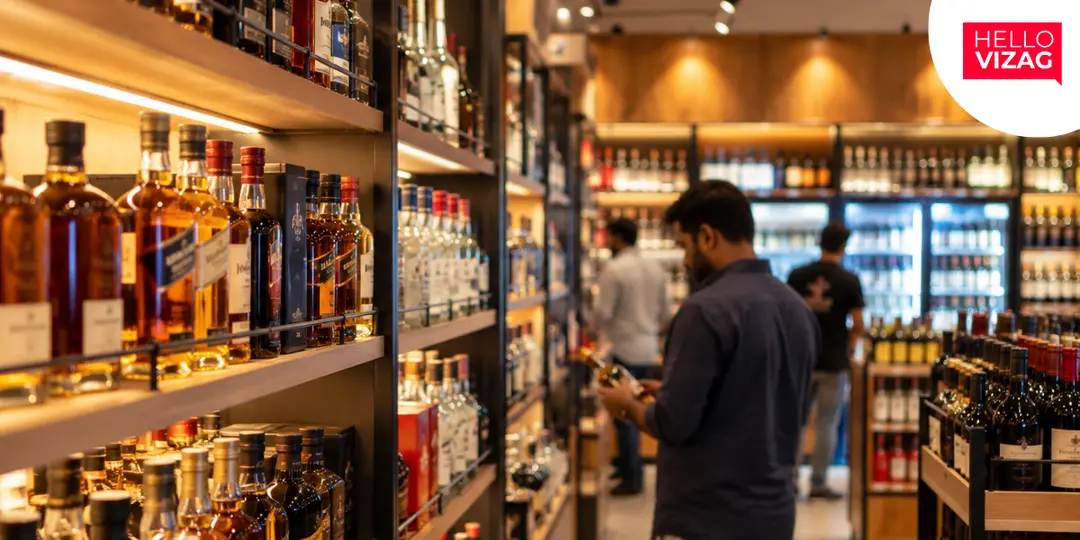
Visakhapatnam to get 52 A4 liquor shop licences
The Andhra Pradesh government is set to allot 52 A4 liquor shop licences in Visakhapatnam under the State's 2026-27 excise arrangements, part of a wider process covering 807 liquor shops across the State. As per the reported district-wise allocation, Anakapalli has 39 shops, Vizianagaram 30, Srikakulam 39, Parvathipuram Manyam 9 and Alluri Sitharama Raju 3. The Excise Department advised applicants to check district gazette notifications for shop locations, eligibility, procedure, fees, documents and deadlines.
Source
Visakhapatnam — news · read the original report ↗
Desk check · some claims need care
What the desk checked (5)
- Visakhapatnam will be allotted 52 A4 liquor shop licences under the 2026-27 excise arrangements. — Figure appears in source; attributed only to a 'reported district-wise allocation', no named official.
- The wider process covers 807 liquor shops across Andhra Pradesh. — Figure appears in source; no source or document cited.
- Anakapalli 39, Vizianagaram 30, Srikakulam 39, Parvathipuram Manyam 9 and Alluri Sitharama Raju 3 shops. — Figures appear in source and are internally consistent with the district-wise list; unattributed.
- The Excise Department advised applicants to check district gazette notifications for shop locations, eligibility, fees, documents and deadlines. — Attributed to the Excise Department in the source.
- The government earlier extended the A4 liquor shop renewal deadline by two days. — Stated in source as background; no date or order number given.
Analysts’ view opinion
Liquor retail licensing is one of the most reliable own-revenue levers a State government controls, and an allocation round covering 807 shops — 52 of them in Visakhapatnam — is best read as a fiscal exercise as much as a regulatory one. For applicants, the economics hinge entirely on details the story leaves to the district gazettes: licence fees, shop locations and eligibility, which together decide whether a licence is a profitable asset or an overpriced one. The urban-rural skew in the district numbers also tells us where the government expects the consumption, and therefore the tax base, to actually sit.
- Excise duty and licence fees are among the largest discretionary revenue streams for Indian States, so the pace and terms of this allocation matter for Andhra Pradesh's own-source receipts.
- Visakhapatnam's 52 shops against 3 in Alluri Sitharama Raju district reflects population density and purchasing power rather than any stated policy preference, with the bulk of turnover likely concentrated in urban and semi-urban outlets.
- The cost side falls on licensees, who must price fees, rent and working capital against regulated margins — the story does not disclose the fee levels, which is the single biggest variable in bid economics.
- A licensed, gazetted retail network is generally easier to tax and monitor than informal channels, though the revenue benefit to the State ultimately depends on how fees and volumes are set.
- The earlier two-day extension of the renewal deadline hints at either administrative friction or cautious applicant appetite, both of which are worth tracking as signals of how attractive operators find the current terms.
What to watch — Watch the fee structure and the subscription rate in the district gazette notifications — heavy oversubscription would suggest licences are priced attractively for operators, while thin response would point to margin pressure and possible revenue shortfall for the State.
The story does not establish licence fees, expected revenue, the selection method or how these numbers compare with previous years, so no conclusion can be drawn about the fiscal gain or the profitability of any individual shop.
Deep dive
Research brief · 7 facts · 3 dates · exam-readyThe brief
Context
Andhra Pradesh is allotting retail liquor shop licences (A4 licences) under its excise arrangements for the 2026-27 year. Visakhapatnam district has been assigned 52 A4 shops, as part of a wider State-level process covering 807 liquor shops. The Excise Department has asked prospective applicants to rely on district gazette notifications for shop-level details, eligibility, fees and deadlines. The allocation follows the State's revised excise arrangements for retail liquor shops, including an earlier two-day extension of the A4 renewal deadline.
Key facts
- Visakhapatnam district is to get 52 A4 liquor shop licences under Andhra Pradesh's 2026-27 excise arrangements.
- The Visakhapatnam allotment is part of a wider State-wide process covering 807 liquor shops in Andhra Pradesh.
- District-wise in the region: Anakapalli 39 shops, Srikakulam 39, Vizianagaram 30, Parvathipuram Manyam 9 and Alluri Sitharama Raju 3.
- The Excise Department advised applicants to consult respective district gazette notifications for shop locations, eligibility, procedure, fees, documents and deadlines.
- The allocation follows the State's revised excise arrangements for retail liquor shops.
- The Andhra Pradesh government had earlier extended the A4 liquor shop renewal deadline by two days.
- The 2026-27 excise process involves thousands of retail outlets across Andhra Pradesh, as per the source.
Timeline
- Earlier (exact date not stated in the source)Andhra Pradesh government extended the A4 liquor shop renewal deadline by two days.
- Current stageState moves to allot A4 licences for 807 liquor shops, including 52 in Visakhapatnam, with district gazette notifications issued.
- 2026-27 excise yearRevised excise arrangements for retail liquor shops to be in force across the State.
Who has a stake
- Andhra Pradesh Excise Department — Conducts the allotment of 807 liquor shop licences and issues district gazette notifications specifying locations, eligibility, fees and deadlines.
- Andhra Pradesh government — Implements revised excise arrangements for retail liquor shops for 2026-27; excise licensing is a State revenue and regulatory function.
- Prospective A4 licence applicants and existing licensees — Must meet eligibility criteria, pay fees, submit documents and apply by deadlines; existing holders were given a two-day renewal extension.
- District administrations (Visakhapatnam, Anakapalli, Vizianagaram, Srikakulam, Parvathipuram Manyam, Alluri Sitharama Raju) — Notify shop-wise allocations within their districts, ranging from 3 shops in ASR to 52 in Visakhapatnam.
- Residents of allotted localities — Placement of retail liquor outlets in specific locations affects neighbourhoods; exact locations are to be listed in gazette notifications.
Why it matters
Retail liquor licensing is one of the largest own-revenue levers available to Indian States, and the way shops are allotted shapes both excise collections and access to alcohol at the neighbourhood level. The shift to licensed retail shops via gazette-notified allotments means transparency of eligibility, fees and deadlines directly determines who gets a share of a lucrative trade. For Visakhapatnam, 52 outlets in a single district signals the scale of the regulated market being reopened for applicants.
UPSC angle
Prelims pointers
- A4 licence: the category of retail liquor shop licence referred to in Andhra Pradesh's excise arrangements.
- Andhra Pradesh's 2026-27 excise process covers 807 liquor shops State-wide.
- Visakhapatnam district allotment: 52 A4 liquor shops.
- Regional split: Anakapalli 39, Srikakulam 39, Vizianagaram 30, Parvathipuram Manyam 9, Alluri Sitharama Raju 3.
- District gazette notifications are the official source for shop locations, eligibility, fees and deadlines.
- The A4 renewal deadline was earlier extended by two days by the State government.
Mains framing
State excise policy sits at the intersection of revenue mobilisation, public health and administrative transparency, and Andhra Pradesh's 2026-27 arrangement — allotting 807 retail liquor shops, including 52 in Visakhapatnam — illustrates the trade-offs. Licensing through gazette-notified, district-wise allotments with defined eligibility criteria, fees, document requirements and deadlines is intended to standardise entry into a high-value trade, while the reported two-day extension of the A4 renewal deadline reflects the operational pressure of aligning thousands of outlets to a new excise year. The unequal district spread (52 in Visakhapatnam versus 3 in Alluri Sitharama Raju) points to allocation being tied to population, urbanisation and local conditions rather than uniform norms. The way forward, on the basis of what the source states, lies in ensuring that gazette notifications are accessible and unambiguous on locations and procedures, that deadlines are communicated well in advance rather than extended at the last moment, and that district authorities enforce the notified criteria consistently — since the credibility of excise allotments rests on the predictability of the process as much as on the revenue it generates.
Key terms
- A4 licence
- The licence category for retail liquor shops referred to in Andhra Pradesh's excise arrangements, being allotted for 2026-27.
- Excise Department (Andhra Pradesh)
- The State department managing liquor licensing, which has advised applicants to follow district gazette notifications.
- District gazette notification
- The official district-level publication listing shop locations, eligibility, application procedure, fees, documents and deadlines.
- Excise year 2026-27
- The period for which the revised retail liquor shop arrangements and the current licence allotments apply.
- Alluri Sitharama Raju district
- An Andhra Pradesh district in the region, allotted the fewest shops in the reported list at 3.
Practice questions
- Discuss how State excise licensing policies balance revenue generation with regulatory and public health concerns, using the example of Andhra Pradesh's 2026-27 retail liquor shop allotment.
- District-wise allocation of liquor shops in Andhra Pradesh ranges from 3 to 52 outlets. What administrative considerations should guide such allocation, and how can transparency be ensured?
- Examine the role of gazette notifications in ensuring procedural fairness in the grant of State licences.
Grounded only in the source report — figures and dates are the source's, not inferred.