
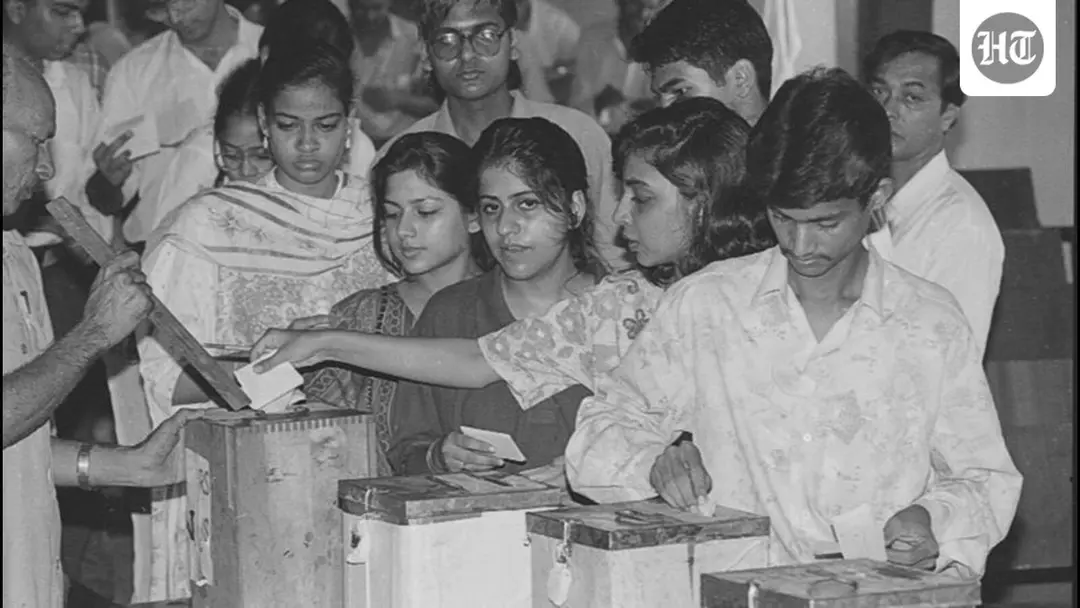
DUSU poll controversies: from 50-day strike to court battles over violence
The Delhi High Court on Thursday pulled up student bodies, Delhi University and police over recurring violence and vandalism in student elections. The first DUSU election was held in 1954. An ABVP agitation led by Arun Jaitley, lasting about 50 days from November 1972 to January 1973, led to direct elections in 1973. Polls were cancelled in 1991 amid Mandal protests. In 2018, EVM malfunctions disrupted counting and president Ankiv Baisoya resigned over fake-degree allegations.
Source
Hindustan Times — India · read the original report ↗
Desk check · compared with the source
What the desk checked (5)
- The first DUSU election was held in 1954 and the first major controversy erupted in 1972-73. — Figure appears in source; no external attribution given.
- An ABVP-led agitation under Arun Jaitley lasted around 50 days between November 1972 and January 1973, after which DUSU moved to direct elections in 1973. — Stated as historical fact in source; no document or official cited.
- DUSU elections were cancelled in 1991 amid unrest over the Mandal Commission recommendations, the first such cancellation. — Asserted in source without attribution.
- In 2018, EVM malfunctions disrupted counting and elected president Ankiv Baisoya resigned over a fake-degree allegation, with his admission cancelled. — Described in source as allegations and outcomes; no official order quoted.
- Delhi High Court on Thursday pulled up student bodies, Delhi University and police over recurring election violence and warned counting or results could be stopped. — Attributed to Delhi High Court observations as reported by the source.
Analysts’ view opinion
Read as policy rather than campus rowdiness, the DUSU record looks like a governance-design failure rather than a discipline problem. Each crisis produced a rule — direct elections in 1973, Lyngdoh-linked spending and campaigning limits from 2009 onwards, court-ordered clean-ups for defacement in 2024 — but the enforcement machinery never caught up. That is why the High Court is now questioning the university and the police too, shifting accountability from student outfits to the institutions meant to police the process.
- The 1973 switch to direct elections was a genuine structural reform, but the story suggests representation was strengthened faster than the machinery to regulate conduct.
- From 2009 the disputes moved from how elections are structured to campaign expenditure, eligibility and rule compliance — a signal that the policy exists while compliance does not.
- The 2018 sequence of EVM malfunctions and a president resigning over fake-degree allegations points to a weakness at the candidate-verification stage itself.
- A stay on counting in 2024, curbs on victory processions in 2025 and a warning about halting results in 2026 show the court steadily filling an enforcement vacuum left by the administration.
- The 1991 cancellation amid the Mandal unrest is a reminder that national politics can override the campus election calendar, so remedies confined to the campus may be insufficient.
What to watch — Watch whether the court's warning translates into action against those responsible, a concrete decision on counting or declaration of results, and a clearer division of responsibility between the university and Delhi Police.
The story does not establish what final orders the High Court has passed, who has been acted against, or whether any of the allegations have been proved.
Deep dive
Research brief · 8 facts · 10 dates · exam-readyThe brief
Context
The Delhi University Students Union (DUSU) is one of India's most prominent student unions, and its annual elections have long been a training ground for national politics. First held in 1954, DUSU polls have repeatedly been disrupted by agitations, national political upheavals, defacement, machine failures and violence. On Thursday, the Delhi High Court pulled up student bodies, Delhi University and the Delhi Police over recurring violence and vandalism in student elections, saying "enough is enough", after clashes marked the 2026 campaign.
Key facts
- The first DUSU election was held in 1954; the first major structural controversy erupted in 1972-73 over indirect elections.
- An ABVP-led agitation, headed by Arun Jaitley, ran for around 50 days between November 1972 and January 1973; DUSU shifted to direct elections in 1973.
- Arun Jaitley, as DUSU president in 1974-75, was arrested during the Emergency as students joined anti-Emergency protests.
- Rajiv Goswami, a Deshbandhu College student, attempted self-immolation in September 1990 during anti-Mandal protests.
- DUSU elections were cancelled in 1991 amid Mandal-related unrest — the first time the polls were called off.
- In 2009, several candidates were barred for campaign-expenditure and rally violations; independent Manoj Chaudhary won the presidency by just 11 votes.
- In 2018, EVM malfunctions disrupted counting and the dispute reached the Delhi High Court; president Ankiv Baisoya resigned over a fake undergraduate degree and his admission was cancelled.
- In 2024, the Delhi High Court stayed vote counting until candidates cleaned up defaced public property; in 2025 it restricted victory processions.
Timeline
- 1954First DUSU election held.
- November 1972 to January 1973ABVP agitation led by Arun Jaitley, lasting about 50 days, against indirect election of office-bearers.
- 1973DUSU shifts to direct elections for central office-bearers.
- 1974-75Jaitley as DUSU president; he is arrested and students join anti-Emergency protests.
- September 1990Anti-Mandal protests; Rajiv Goswami of Deshbandhu College attempts self-immolation.
- 1991DUSU elections cancelled amid continuing unrest — a first.
- 2009Candidates barred over campaign expenditure and use of cars; Manoj Chaudhary wins presidency by 11 votes.
- 2017Ramjas College clashes over a seminar involving Umar Khalid and Shehla Rashid form the backdrop to student politics.
- 2018EVM malfunctions disrupt counting; case reaches High Court; president Ankiv Baisoya resigns over fake-degree allegations.
- 2019Candidates move Delhi High Court over eligibility, rules and Lyngdoh compliance.
Who has a stake
- Delhi High Court — Has repeatedly intervened — staying counting in 2024, curbing victory processions in 2025, and now warning that counting or results could be stopped in 2026.
- Delhi University administration — Questioned by the court over failure to curb violence, defacement and candidate-eligibility lapses; must enforce Lyngdoh norms.
- Delhi Police — Pulled up for recurring violence and vandalism during campaigning and polling.
- Student organisations (including ABVP) — Their campaigns, candidates and results are at risk; historically drivers of both reform (1973 direct polls) and confrontation.
- Students and faculty — Safety during campaigning — the 2026 season saw an alleged assault involving a teacher; academic functioning is disrupted.
- Candidates and elected office-bearers — Face disqualification, litigation and resignation, as with Ankiv Baisoya in 2018 and barred candidates in 2009.
Why it matters
DUSU has been a nursery for national political leadership, and its recurring breakdowns \u2014 violence, defacement, machine failures and fake credentials \u2014 show how campus democracy can be captured by money, muscle and party rivalry. Repeated judicial intervention, now to the point of threatening to stop counting, indicates that university and police mechanisms have not been able to enforce the rules on their own. For millions of students, the question is whether elections meant to build democratic habits instead normalise disruption of academic life.
UPSC angle
Prelims pointers
- First DUSU election: 1954; direct elections for central office-bearers began in 1973.
- ABVP agitation of November 1972–January 1973, led by Arun Jaitley, lasted about 50 days.
- DUSU polls were cancelled for the first time in 1991, amid Mandal Commission protests.
- Rajiv Goswami of Deshbandhu College attempted self-immolation in September 1990 during anti-Mandal protests.
- Lyngdoh Committee recommendations prescribe campaign expenditure limits and campaigning restrictions in student polls.
- 2018: EVM malfunction row reached Delhi High Court; DUSU president Ankiv Baisoya resigned over a fake degree.
Mains framing
The DUSU story traces an arc from a struggle for democratic voice to a struggle to contain democracy's excesses. The 1972-73 agitation, which forced a shift from councillor-based indirect selection to direct elections in 1973, showed student mobilisation producing institutional reform; the Emergency years and the 1990 anti-Mandal protests showed how campus politics mirrors national fault lines, culminating in the unprecedented cancellation of the 1991 polls. From 2009 onward the dominant problems changed character: money power and rally violations, EVM credibility disputes and candidate-eligibility fraud in 2018, mass defacement of public property in 2024, unruly victory processions in 2025 and open physical clashes in 2026. The consistent pattern is that enforcement has migrated from the university to the courts \u2014 the Lyngdoh framework exists on paper, but compliance has had to be secured by judicial coercion such as staying counting or conditioning results on clean-up. A credible way forward, as suggested by the court's own approach, lies in tying declaration of results to verified compliance, fixing accountability on named candidates and their supporters, strict verification of candidate credentials, transparent counting procedures, and clear coordination between the university administration and Delhi Police on campus security.
Key terms
- DUSU
- Delhi University Students Union, the university-wide student body whose first election was held in 1954.
- Lyngdoh Committee recommendations
- Norms for student union elections prescribing campaign expenditure limits and restrictions on campaigning.
- ABVP
- Akhil Bharatiya Vidyarthi Parishad, the student organisation that led the 1972-73 agitation under Arun Jaitley.
- Mandal Commission recommendations
- Reservation recommendations whose 1990 implementation triggered intense student protests and the 1991 poll cancellation.
- Indirect election (pre-1973 DUSU)
- System where colleges elected councillors who then chose the union executive, alleged to be open to manipulation.
- Defacement
- Covering walls and public spaces with posters and graffiti — the central 2024 DUSU controversy that drew a High Court stay on counting.
Practice questions
- Trace the evolution of controversies in DUSU elections from 1954 to 2026. What does this trajectory reveal about the health of student democracy in India?
- The Lyngdoh Committee recommendations have not prevented money power and violence in student elections. Discuss the reasons and suggest enforcement reforms.
- Judicial intervention has become the default corrective in DUSU polls. Critically examine whether courts should regulate campus elections, and what institutional alternatives exist.
Grounded only in the source report — figures and dates are the source's, not inferred.